Side by side
Norway spruce or Serbian spruce? How to tell them apart
Picea abies · Picea omorika
How to tell them apart – Norway spruce: broad crown, square needles that are green all over, and much larger cones (10–15 cm); Serbian spruce: very slender, narrow spruce with short, drooping side branches that curve up again at the tips, needles with two white bands underneath.


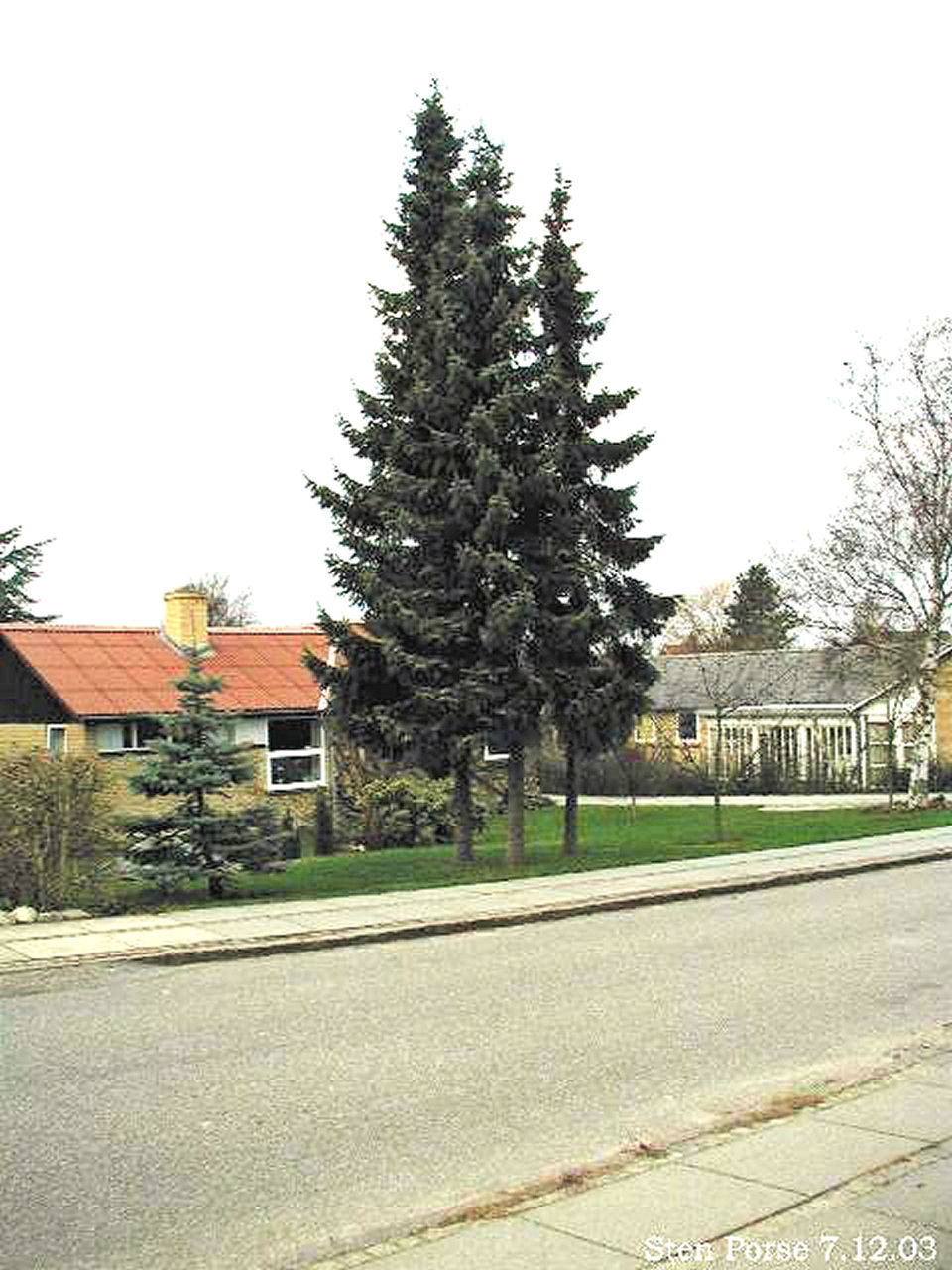
Photo: http://da.wikipedia.org/wiki/Brugerdiskussion:Sten, CC BY-SA 3.0 · source

Serbian spruce Picea omorika
How do you recognise them?
- Norway spruce
- Sharp, four-sided needles on woody pegs; large hanging cones.
- Compared with Serbian spruce: broad crown, square needles that are green all over, and much larger cones (10–15 cm).
- Serbian spruce
- Very slender, narrow spruce with short, drooping side branches that curve up again at the tips; needles with two white bands underneath.
| Norway spruce | Serbian spruce | |
|---|---|---|
| Needles | Needles 1–2.5 cm, stiff, pointed and square in cross-section (you can roll them between your fingers). They grow all round the twig on small woody pegs that remain when the needle falls. | Needles 1–2 cm, flattened (not square), blunt or briefly pointed and barely prickly; dark green above, with two conspicuous white bands below. They grow all round the twig on small woody pegs. |
| Flowering | – | – |
| Cones and seeds | Hanging, cigar-shaped cones 10–15 cm that fall whole. | Hanging cones 3–6 cm long, bluish purple when young, glossy reddish-brown when ripe. |
| Bark | Red-brown, thin and flaking in small round scales. | Orange-brown to grey-brown, in thin scales. |
| Shape and height | Conifer, 30–50 m | Conifer, 15–30 m |
| Site | Sun or partial shade, acid soil, normal | Sun or partial shade, any garden soil, normal |
| Native to Belgium | No, naturalised | No, planted |
| Good for bees, butterflies and birds | Yes, for birds | – |
| Poisonous to people and pets | Not known to be poisonous | Not known to be poisonous |
| Pruning months | August–September | August–September |
What does it mean for your garden?
- Norway spruce (30–50 m) and Serbian spruce (15–30 m) both grow into large trees: too big for an ordinary garden, but fine in a large garden, a park or a meadow.
Read on
- Plant profile: Norway spruce
- Plant profile: Serbian spruce
- Norway spruce: when and how to prune
- Serbian spruce: when and how to prune
- Identification key
Also looks like
This comparison is compiled from the Bladwijzer species pages.