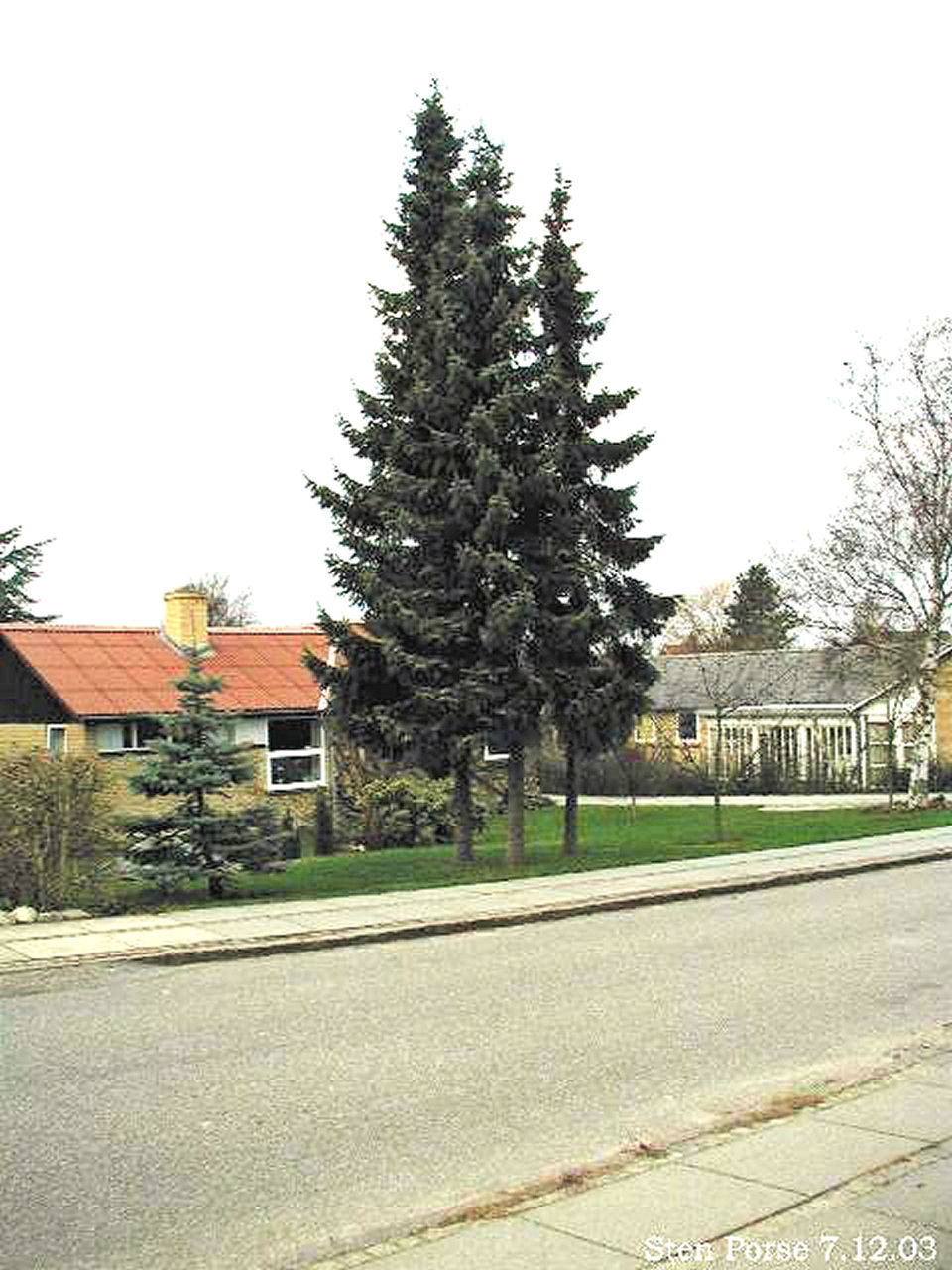
Photo: http://da.wikipedia.org/wiki/Brugerdiskussion:Sten, CC BY-SA 3.0 · source

Conifer · Pine family (Pinaceae)
Serbian spruce
Picea omorika · also: Omorika spruce
The Serbian spruce is the slenderest spruce you can plant: a narrow evergreen conifer with short, drooping side branches that curve up again at the tips. In the wild it grows only in a small area along the Drina, on the border between Serbia and Bosnia, where it was not discovered until 1875. It grows 15–30 m tall, but its crown stays only about 4 m wide. Unlike most spruces, it therefore fits in a smaller garden too, as long as there is room upwards. It tolerates urban air and chalk.
Light
Sun or partial shade
preferably some sun
Moisture
Normal
no wet feet
Legal basis
Any garden soil
any pH
Hardiness
Throughout Belgium
no protection needed
Size
15–30 m
tall
| Pruning months | August–September |
|---|---|
| Height | 15–30 m |
| Native to Belgium | No, planted |
| Poisonous to people and pets | Not known to be poisonous |
Identify
Serbian spruce: how do you recognise it?
- Habit
- Very slender tree of 15–30 m with a narrow, pointed crown of about 4 m; short, drooping side branches that curve up again at the tips.
- Needles
- 1–2 cm, flattened (not square), blunt or briefly pointed and barely prickly; dark green above, with two conspicuous white bands below. They grow all round the twig on small woody pegs.
- Bark
- Orange-brown to grey-brown, in thin scales.
- Cones
- Hanging, 3–6 cm; bluish purple when young, glossy reddish-brown when ripe.
- Difference from Norway spruce
- Norway spruce has a broad crown, square needles that are green all over, and much larger cones (10–15 cm).
- Difference from Sitka spruce
- Sitka spruce has a broad crown, very sharp needles and pale brown cones with crinkled scales.
Pruning: August–September
Looks like it, but isn’t
- Norway spruce Picea abies: broad crown, square needles that are green all over, and much larger cones (10–15 cm). Difference from Norway spruce
- Sitka spruce Picea sitchensis: broad crown, very sharp needles and pale brown cones with crinkled scales. Difference from Sitka spruce
In your garden
Why grow it?
- A slender, vertical eye-catcher that only grows about 4 m wide.
- Tolerates urban air better than most spruces, and also grows on chalky soil.
- The upturned branch tips show the white undersides of the needles: the tree seems to shimmer silver.
- No pruning: the narrow shape comes naturally.
Serbian spruce: where does it grow best?
- Sun to partial shade; it is densest in sun.
- Almost any soil, including chalky soil, that is neither too dry nor waterlogged.
- A good spruce for towns: it tolerates polluted air better than most spruces.
- With a crown of about 4 m it fits in a smaller garden too, but allow for 15–30 m in height: not right next to the house or under overhead cables.
- Light
- Sun or partial shade
- Legal basis
- Any garden soil
- Moisture
- Normal
- Size
- 20 m tall, 4 m wide
- Hardiness
- Throughout Belgium, no protection needed
Goes well with
- Winter heath: A low ground cover at the base, which flowers in winter and also tolerates chalk.
- Japanese maple: Fine leaves, red or orange in autumn, next to the dark, slender spire.
- Rhododendron: On acid soil it flowers in May in partial shade next to the spruce.
Good and bad companions
Goes well with
- Like the acid soil under this tree: heather, rhododendron, japanese skimmia, raspberry, highbush blueberry, witch hazel, broom, gorse
- Tolerate the shade under this tree: oregon grape, rhododendron, oleaster, japanese skimmia, garden privet, camellia, laurustinus, box-leaved honeysuckle
Maintenance
Serbian spruce: when and how to plant it?
- Plant from October to April, when the ground is not frozen.
- Choose a young pot-grown or root-balled tree: it establishes better than a large one.
- After the holidays, let a root-balled Christmas tree acclimatise in a cool place first, and plant it in mild weather.
- Plant shallowly, with the top of the root ball level with the soil.
- Water after planting and during dry spells in the first year.
Care
- Watering
- In dry spells during the first two years; later too in long dry summers, as spruces are shallow-rooted.
- Feeding
- Not needed; leave the needles where they fall.
- Mulch
- A layer of wood chips keeps the soil cool and moist.
- Lower branches
- Leave them: a Serbian spruce looks best when it stays green right down to the ground.
Tip: Looking for a root-balled Christmas tree that can go into the garden afterwards? Choose a Serbian spruce: it stays narrow, so it finds a place even in a smaller garden.
Serbian spruce: when to prune it?
Pruning months: August–September.
When: Dead, diseased and broken branches can be removed at any time of year. If pruning is needed, do it in August–September.
How:
- Do not prune: the narrow shape comes naturally.
- Never remove the leader: without it the tree loses its slender shape. If it has two leaders, remove the weaker one.
- Never cut back into bare wood.
Caution: A spruce will not sprout from old, bare wood: a bare patch stays bare.
Propagation
- Sowing
- In autumn, let closed cones open in a warm place and sow the seeds in a tray in spring.
- Grafting
- Dwarf and weeping forms such as ‘Nana’ and ‘Pendula’ are grafted or grown from cuttings; that is a job for the nursery.
Serbian spruce: how does it get through the winter?
Hardy throughout Belgium: no protection needed.
- Fully hardy.
- Shake wet snow off young trees so that the leader does not break.
Diseases and pests
- Green spruce aphid: A green aphid that sucks the older needles in late winter: they turn yellow and drop, especially after mild winters. The tree usually recovers.
- Conifer spider mite: Fine webbing and dull, yellowish-grey speckled needles in hot, dry summers, especially on dwarf forms. Spray the plant with water regularly.
- Drought: Brown needles and bare patches after a dry summer, especially on sand. Water and mulch the soil.
Through the year
- January: Let a root-balled Christmas tree acclimatise and plant it in mild weather.
- March: Planting season; look out for yellow needles from the green spruce aphid.
- May: The young cones turn bluish purple.
- July: Water in dry spells; look out for spider mite.
- August: Remove a double leader or trim a dwarf form if needed.
- September: Last month for pruning.
- October: Planting season begins; pick ripe cones for sowing.
- December: As a root-balled Christmas tree: keep it cool indoors and the root ball moist.
Use
What can you use it for?
- Garden and landscape
- Slender spruce for smaller gardens and parks; tolerates urban air better than most spruces.
- Also used for
- Also used as a pot-grown Christmas tree, and in dwarf forms for the rock garden.
You and this species
Did you know?
- Discovered only in 1875, in a small area along the Drina on the border between Serbia and Bosnia. Thanks to its narrow shape it even fits in a small garden.
- It was discovered by the Serbian botanist Josif Pančić; ‘omorika’ is the Serbian word for spruce.
- In the wild it grows on limestone, on steep slopes and cliffs in the mountains.