Side by side
Norway spruce or European silver fir? How to tell them apart
Picea abies · Abies alba
You can tell a Norway spruce by its prickly, four-sided needles on small woody pegs and its hanging cones; a European silver fir has flat, soft needles with two white bands underneath and cones that stand upright.
Grab a twig: if it prickles, it is a spruce; if it feels soft, it is a fir. Roll a needle between your fingers: the square needle of the spruce rolls, the flat needle of the fir does not.

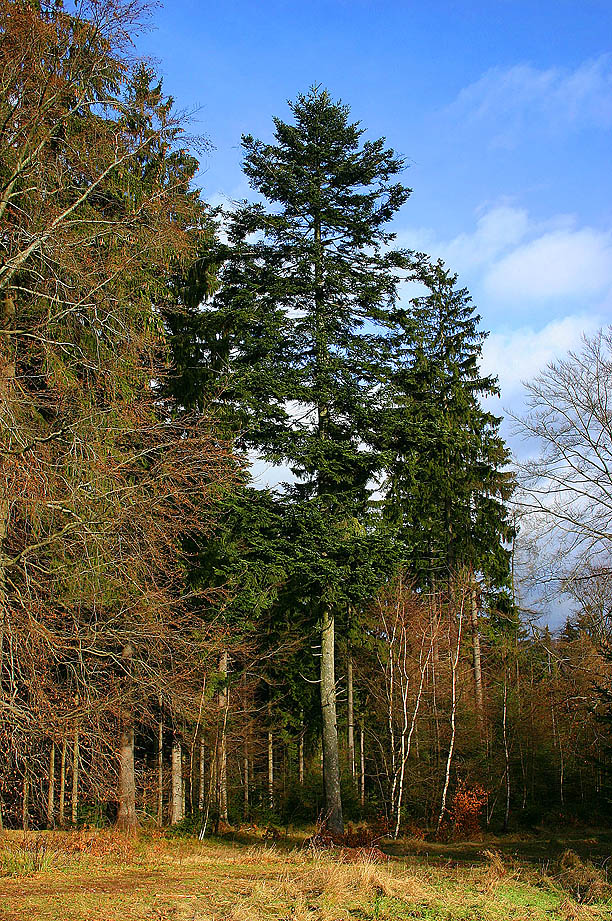


| Norway spruce | European silver fir | |
|---|---|---|
| Needles | Needles 1–2.5 cm, stiff, pointed and square in cross-section (you can roll them between your fingers). They grow all round the twig on small woody pegs that remain when the needle falls. | Needles 1.5–3 cm, flat and soft with a blunt or notched tip; two white stripes underneath. They are arranged in two rows to the sides (comb-like). The base is widened like a little sucker and leaves a round scar on a smooth twig. |
| Flowering | – | – |
| Cones and seeds | Hanging, cigar-shaped cones 10–15 cm that fall whole. | Upright cones 10–15 cm that break up on the tree; only the central spike remains. |
| Bark | Red-brown, thin and flaking in small round scales. | Smooth and silver-grey, in small plates on old trees. |
| Shape and height | Conifer, 30–50 m | Conifer, 30–50 m |
| Site | Sun or partial shade, acid soil, normal | Partial shade or shade, any garden soil, normal |
| Native to Belgium | No, naturalised | No, planted |
| Good for bees, butterflies and birds | Yes, for birds | Little |
| Poisonous to people and pets | Not known to be poisonous | Not known to be poisonous |
| Pruning months | August–September | August–September |
The best feature in each season
- Spring
- The new shoots are fresh green on both. Look at how the needles are attached: on small woody pegs on the spruce, with a base like a little sucker on the fir.
- Summer
- On the fir the cones stand upright at the top of the crown; on the spruce they hang from the branches like cigars.
- Autumn
- Under a spruce you find whole cones, because they fall in one piece; under a fir you find loose scales, because the cones break up on the tree and only the central spike remains.
- Winter
- Both are evergreen. Pull off a needle: the spruce leaves a woody peg on a rough twig, the fir a round scar on a smooth twig. The bark is reddish brown and scaly on the spruce, smooth and silver-grey on the fir.
Where do they grow?
Neither is native here. The Norway spruce comes from the mountains and north of Europe and grows in many forests, especially in the Ardennes. The European silver fir comes from the uplands, such as the Vosges and the Black Forest, and is rarely planted here.
Which one for your garden?
- Both reach 30–50 m: far too big for a garden. The spruce roots shallowly and blows over easily in storms; the fir struggles with drought and late frost.
- If you want to plant a Christmas tree in the garden, choose a dwarf form such as the bird’s nest spruce, or plant it well away from the house. For wildlife, a native tree or shrub does better.
Did you know? The Norway spruce was the classic Christmas tree, but that role has largely passed to the Nordmann fir, which keeps its soft needles for longer.
Read on
- Plant profile: Norway spruce
- Plant profile: European silver fir
- Norway spruce: when and how to prune
- European silver fir: when and how to prune
- Identification key: the question that separates them