Side by side
Bog-myrtle or eared willow? How to tell them apart
Myrica gale · Salix aurita
How to tell them apart – bog-myrtle: low shrub of wet heaths and bogs, with grey-green leaves that smell strongly resinous when crushed, and reddish-brown catkins on bare twigs in spring; eared willow: scentless, wrinkled leaves with ears at the base and silvery catkins.
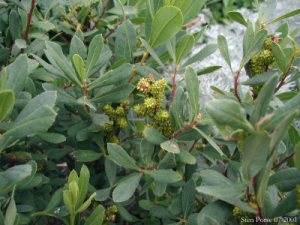


How do you recognise them?
- Bog-myrtle
- Low shrub of wet heaths and bogs, with grey-green leaves that smell strongly resinous when crushed, and reddish-brown catkins on bare twigs in spring.
- Eared willow
- Low, densely branched willow with small, strongly wrinkled leaves with a bent-over tip and large ‘ears’ at the leaf base.
- Compared with bog-myrtle: scentless, wrinkled leaves with ears at the base and silvery catkins.
| Bog-myrtle | Eared willow | |
|---|---|---|
| Leaves | Alternate, 2–6 cm, narrowly obovate, a little toothed only near the tip; dotted with yellow glands that give off a strong, resinous scent when crushed. | Alternate, 2–5 cm, obovate with a short, twisted tip and a wavy edge; upper side dull and strongly wrinkled, underside grey-hairy. At the base, large, kidney-shaped stipules that stay on for a long time. |
| Flowering | Catkins in April, before the leaves: the male ones reddish-brown and elongated, the female ones small and reddish; usually on separate shrubs (April–May). | Small catkins in April, before the leaves; male and female on separate shrubs (April–May). |
| Fruit | Small, resinous nutlets in short, cone-shaped catkins. | Fluffy seeds in May–June. |
| Bark | Reddish-brown, glossy twigs with yellow glands. | Thin, reddish-brown twigs that become hairless and spread widely; under the bark of two- or three-year-old twigs the wood has distinct lengthwise ridges. |
| Shape and height | Shrub, 0.5–1.5 m | Shrub, 1–3 m |
| Site | Sun or partial shade, acid soil, moist to wet | Sun or partial shade, acid soil, moist to wet |
| Native to Belgium | Yes | Yes |
| Good for bees, butterflies and birds | – | – |
| Poisonous to people and pets | Not known to be poisonous | Not known to be poisonous |
| Pruning months | March–April | April–May |
What does it mean for your garden?
- Both are native and good for wildlife: choose what suits your soil, your light and the space you have.
Read on
- Plant profile: Bog-myrtle
- Plant profile: Eared willow
- Bog-myrtle: when and how to prune
- Eared willow: when and how to prune
- Identification key
Also looks like
This comparison is compiled from the Bladwijzer species pages.