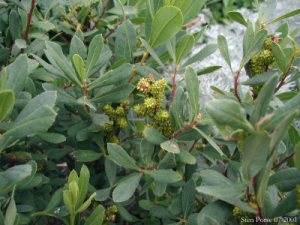
Photo: Wikimedia Commons, CC BY-SA 3.0 · source

Shrub · Bog-myrtle family (Myricaceae)
Bog-myrtle
Myrica gale · also: Sweet gale
Bog-myrtle is a low shrub of 0.5–1.5 m of wet heaths and bogs. Its grey-green leaves are dotted with yellow glands and smell strongly resinous when crushed. In April, before the leaves, the bare reddish-brown twigs are covered in catkins. Before hops, brewers flavoured their beer with bog-myrtle. It only grows on wet, acid, nutrient-poor soil, and fixes its own nitrogen from the air through nodules on its roots. In the wild it is rare in our region: buy it from a nursery that sells native planting stock and never take plants from the wild.
Light
Sun or partial shade
preferably some sun
Moisture
Moist to wet
must not dry out
Legal basis
Acid soil
acid
Hardiness
Throughout Belgium
no protection needed
Size
0.5–1.5 m
tall
Flowering
April–May
| Pruning months | March–April |
|---|---|
| Height | 0.5–1.5 m |
| Native to Belgium | Yes |
| Poisonous to people and pets | Not known to be poisonous |
| Flowering | April–May |
Identify
Bog-myrtle: how do you recognise it?
- Habit
- Low, dense shrub of 0.5–1.5 m with upright twigs; in a good spot it slowly grows into a small clump.
- Leaf
- Alternate, 2–6 cm, narrowly obovate, a little toothed only near the tip; dotted with yellow glands that give off a strong, resinous scent when crushed.
- Twigs
- Reddish-brown, glossy twigs with yellow glands.
- Flower
- Catkins in April, before the leaves: the male ones reddish-brown and elongated, the female ones small and reddish; usually on separate shrubs.
- Fruit
- Small, resinous nutlets in short, cone-shaped catkins.
- Difference from eared willow
- Eared willow has scentless, wrinkled leaves with ears at the base and silvery catkins.
Flowering: April–May · Harvest and fruit: May–August · Pruning: March–April
Looks like it, but isn’t
- Eared willow Salix aurita: scentless, wrinkled leaves with ears at the base and silvery catkins. Difference from eared willow
In your garden
Why grow it?
- Wonderfully resinous, fragrant leaves: crush one as you walk past.
- One of the few shrubs for a wet, acid, poor spot.
- Reddish-brown catkins in April on the bare twigs.
- Small: 0.5–1.5 m, it fits beside any heathland pond.
- A piece of history: the old beer herb of the Low Countries.
Bog-myrtle: where does it grow best?
- Sun to partial shade.
- Wet to moist, acid, nutrient-poor soil: peat or wet sand. On chalky or fertilised soil it struggles.
- A spot at the edge of a heathland pond, in a wet heather garden or a hollow where water lies.
- Allow about 1 m height and width.
- Light
- Sun or partial shade
- Legal basis
- Acid soil
- Moisture
- Moist to wet
- Size
- 1 m tall, 1 m wide
- Hardiness
- Throughout Belgium, no protection needed
Goes well with
- Cross-leaved heath: Pink bells in summer on the same wet, acid soil.
- Eared willow: A small native willow of the same wet heath, with catkins for the bees.
- Alder buckthorn: A native shrub for wet, acid soil, flowering into autumn.
- Downy birch: A light, airy tree of wet, acid soil, as a backdrop for the low bog-myrtle.
Good and bad companions
Goes well with
- Suits the woodland edge or the light shade of: english oak, sessile oak, pin oak, turkey oak
- Like acid soil, just like this plant: heather, rhododendron, japanese skimmia, raspberry, highbush blueberry, witch hazel, broom, gorse
Maintenance
Bog-myrtle: when and how to plant it?
- Buy bog-myrtle from a nursery that sells native planting stock. Never take plants from the wild: it is rare and grows on fragile wet heathland.
- Plant from October to March, or in spring from a container.
- It grows poorly in ordinary garden soil: choose a truly wet, acid spot, and don’t add compost or manure.
- Water after planting, preferably with rainwater, and never let the soil dry out in the first year.
Care
- Watering
- The soil must never dry out; in dry spells, water with rainwater, not hard tap water.
- Feeding
- Never: it fixes its own nitrogen and belongs on poor soil.
- Space
- Keep fast-growing neighbours such as willows and birches at a distance, so it does not get overgrown.
- Picking
- Feel free to pick a few twigs or leaves: for the scent, for tea or to flavour beer.
Tip: Hang a bunch of dried bog-myrtle twigs in a wardrobe or by a window: the resinous scent lasts a long time and keeps insects away.
Bog-myrtle: when to prune it?
Pruning months: March–April.
When: End of winter (March–April).
How:
- Hardly needs pruning: at most, remove dead or overlong branches.
- Rejuvenate an old, bare shrub by cutting a few of the oldest branches off at ground level.
Caution: Don’t cut back every twig: the catkins form on last year’s twigs.
Propagation
- Layering
- Bend a low branch down to the ground and cover a section with moist soil; after a year, cut the rooted plant free.
- Cuttings
- In summer, take 10–15 cm cuttings from semi-ripe shoots and root them in a pot of acid, moist compost under plastic.
Bog-myrtle: how does it get through the winter?
Hardy throughout Belgium: no protection needed.
- Fully hardy.
- It tolerates wet feet and standing in water for a while in winter.
Diseases and pests
- Drying out: In a spot that is too dry, the leaves turn brown and drop early. Bog-myrtle needs to be wet: water with rainwater or move it to a wetter spot.
- Yellow leaves and decline: Too much lime, soil that is too rich, or hard tap water. Choose acid, poor soil and water with rainwater.
- Overgrown: Faster shrubs and trees take away its light. Cut the neighbours back a little.
Through the year
- March: Remove dead or overlong branches; last month for bare-root planting.
- April: Flowering: reddish-brown catkins on the bare twigs. Last month for pruning.
- May: The fragrant leaves appear.
- June: Pick twigs and leaves for the scent or to dry.
- July: Water with rainwater in dry spells; take cuttings.
- September: The resinous nutlets ripen.
- October: Planting season begins.
Use
What can you use it for?
- For wildlife
- Typical plant of wet heathland; fixes nitrogen from the air through nodules on its roots.
- Also used for
- Herb for gruit beer; the scented twigs also keep insects away.
- Garden and landscape
- Fragrant shrub for a wet, acid spot, for example by a heathland pond.
Edible and useful
- Leaves (May–August)
- Pick the leaves from May to August, preferably in May and June, when they are young and most fragrant. Cut sprigs from a shrub in your own garden and strip the leaves off with your fingers. Rub them and they smell strongly resinous and spicy. Use bog myrtle sparingly: a few leaves already give plenty of flavour, as with bay.
- Storing
- Fresh sprigs keep for a few days in a glass of water or in a box in the fridge. To keep them longer, dry them: tie the sprigs together and hang them upside down somewhere dry, airy and dark (1–2 weeks). Strip the dried leaves and keep them whole in a closed jar, dark and dry; they hold their fragrance for about a year.
- Fermenting
- Bog myrtle was the main herb in gruit, the herb mixture used to flavour beer in the Middle Ages before hops took over. Anyone brewing their own beer can boil a handful of leaves with the wort. That takes malt, yeast and experience, and falls outside these recipes.
Caution: Bog myrtle is strongly aromatic: always use small amounts, as a lot can cause headaches or nausea. It is not recommended during pregnancy and breastfeeding or for children; if in doubt, ask your doctor. In the wild it grows mainly on wet heath in nature reserves, where picking is not allowed: use a shrub from your own garden or a nursery. Recognise the plant by the strong, resinous smell of a rubbed leaf and by the tiny yellow resin glands on the leaves; if a leaf has no smell, leave it. Do not pick from a sprayed shrub or one beside a busy road. If you are allergic to herbs or plants, start with a very small amount. Never eat anything you have not identified with certainty.
Eating and using is at your own risk: see the terms of use.
Recipes
- Bog myrtle tea (Tea · 1 cup (250 ml) · 10 min)
- Bog myrtle schnapps (Liqueur · ± 500 ml · 15 min + 1 week steeping)
- Flemish beef and beer stew with bog myrtle (Dish · 4 servings · 3 hrs)
- Bog myrtle salt (Other · ± 100 g · 20 min + 1 day drying)
You and this species
Did you know?
- Before hops, brewers flavoured their beer with bog-myrtle: this gruit beer was widely drunk in the Low Countries in the Middle Ages.
- Like the alder, bog-myrtle fixes nitrogen from the air through nodules on its roots; this lets it grow on very poor soil.
- Male and female catkins are usually on separate shrubs.