Side by side
Hornbeam or Japanese zelkova? How to tell them apart
Carpinus betulus · Zelkova serrata
How to tell them apart – hornbeam: double-toothed, pleated leaf and nutlets on three-lobed winged bracts; Japanese zelkova: elm-like tree with a vase-shaped crown, a leaf with regular, sharp teeth and smooth grey bark.

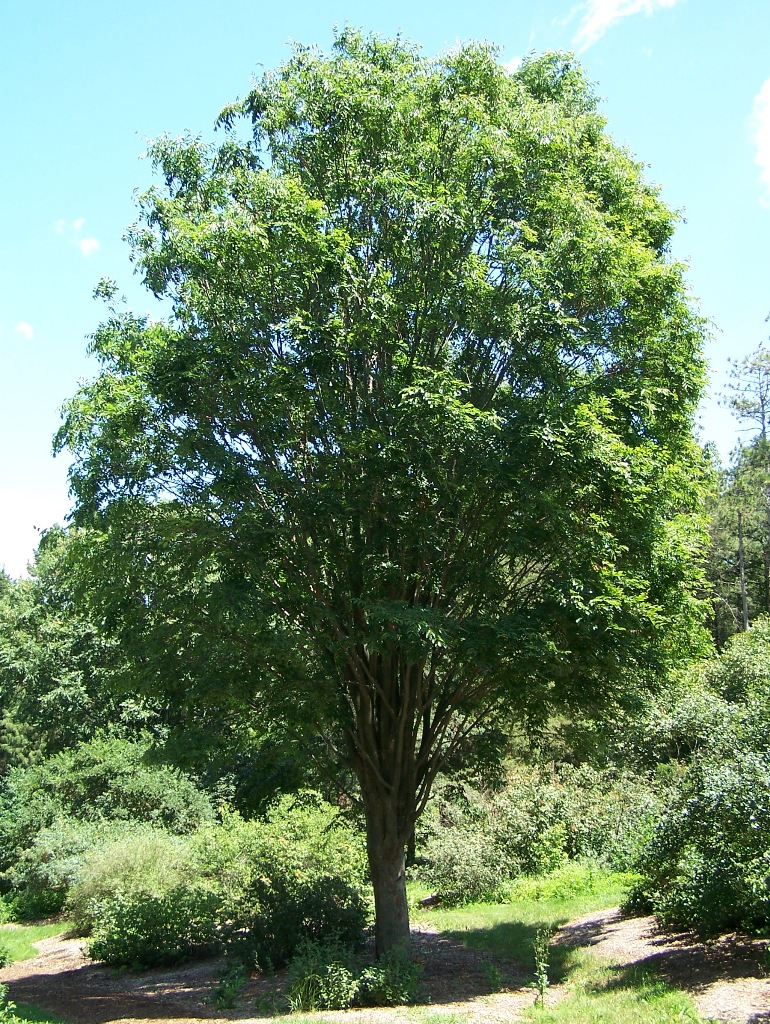


How do you recognise them?
- Hornbeam
- Sharply double-toothed leaf, pleated between the veins; grey, ‘muscular’ trunk.
- Compared with Japanese zelkova: double-toothed, pleated leaf and nutlets on three-lobed winged bracts.
- Japanese zelkova
- Elm-like tree with a vase-shaped crown, a leaf with regular, sharp teeth and smooth grey bark.
| Hornbeam | Japanese zelkova | |
|---|---|---|
| Leaves | Alternate, oval and pointed, 5–10 cm, sharply double-toothed, with 10–15 pairs of parallel veins between which the leaf is pleated. | Alternate, 5–12 cm, elliptic with a long pointed tip, singly toothed with 8–14 pairs of regular, sharp teeth; base barely lopsided. Autumn colour yellow to orange-red. |
| Flowering | April–May | Inconspicuous greenish flowers in April, with the leaves (April). |
| Fruit | Nutlets on a three-lobed wing, in hanging clusters. | Small, wingless drupes 4–5 mm across. |
| Bark | Grey and smooth, with twisting ridges as if there were muscles underneath. Buds pointed and pressed against the twig. | Smooth and grey with lenticels, like a beech; on older trees flaking in patches with orange-brown blotches. |
| Shape and height | Broadleaf tree, 15–25 m, often as a hedge | Broadleaf tree, 15–25 m |
| Site | Sun to shade, any garden soil, normal | Full sun, any garden soil, normal |
| Native to Belgium | Yes | No, planted |
| Good for bees, butterflies and birds | Yes, for butterflies and birds | – |
| Poisonous to people and pets | Not known to be poisonous | Not known to be poisonous |
| Pruning months | June–September and November–February | November–March |
What does it mean for your garden?
- Hornbeam is native: it feeds more insects and birds than a non-native species. If in doubt, choose this one.
- Hornbeam (15–25 m) and Japanese zelkova (15–25 m) both grow into large trees: too big for an ordinary garden, but fine in a large garden, a park or a meadow.
Read on
- Plant profile: Hornbeam
- Plant profile: Japanese zelkova
- Hornbeam: when and how to prune
- Japanese zelkova: when and how to prune
- Identification key
Also looks like
This comparison is compiled from the Bladwijzer species pages.