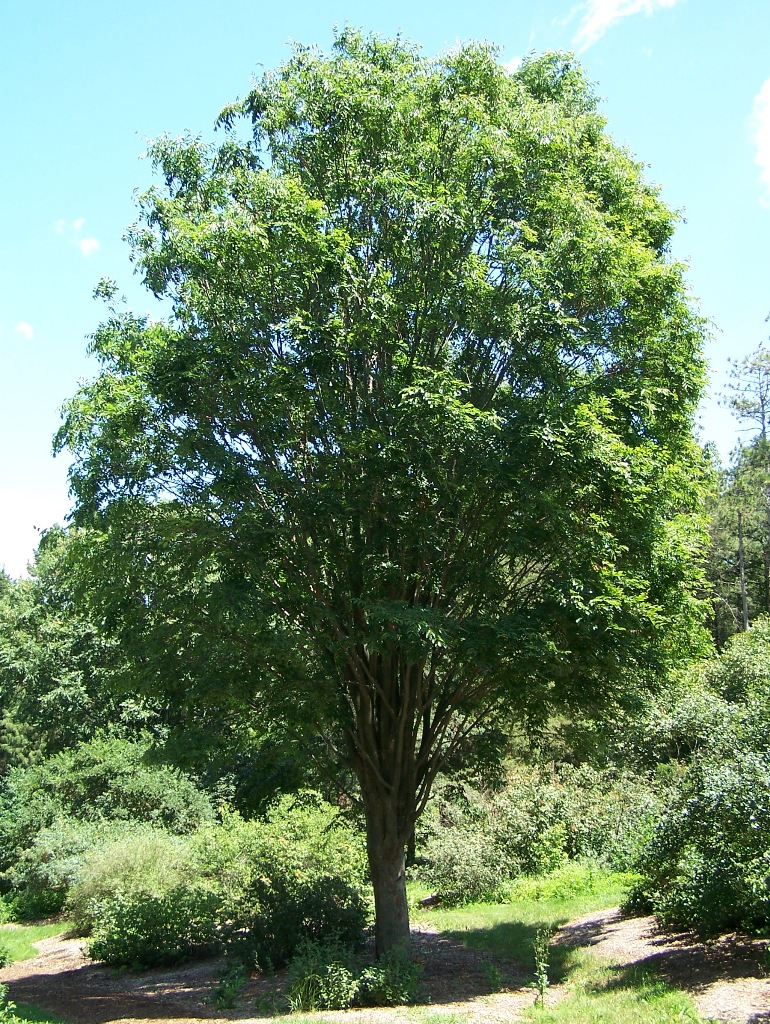
Photo: Bruce Marlin, CC BY-SA 2.5 · source

Broadleaf tree · Elm family (Ulmaceae)
Japanese zelkova
Zelkova serrata · also: Keyaki
Japanese zelkova is a relative of the elm from East Asia, with an elegant, vase-shaped crown and smooth grey bark like a beech. Its leaves have regular, sharp teeth and turn yellow to orange-red in autumn. Because it is much less susceptible to Dutch elm disease, it is often planted where elms once stood: in streets, on squares and in parks. It grows 15–25 m tall with a crown about 12 m across: too big for an ordinary garden, but lovely in a large garden, a park or an avenue.
Light
Full sun
warm and bright
Moisture
Normal
no wet feet
Legal basis
Any garden soil
any pH
Hardiness
Throughout Belgium
no protection needed
Size
15–25 m
tall
Flowering
April
| Pruning months | November–March |
|---|---|
| Height | 15–25 m |
| Native to Belgium | No, planted |
| Poisonous to people and pets | Not known to be poisonous |
| Flowering | April |
Identify
Japanese zelkova: how do you recognise it?
- Habit
- Tree of 15–25 m with a short trunk and ascending branches forming a vase; crown about 12 m across.
- Leaf
- Alternate, 5–12 cm, elliptic with a long pointed tip, singly toothed with 8–14 pairs of regular, sharp teeth; base barely lopsided. Autumn colour yellow to orange-red.
- Bark
- Smooth and grey with lenticels, like a beech; on older trees flaking in patches with orange-brown blotches.
- Flower
- Inconspicuous greenish flowers in April, with the leaves.
- Fruit
- Small, wingless drupes 4–5 mm across.
- Difference from field elm
- Field elm has a double-toothed leaf with a very lopsided base, and round, winged fruits.
- Difference from hornbeam
- Hornbeam has a double-toothed, pleated leaf and nutlets on three-lobed winged bracts.
Flowering: April · Pruning: November–March
Identify by feature: Peeling bark
Looks like it, but isn’t
- Field elm Ulmus minor: double-toothed leaf with a very lopsided base, and round, winged fruits. Difference from field elm
- Hornbeam Carpinus betulus: double-toothed, pleated leaf and nutlets on three-lobed winged bracts. Difference from hornbeam
In your garden
Why grow it?
- An elegant, vase-shaped crown that leaves room underneath for a path or a street.
- Fine autumn colours, from yellow to orange-red.
- Much less susceptible to Dutch elm disease than our elms.
- Copes well with wind and urban conditions.
Japanese zelkova: where does it grow best?
- Full sun.
- Almost any free-draining soil that doesn’t dry out; chalk is no problem.
- Copes well with wind and urban air: a good street and avenue tree.
- Allow for 15–25 m in height and a crown about 12 m across: for a large garden, a park or an avenue.
- Light
- Full sun
- Legal basis
- Any garden soil
- Moisture
- Normal
- Size
- 20 m tall, 12 m wide
- Hardiness
- Throughout Belgium, no protection needed
Goes well with
- Japanese maple: Fits in the light shade beside the vase-shaped crown; together they give fine autumn colour.
- Japanese cherry: Another Japanese tree, with spring blossom, for an avenue or a large garden.
- Lesser periwinkle: Evergreen ground cover for under the crown.
Good and bad companions
Goes well with
- Tolerate the shade under this tree: oregon grape, rhododendron, oleaster, japanese skimmia, garden privet, camellia, laurustinus, box-leaved honeysuckle
Maintenance
Japanese zelkova: when and how to plant it?
- Plant from November to March when the ground isn’t frozen.
- For a street or a narrower spot, choose a cultivar with a narrow vase shape, such as ‘Green Vase’.
- Put a stake on the windward side and tie the trunk loosely; remove stake and tie after 2–3 years.
- Water generously after planting and during dry spells in the first two summers.
Care
- Watering
- In dry spells during the first few years; after that it copes.
- Feeding
- Not needed.
- Formative pruning
- Train a young tree to a strong framework: choose a few well-spaced main branches with wide angles.
- Checks
- On older trees, look out for cracks in narrow forks, especially over paths or car parks.
Tip: Looking for a replacement for an elm in an avenue or on a square? Japanese zelkova has an equally elegant crown and is much less susceptible to Dutch elm disease; choose ‘Green Vase’ if you want a narrower crown.
Japanese zelkova: when to prune it?
Pruning months: November–March.
When: Dead, diseased and broken branches can be removed at any time of year. If pruning is needed, do it during winter dormancy (November–March).
How:
- Little pruning needed. Train a young tree to a strong framework: narrow forks split later on.
- On a young tree, remove competing branches with a narrow fork in good time, while they are still thin.
- A street tree can be crown-lifted gradually in winter.
Caution: Don’t leave formative pruning too late: on an old tree a narrow fork with included bark can no longer be corrected and may split.
Propagation
- Sowing
- Sow the fruits outdoors in a seed tray in autumn; they germinate in spring. Cultivars such as ‘Green Vase’ are propagated vegetatively by the nursery.
Japanese zelkova: how does it get through the winter?
Hardy throughout Belgium: no protection needed.
- Fully hardy.
- In winter you recognise it by its vase-shaped crown with fine twigs and its smooth grey trunk.
Diseases and pests
- Narrow forks: Branches with a narrow fork can split later on. Correct this on young trees with formative pruning.
- Dutch elm disease: Much less susceptible than our elms, but not completely immune. If branches suddenly wilt in summer, have the tree checked by an arborist.
- Drought in young trees: A newly planted tree needs water in its first summers, or the leaves shrivel.
Through the year
- January: Formative pruning during winter dormancy.
- February: Formative pruning; planting season when it isn’t freezing.
- March: Last month for formative pruning and planting.
- April: Leaves unfold, with inconspicuous flowers.
- July: Water young trees in dry spells.
- October: Autumn colour: yellow to orange-red.
- November: Planting season; formative pruning possible again.
- December: Formative pruning and crown-lifting during winter dormancy.
Use
What can you use it for?
- Garden and landscape
- Street and park tree with a vase-shaped crown and fine autumn colours.
- Wood
- In Japan (‘keyaki’) a valued wood for temples, furniture and taiko drums.
- Also used for
- Also grown as bonsai.
You and this species
Did you know?
- A relative of the elm, but much less susceptible to Dutch elm disease; that is why it is often planted where elms once stood.
- In Japan (‘keyaki’) its wood is valued for temples, furniture and taiko drums.
- The name zelkova comes from Georgian, a language of the Caucasus, where a related species grows.