Side by side
Common lime or Caucasian lime? How to tell them apart
Tilia × europaea · Tilia × euchlora
How to tell them apart – common lime: duller leaf, a trunk full of shoots and burrs, and lots of aphids; Caucasian lime: very glossy dark green leaf and a trunk without shoots.
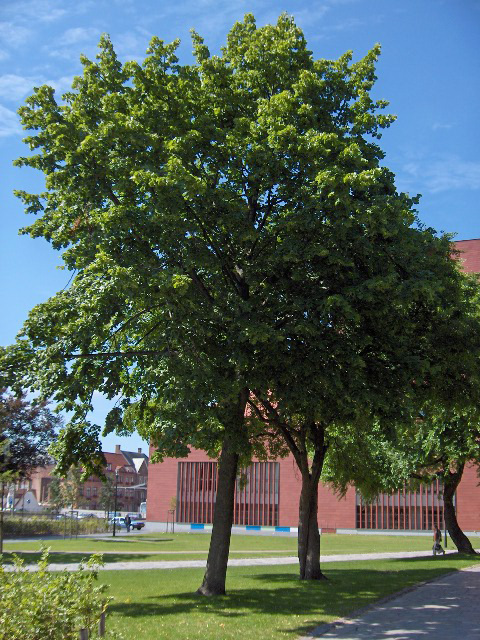
Photo: No machine-readable author provided. JoJan assumed (based on copyright claims)., CC BY-SA 3.0 · source
Common lime Tilia × europaea


How do you recognise them?
- Common lime
- A cross between large-leaved and small-leaved lime: large, lopsided heart-shaped leaf with pale hair tufts underneath; the trunk is often covered in shoots.
- Compared with Caucasian lime: duller leaf, a trunk full of shoots and burrs, and lots of aphids.
- Caucasian lime
- Lime with very glossy dark green leaves, drooping lower branches and a trunk without shoots.
- Compared with common lime: very glossy dark green leaf and a trunk without shoots.
| Common lime | Caucasian lime | |
|---|---|---|
| Leaves | Alternate, 6–12 cm, lopsided heart-shaped, finely toothed; underside light green and largely hairless, with white to pale brown tufts of hair in the vein axils. | Alternate, 5–10 cm, lopsided heart-shaped, finely and sharply toothed; glossy dark green above, paler below with brown tufts of hair in the vein axils. |
| Flowering | Hanging clusters of 4–10 fragrant, yellowish-white flowers on a tongue-shaped bract, in early July (June–July). | Clusters of 3–7 fragrant, yellowish-white flowers, in mid-July (July). |
| Fruit | Globular nutlets with faint ribs. | Egg-shaped, felted nutlets with a pointed tip. |
| Bark | Grey and finely fissured; the base and trunk are often covered in epicormic shoots and burrs. | Grey, smooth, later shallowly fissured; young twigs hairless and yellowish green. |
| Shape and height | Broadleaf tree, 25–35 m | Broadleaf tree, 15–20 m |
| Site | Sun or partial shade, any garden soil, normal | Sun or partial shade, any garden soil, normal |
| Native to Belgium | No, planted | No, planted |
| Good for bees, butterflies and birds | – | – |
| Poisonous to people and pets | Not known to be poisonous | Not known to be poisonous |
| Pruning months | November–March | November–March |
What does it mean for your garden?
- Common lime (25–35 m) and Caucasian lime (15–20 m) both grow into large trees: too big for an ordinary garden, but fine in a large garden, a park or a meadow.
Read on
- Plant profile: Common lime
- Plant profile: Caucasian lime
- Common lime: when and how to prune
- Caucasian lime: when and how to prune
- Identification key
Also looks like
Identify by feature
This comparison is compiled from the Bladwijzer species pages.