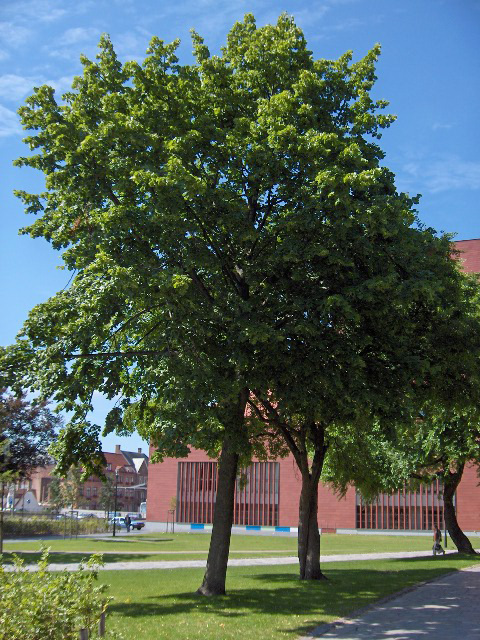
Photo: No machine-readable author provided. JoJan assumed (based on copyright claims)., CC BY-SA 3.0 · source

Broadleaf tree · Mallow family (Malvaceae)
Common lime
Tilia × europaea · also: European linden
Common lime is a cross between large-leaved and small-leaved lime, and the lime you see most often in avenues, on squares and along village streets. Its large, lopsided heart-shaped leaf is largely hairless underneath, with pale tufts of hair in the vein axils. In early July the crown is covered in fragrant, yellowish-white flowers that draw bees and bumblebees in their thousands. Typical features are the many shoots on the trunk and around its base, and the sticky honeydew of aphids. It grows 25–35 m tall with a dense crown of about 15 m: as a free-standing tree it only suits a park, a farmyard or a very large garden. As a pleached or pollarded lime it also fits a smaller garden.
Caution: In summer aphids secrete lots of sticky honeydew: don’t plant it over a patio, drive or parking space.
Light
Sun or partial shade
preferably some sun
Moisture
Normal
no wet feet
Legal basis
Any garden soil
any pH
Hardiness
Throughout Belgium
no protection needed
Size
25–35 m
tall
Flowering
June–July
| Pruning months | November–March |
|---|---|
| Height | 25–35 m |
| Native to Belgium | No, planted |
| Poisonous to people and pets | Not known to be poisonous |
| Flowering | June–July |
Identify
Common lime: how do you recognise it?
- Habit
- Tree of 25–35 m with a tall, dense crown about 15 m across; trunk and base often covered in shoots and burrs.
- Leaves
- Alternate, 6–12 cm, lopsided heart-shaped, finely toothed; underside light green and largely hairless, with white to pale brown tufts of hair in the vein axils.
- Bark
- Grey and finely fissured; the base and trunk are often covered in epicormic shoots and burrs.
- Flowers
- Hanging clusters of 4–10 fragrant, yellowish-white flowers on a tongue-shaped bract, in early July.
- Fruit
- Globular nutlets with faint ribs.
- Difference from large-leaved lime
- In large-leaved lime the underside of the leaf is softly hairy all over, and it flowers as early as late June.
- Difference from small-leaved lime
- Small-leaved lime has a smaller leaf with a blue-green underside and rusty-brown hair tufts.
- Difference from Caucasian lime
- Caucasian lime has a very glossy dark green leaf and a trunk without shoots.
Flowering: June–July · Harvest and fruit: June–July · Pruning: November–March
Identify by feature: Heart-shaped leaves · Lopsided leaf base
Looks like it, but isn’t
- Large-leaved lime Tilia platyphyllos: underside of the leaf softly hairy all over; flowers as early as late June. Difference from large-leaved lime
- Small-leaved lime Tilia cordata: smaller leaf with a blue-green underside and rusty-brown hair tufts. Difference from small-leaved lime
- Caucasian lime Tilia × euchlora: very glossy dark green leaf and a trunk without shoots. Difference from Caucasian lime
In your garden
Why grow it?
- In early July a top tree for bees and bumblebees, and beekeepers harvest lime honey from it.
- Its blossom makes lime-flower tea, like that of large-leaved and small-leaved lime.
- Tolerates hard pruning very well: the classic tree for pleached and pollarded limes.
- Not fussy about soil: it grows on sand, loam and clay.
- A dense crown that casts cool shade in summer.
Common lime: where does it grow best?
- Sun to partial shade.
- Ordinary garden soil, sand, loam or clay, neither too dry nor too wet.
- Don’t plant it over a patio, drive or parking space: in summer aphids drip sticky honeydew.
- Allow for 25–35 m in height and a crown of about 15 m: as a free-standing tree only for a park, a farmyard or a very large garden. In a smaller garden it can be grown pleached or pollarded.
- Under the dense crown it is dark and dry: only shade plants grow there.
- Light
- Sun or partial shade
- Legal basis
- Any garden soil
- Moisture
- Normal
- Size
- 30 m tall, 15 m wide
- Hardiness
- Throughout Belgium, no protection needed
Goes well with
- Large-leaved lime: Flowers a little earlier: together they extend the lime blossom season for bees.
- Hornbeam: A hornbeam hedge next to a row of pleached limes makes a crisp green garden room.
- Common ivy: Evergreen ground cover for the dry shade beneath the dense crown.
- Holly: An evergreen shrub that tolerates the shade under a lime and adds colour in winter.
Good and bad companions
Goes well with
- Tolerate the shade under this tree: oregon grape, rhododendron, oleaster, japanese skimmia, garden privet, camellia, laurustinus, box-leaved honeysuckle
Best kept away from
- Sun-loving plants get too little light under the dense crown: english lavender, heather, butterfly bush, blackthorn, highbush blueberry, sea buckthorn, japanese rose, broom
Maintenance
Common lime: when and how to plant it?
- Plant from November to March when the ground isn’t frozen.
- Secure a young root-balled or bare-root avenue tree to a stake with a tree tie.
- It is best to buy pleached limes already trained on a frame; plant them a frame’s width apart, so that the branches of neighbouring trees just touch.
- Mix a little compost into the planting soil, but no fresh manure.
- Water after planting and during dry spells in the first two or three summers.
Care
- Watering
- In dry spells during the first few years; an established tree copes in ordinary garden soil.
- Suckers
- Common lime produces more shoots than other limes: cut them off the trunk and base every summer, or the trunk disappears in a mass of twigs.
- Pleaching
- Tie the new shoots of a young pleached lime to the frame and each winter prune whatever grows beyond the framework.
- Feeding
- Not needed; a layer of compost around the base is enough.
- Aphids
- Let ladybirds, lacewings and parasitic wasps do their work: spraying a large tree is pointless.
Tip: A row of pleached limes along the boundary gives a green screen at eye level. Cut off the shoots on the trunk and base every July while they are still young and soft: then it only takes a few minutes.
Common lime: when to prune it?
Pruning months: November–March.
When: During winter dormancy (November–March). Remove trunk shoots in summer.
How:
- Tolerates hard pruning very well: ideal as a pleached or pollarded lime. Cut a pleached lime back to its framework every winter, and cut a pollard back to its head every few years.
- A free-standing tree only needs formative pruning while young: a single leader, crossing branches removed and the crown gradually lifted to the height you want.
- Keep the trunk and base free of the many shoots.
Caution: Suddenly cutting back a large, mature lime (‘topping’) leaves big wounds and a mass of weak shoots. Decide from the start on a free-standing tree or on a pleached or pollarded form.
Propagation
- Layering
- In winter, bend a base shoot or low branch down to the ground and cover it with soil; after a year it will have rooted and you can sever it.
- Sowing
- Hardly worth it: many nutlets don’t germinate, limes are slow to come up, and a seedling of a hybrid doesn’t always resemble its parent.
Common lime: how does it get through the winter?
Hardy throughout Belgium: no protection needed.
- Fully hardy.
- In winter you can recognise it by its hairless twigs (hairy in large-leaved lime) and the clumps of shoots at the base of the trunk.
Diseases and pests
- Aphids and sooty mould: The lime aphid secretes sticky honeydew, on which black sooty mould grows. Often worse on common lime than on other limes; harmless to the tree, but a nuisance for whatever is underneath.
- Spider mites: In hot, dry summers the leaves turn bronze and drop early. Water young trees; a mature tree simply leafs out again the following year.
- Little red nails on the leaves: Small, red, pointed galls caused by a gall mite. Harmless: no action needed.
- Lots of suckers: Typical of this lime. Cut them off every summer while they are still young and soft.
Through the year
- January: Prune during dormancy: shape pleached and pollarded limes.
- February: Pruning; planting season when there is no frost.
- March: Last month for pruning and planting bare-root trees.
- May: Leaves emerge; the first aphids appear.
- July: Flowering in early July, full of bees; pick blossom for tea and cut off the suckers.
- August: Water young trees in dry spells.
- November: Planting season; pruning can start again.
- December: Prune pleached and pollarded limes.
Use
What can you use it for?
- Garden and landscape
- Classic avenue, village and square tree, also as a pleached or pollarded lime.
- For wildlife
- Flowers massively in early July and is then a top plant for bees and bumblebees.
- Food and drink
- Its blossom makes lime-flower tea, like that of large-leaved and small-leaved lime.
Caution: Aphids produce lots of sticky honeydew: do not plant it over a patio or driveway.
Edible and useful
- Blossom (June–July)
- Pick the blossom in late June and in July, on a dry, sunny morning, when the flowers have just opened and smell sweetly of honey. Cut the whole cluster with its long, pale bract. Choose branches without a sticky coating: the common lime has a lot of aphids, and their honeydew makes blossom and leaves tacky. So preferably pick from a tree with little of it, and pick sparingly, because bees and bumblebees swarm over this tree. Lay the blossom loosely in a basket, not in a closed bag, and use it the same day or dry it.
- Storing
- Process fresh blossom the same day; until then, lay it loosely on a cloth. Dry it in a thin layer on a rack somewhere airy and shady or in a dehydrator at 35–40 °C, until crisp. Keep the dried blossom in a closed jar or paper bag, dark and dry; it keeps its scent for about a year. Syrup keeps for a year, lime blossom honey for six months.
Caution: Use only fresh, fragrant blossom from true limes (Tilia). The common lime has a lot of aphids: black sooty mould often grows on their sticky honeydew. Do not pick blossom from branches that are sticky, blackened or full of aphids, and do not use brown or musty blossom. Common lime is an avenue and square tree: do not pick beside busy roads or above car parks, where exhaust fumes, road salt and dog urine soil the blossom, or from sprayed trees. Ask the owner or the council for permission. Pick sparingly: bees and bumblebees need the blossom. If you are allergic to pollen, start with a small cup of tea. Never eat anything you have not identified with certainty.
Eating and using is at your own risk: see the terms of use.
Recipes
- Lime blossom cordial (Syrup · ± 800 ml · 30 min + 24 hrs steeping)
- Fresh lime blossom tea (Tea · 1 pot (1 litre) · 15 min)
- Lime blossom loaf cake (Dish · ± 10 slices (25 cm loaf tin) · 1 hr 15 min)
- Lime blossom honey (Other · ± 300 g · 10 min + 2–3 weeks)
You and this species
Did you know?
- The most widely planted lime in avenues and squares, and also the stickiest: aphids coat everything below it in honeydew.
- As a hybrid it takes after both parents: a larger leaf than small-leaved lime, but less hairy than that of large-leaved lime.
- Thanks to the many shoots at its base it is easy to layer: that is also how nurseries propagate limes.