Side by side
False acacia or honey locust? How to tell them apart
Robinia pseudoacacia · Gleditsia triacanthos
How to tell them apart – false acacia: fewer, larger leaflets with a terminal leaflet, and paired spines at the leaf base; honey locust: much smaller leaflets without a terminal leaflet.


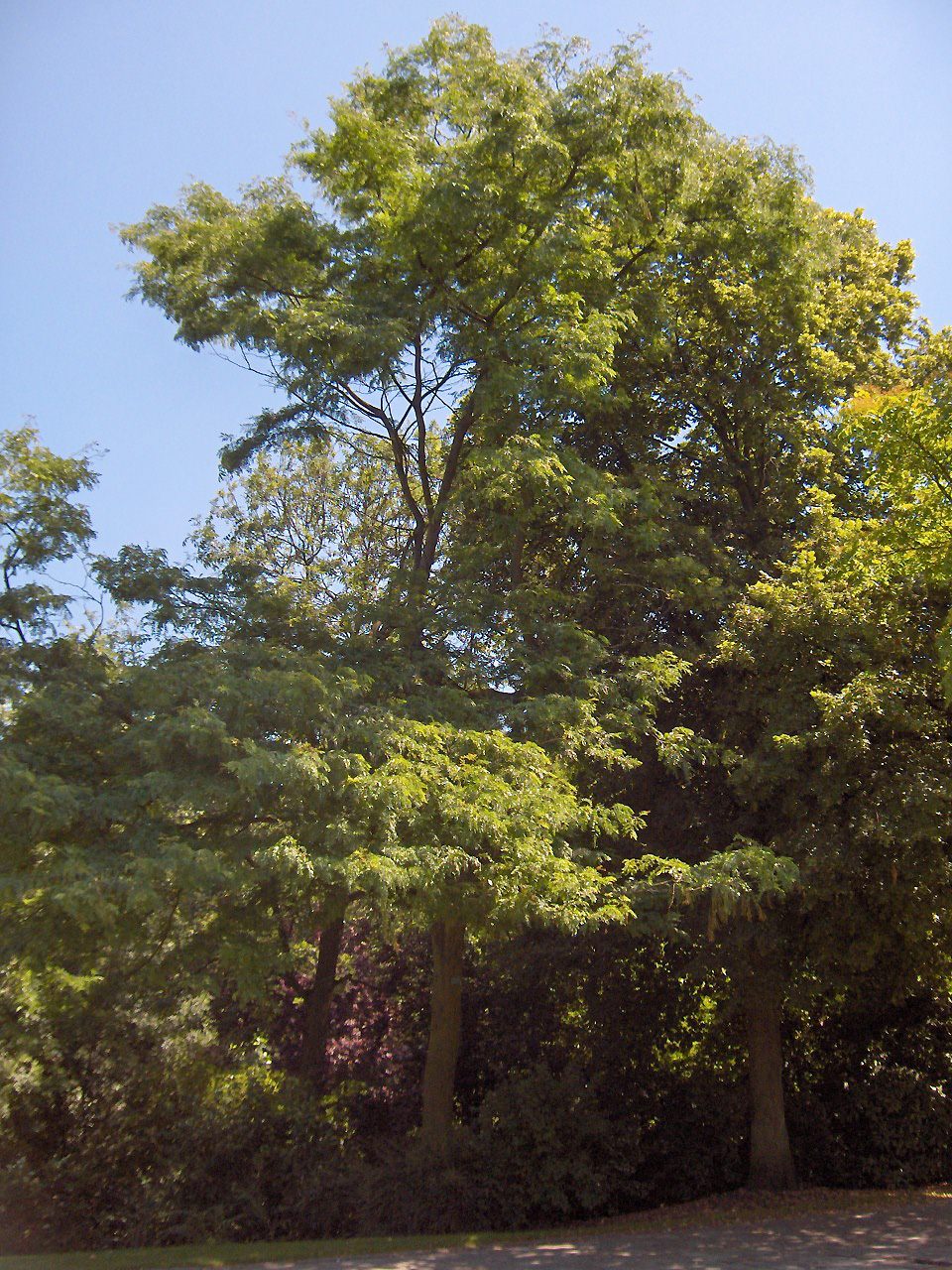
Photo: No machine-readable author provided. JoJan assumed (based on copyright claims)., CC BY-SA 3.0 · source

Honey locust Gleditsia triacanthos
How do you recognise them?
- False acacia
- Pinnate leaf with oval, untoothed leaflets and two spines at the base of each leaf; hanging clusters of white flowers.
- Compared with honey locust: fewer, larger leaflets with a terminal leaflet, and paired spines at the leaf base.
- Honey locust
- Fine, airy foliage with many small leaflets, sometimes twice pinnate; wild forms have large branched thorns.
- Compared with false acacia: much smaller leaflets without a terminal leaflet.
| False acacia | Honey locust | |
|---|---|---|
| Leaves | Alternate, pinnate with 9–19 oval, smooth-edged leaflets and a terminal leaflet. Two sharp spines at the leaf base. | Alternate, pinnate or bipinnate with many (20–30) small leaflets 1.5–3 cm long, without a terminal leaflet. |
| Flowering | Hanging clusters of white, highly fragrant pea flowers in May–June; loved by bees (June). | June |
| Fruit | Flat brown pods 5–10 cm that stay on the tree for a long time. | Long (20–40 cm), flat, twisted brown pods. |
| Bark | Grey-brown and deeply furrowed in a network pattern, often twisted. | Dark grey-brown; wild trees have large, branched thorns on trunk and branches. Street trees are usually thornless. |
| Shape and height | Broadleaf tree, 15–25 m | Broadleaf tree, 15–25 m |
| Site | Full sun, any garden soil, dry | Full sun, any garden soil, dry |
| Native to Belgium | No, an invasive alien species | No, planted |
| Good for bees, butterflies and birds | Yes, for bees | Yes, for bees |
| Poisonous to people and pets | Yes, take care with children and pets | Not known to be poisonous |
| Pruning months | June–August | July–August and November–February |
What does it mean for your garden?
- False acacia is an invasive non-native species: do not plant it. Pull up seedlings and choose a native species instead.
- False acacia is poisonous to people and pets: take care with children and animals.
- False acacia (15–25 m) and honey locust (15–25 m) both grow into large trees: too big for an ordinary garden, but fine in a large garden, a park or a meadow.
Read on
- Plant profile: False acacia
- Plant profile: Honey locust
- False acacia: when and how to prune
- Honey locust: when and how to prune
- Identification key: the question that separates them
Also looks like
Identify by feature
This comparison is compiled from the Bladwijzer species pages.