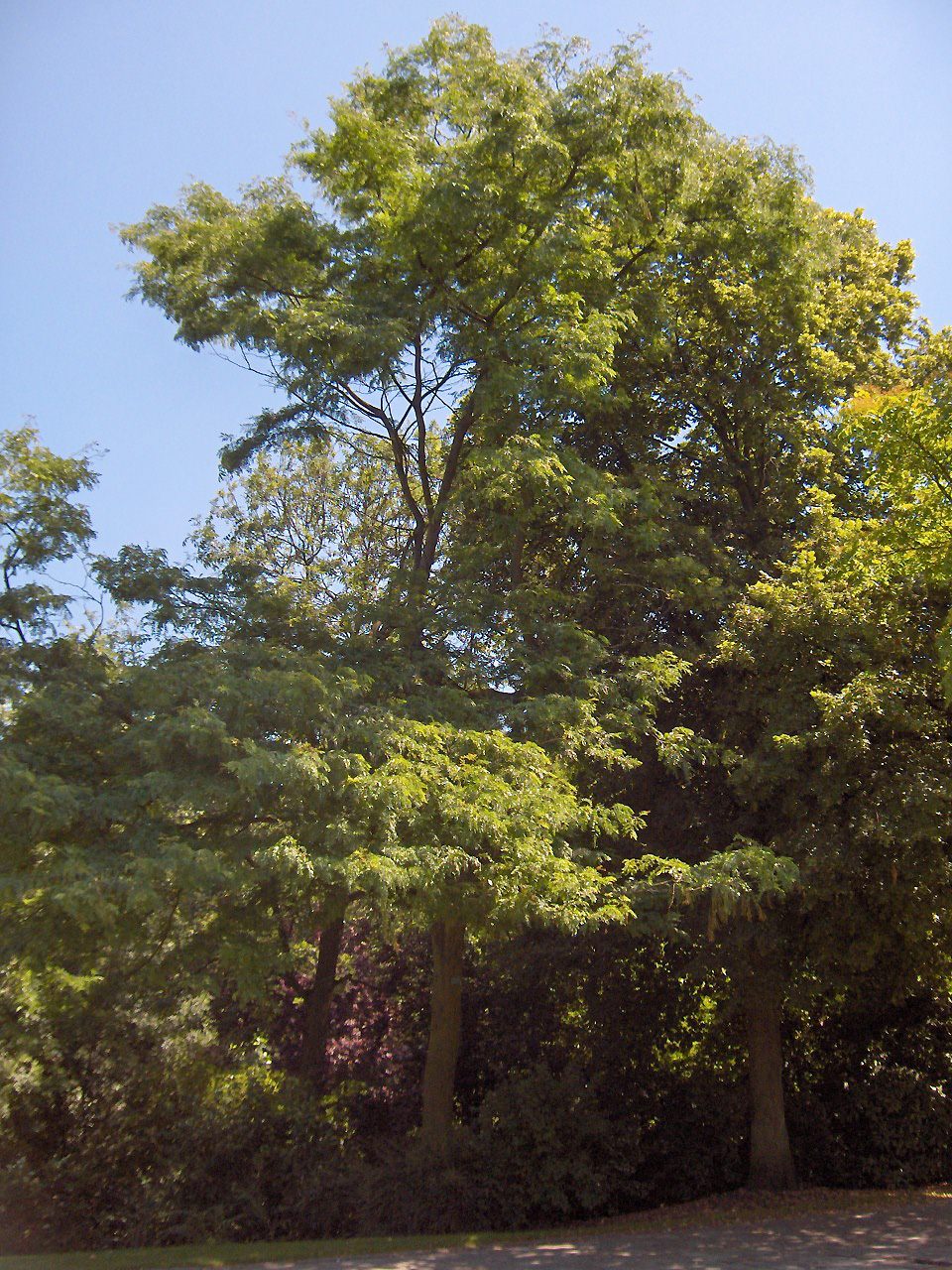
Photo: No machine-readable author provided. JoJan assumed (based on copyright claims)., CC BY-SA 3.0 · source

Broadleaf tree · Pea family (Fabaceae)
Honey locust
Gleditsia triacanthos · also: Gleditsia, Thorny locust
The honey locust is an airy tree from North America, 15–25 m tall, with finely divided leaves that cast a light, dappled shade: lawn grows quite happily beneath its crown. It comes into leaf late, turns golden yellow in autumn and often carries long, twisted pods. Wild trees have large, branched thorns on the trunk and branches; in gardens and streets, thornless forms are planted, such as the golden ‘Sunburst’. It copes well with drought, heat and urban soil. The species is too big for a small garden, but in a large garden, a park or a street it is a tough shade tree.
Caution: Wild trees and seedlings carry hard, branched thorns, sometimes more than 10 cm long: don’t plant them near paths, play areas or a patio.
Light
Full sun
warm and bright
Moisture
Dry
tolerates drought
Legal basis
Any garden soil
any pH
Hardiness
Throughout Belgium
no protection needed
Size
15–25 m
tall
Flowering
June
| Pruning months | July–August and November–February |
|---|---|
| Height | 15–25 m |
| Native to Belgium | No, planted |
| Good for bees, butterflies and birds | Yes, for bees |
| Poisonous to people and pets | Not known to be poisonous |
| Flowering | June |
Identify
Honey locust: how do you recognise it?
- Habit
- Tree of 15–25 m with an open, broad crown and fine, airy foliage; comes into leaf late (May).
- Leaf
- Alternate, pinnate or bipinnate with many (20–30) small leaflets 1.5–3 cm long, without a terminal leaflet; golden yellow in autumn.
- Bark
- Dark grey-brown; wild trees have large, branched thorns on trunk and branches. Street trees are usually thornless.
- Flower
- Small greenish-yellow flowers in short clusters in June; inconspicuous, but loved by bees.
- Fruit
- Long (20–40 cm), flat, twisted brown pods; some thornless forms bear few or none.
- Difference from false acacia
- False acacia has fewer, larger leaflets with a terminal leaflet, and paired spines at the leaf base.
Flowering: June · Pruning: July–August and November–February
Identify by feature: Pinnate leaves · Pods · Thorns or prickles
Looks like it, but isn’t
- False acacia Robinia pseudoacacia: fewer, larger leaflets with a terminal leaflet, and paired spines at the leaf base. Difference from false acacia
In your garden
Why grow it?
- Fine, airy foliage that casts light shade: grass and plants grow happily beneath it.
- Tolerates drought, heat and compacted urban soil: a tough tree for a hot, dry spot.
- Thornless forms such as ‘Sunburst’ (golden young leaves) and ‘Skyline’ are safe in a garden.
- The small flowers in June provide nectar for bees.
- Golden-yellow autumn colour, and after leaf fall the tiny leaflets simply disappear into the lawn.
Honey locust: where does it grow best?
- Full sun: that is where it grows best and where the leaves of ‘Sunburst’ colour most beautifully.
- Any well-drained soil, from poor sand to clay and chalk; tolerates drought, heat and compacted urban soil.
- Allow for a crown up to 12 m wide: the species suits a large garden, a park or a street; ‘Sunburst’ stays somewhat smaller.
- Lovely as a light shade tree by a patio: always choose a thornless form there.
- Light
- Full sun
- Legal basis
- Any garden soil
- Moisture
- Dry
- Size
- 20 m tall, 12 m wide
- Hardiness
- Throughout Belgium, no protection needed
Goes well with
- Smoke-tree: A purple-leaved smoke-tree makes a lovely contrast with the golden leaves of ‘Sunburst’ and also likes a sunny, dry spot.
- English lavender: Flowers in the sun at the edge of the light crown and tolerates the same dry soil.
- Catmint: A drought-tolerant perennial that flowers for a long time for bees, even in light shade.
Good and bad companions
Goes well with
- Tolerate the shade under this tree: oregon grape, rhododendron, oleaster, japanese skimmia, garden privet, camellia, laurustinus, box-leaved honeysuckle
Maintenance
Honey locust: when and how to plant it?
- Plant from November to March when the ground isn’t frozen; a container-grown tree can go in at any time of year, except in frost or drought.
- Buy a grafted, thornless form (such as ‘Skyline’ or ‘Sunburst’): seedlings usually do have thorns.
- Dig a generous planting hole, set the tree at the same depth as before and firm the soil well.
- Put a stake on the windward side and tie the trunk loosely; remove stake and tie after 2–3 years.
- Water generously after planting and during dry spells in the first year.
Care
- Watering
- In dry spells during the first two years; after that it copes even in dry summers.
- Feeding
- Not needed: it also grows on poor soil.
- Leaf fall
- The tiny leaflets fall into the grass and break down quickly: there is hardly any raking to do.
- Pods
- On fruiting forms, many pods drop in autumn and winter: clear them from paths and the patio.
- Suckers
- Cut off shoots below the graft, on the trunk or from the base, straight away: they come from the rootstock and often have thorns.
Tip: For a garden, always choose a grafted, thornless form: seedlings and wild trees develop long, branched thorns.
Honey locust: when to prune it?
Pruning months: July–August and November–February.
When: Dead, diseased and broken branches can be removed at any time of year. Formative pruning in winter or summer.
How:
- Prune little: a honey locust forms a fine, open crown by itself.
- Train a young tree on a single leader and remove competing leaders and crossing branches.
- Gradually lift the crown of a tree by a path or patio: remove one or two of the lowest branches each year.
- Wear thick gloves when handling wild, thorny trees.
Caution: The thorns of wild trees are hard and sharp: clear up prunings straight away, as they go through shoe soles and bicycle tyres.
Propagation
- Sowing
- In autumn, take the seeds out of the pods, pour hot water over them and leave them to soak overnight; sow them in spring. Seedlings usually have thorns.
- Grafting
- Thornless and golden forms are grafted onto a seedling; that is a job for the nursery.
Honey locust: how does it get through the winter?
Hardy throughout Belgium: no protection needed.
- Fully hardy.
- In winter you recognise it by the long, twisted pods hanging in the bare crown and, on wild trees, by the branched thorns.
Diseases and pests
- Honey locust gall midge: Leaflets that swell into pod-like galls and drop off brown, especially on ‘Sunburst’. Unsightly but harmless to the tree.
- Thorny shoots: Shoots from the rootstock and seedlings have thorns. Cut them off as soon as you see them.
- Pods: Fruiting forms drop lots of pods. For a patio, choose a form that bears few or no pods.
- Drought in young trees: Small leaflets and early leaf drop in the first year after planting. Water until it is well established.
Through the year
- January: Formative pruning in mild weather; plant bare-root trees.
- February: Last month for winter pruning.
- March: Planting season ends.
- May: Late leafing: don’t worry if it is still bare.
- June: Small greenish-yellow flowers for bees.
- July: Summer pruning: remove crossing and low branches.
- August: Summer pruning still possible; water young trees in dry spells.
- October: Golden-yellow autumn colour; pods ripen and fall.
- November: Planting season starts; winter pruning possible.
- December: Winter pruning; clear pods from paths.
Use
What can you use it for?
- Garden and landscape
- Airy street and garden tree that casts light shade; thornless forms for gardens.
- Wood
- Hard, durable wood.
- For wildlife
- The inconspicuous flowers provide nectar for bees.
Good for wildlife
- Bees
- Nectar and pollen for honeybees and wild bees.
You and this species
Did you know?
- A popular street tree; the golden-yellow form ‘Sunburst’ is seen in many gardens.
- The name triacanthos means ‘three-thorned’: the thorns are often branched in three.
- Although it belongs to the pea family, it does not fix nitrogen from the air, unlike false acacia.
- The name honey locust refers to the sweet pulp inside the pods.
- The genus Gleditsia honours the German botanist Johann Gottlieb Gleditsch; triacanthos means ‘three-thorned’, after the branched thorns.
- The pods contain a sweet, sticky pulp, which gives the tree its English name, honey locust.