Side by side
Common lilac or Indian bean tree? How to tell them apart
Syringa vulgaris · Catalpa bignonioides
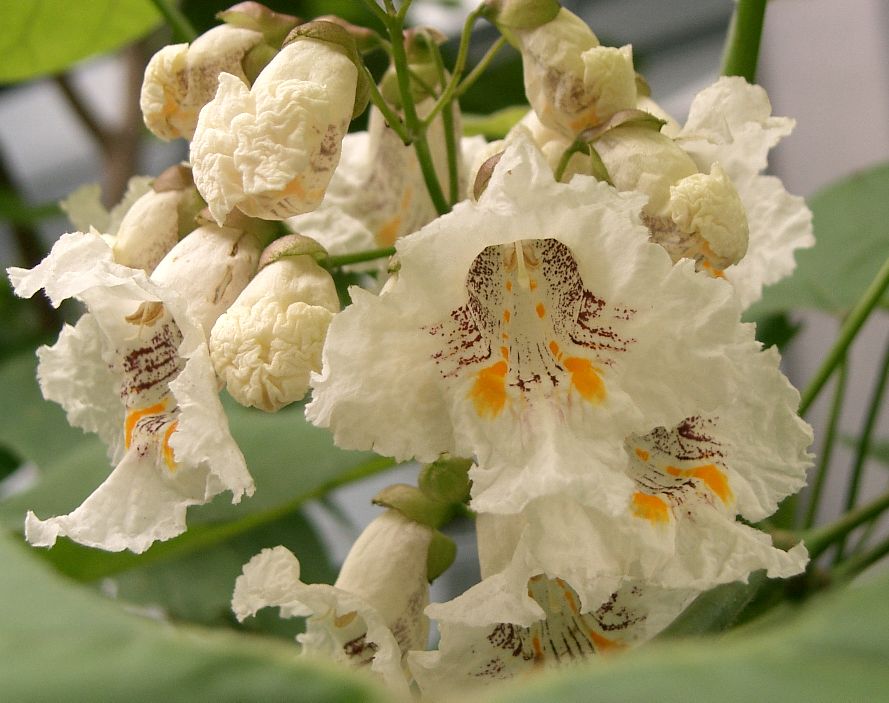
How to tell them apart – common lilac: shrub with heart-shaped leaves and fragrant lilac or white flower panicles in May; Indian bean tree: much bigger leaves and white flowers in July.



How do you recognise them?
- Common lilac
- Shrub with heart-shaped leaves and fragrant lilac or white flower panicles in May.
- Indian bean tree
- Very large heart-shaped leaves, often in threes; long ‘beans’ that hang on through winter.
- Compared with common lilac: much bigger leaves and white flowers in July.
| Common lilac | Indian bean tree | |
|---|---|---|
| Leaves | Opposite, heart-shaped to oval, 5–12 cm, untoothed and hairless. | Opposite or in whorls of 3, broadly heart-shaped and untoothed, 15–30 cm. Smells unpleasant when crushed. Comes into leaf late (June). |
| Flowering | Large panicles of fragrant flowers in lilac, purple or white (May) (April–May). | Upright panicles of white trumpet flowers with yellow and purple spots (July) (July). |
| Fruit | Brown capsules that stay on the shrub for a long time. | Thin, bean-like pods 20–40 cm that hang on all winter. |
| Bark | Grey, becoming furrowed with age. | Grey-brown, in thin scales. |
| Shape and height | Shrub, 3–6 m | Broadleaf tree, 10–15 m |
| Site | Full sun, any garden soil, normal | Full sun, any garden soil, normal |
| Native to Belgium | No, planted | No, planted |
| Good for bees, butterflies and birds | Yes, for bees and butterflies | Yes, for bees |
| Poisonous to people and pets | Not known to be poisonous | Not known to be poisonous |
| Pruning months | May–June | February–March |
What does it mean for your garden?
- Choose what suits your soil, your light and the space you have: see the growing conditions in the table.
Read on
- Plant profile: Common lilac
- Plant profile: Indian bean tree
- Common lilac: when and how to prune
- Indian bean tree: when and how to prune
- Identification key
Also looks like
- Californian lilac or common lilac
- Foxglove tree or Indian bean tree
- Trumpet vine or Indian bean tree
- Indian bean tree or large-leaved lime
Identify by feature
This comparison is compiled from the Bladwijzer species pages.