Photo: KENPEI, CC BY-SA 3.0 · source

Broadleaf tree · Bignonia family (Bignoniaceae)
Indian bean tree
Catalpa bignonioides · also: Southern catalpa, Catalpa
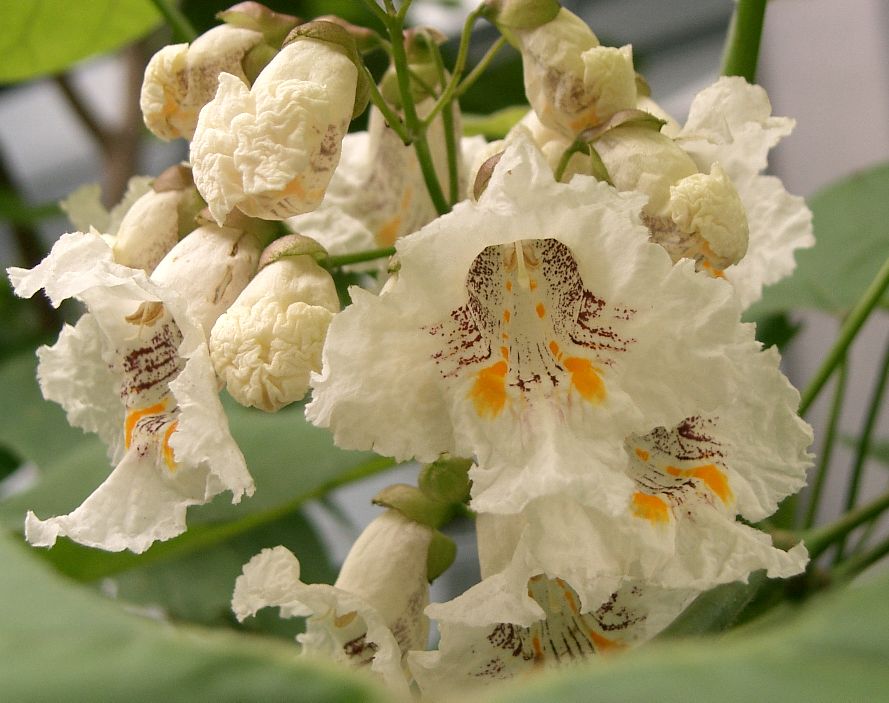
The Indian bean tree comes from the south-eastern United States. At 10–15 m it stays fairly compact, with a broad, rounded crown and huge heart-shaped leaves. It only comes into leaf late, in June, and in July it is covered in upright panicles of white trumpet flowers with yellow and purple spots, loved by bees and bumblebees. Afterwards long, thin ‘beans’ hang from it all winter. It is popular as a shade tree by a patio or in a square; the grafted mophead form ‘Nana’ stays small and fits into almost any garden.
Light
Full sun
warm and bright
Moisture
Normal
no wet feet
Legal basis
Any garden soil
any pH
Hardiness
Throughout Belgium
no protection needed
Size
10–15 m
tall
Flowering
July
| Pruning months | February–March |
|---|---|
| Height | 10–15 m |
| Native to Belgium | No, planted |
| Good for bees, butterflies and birds | Yes, for bees |
| Poisonous to people and pets | Not known to be poisonous |
| Flowering | July |
Identify
Indian bean tree: how do you recognise it?
- Habit
- Tree of 10–15 m with a broad, rounded crown and a short trunk; the grafted mophead ‘Nana’ stays much smaller.
- Leaf
- Opposite or in whorls of 3, broadly heart-shaped and untoothed, 15–30 cm. Smells unpleasant when crushed. Comes into leaf late (June).
- Bark
- Grey-brown, in thin scales.
- Flower
- Upright panicles of white trumpet flowers with yellow and purple spots (July).
- Fruit
- Thin, bean-like pods 20–40 cm that hang on all winter.
- Difference from large-leaved lime
- Large-leaved lime has a smaller, toothed leaf that is alternate.
Flowering: July · Pruning: February–March
Identify by feature: Heart-shaped leaves · Opposite leaves · Pods
Looks like it, but isn’t
- Large-leaved lime Tilia platyphyllos: smaller, toothed leaf that is alternate. Difference from large-leaved lime
In your garden
Why grow it?
- One of the last trees to flower: white trumpet flowers in July, for bees and bumblebees.
- Large heart-shaped leaves that cast cool shade over a patio.
- Stays compact; the mophead ‘Nana’ even fits into a small town garden.
- Long pods that hang on all winter: it stands out even when bare.
Indian bean tree: where does it grow best?
- Full sun: that is where it flowers best.
- Any fertile, well-drained soil; tolerates urban soil.
- Sheltered from strong wind: the large leaves tear easily.
- As a tree, allow for a crown 10 m wide; the mophead stays much smaller, especially if you cut it back regularly.
- Light
- Full sun
- Legal basis
- Any garden soil
- Moisture
- Normal
- Size
- 15 m tall, 10 m wide
- Hardiness
- Throughout Belgium, no protection needed
Goes well with
- Panicled hydrangea: Flowers white from July to September, alongside and after the Indian bean tree, and tolerates sun and light shade.
- Hydrangea: Likes the partial shade under the large leaves.
- Hosta: Large leaves in the shade under the crown, a lovely echo of the tree’s foliage.
Good and bad companions
Goes well with
- Tolerate the shade under this tree: oregon grape, rhododendron, oleaster, japanese skimmia, garden privet, camellia, laurustinus, box-leaved honeysuckle
Maintenance
Indian bean tree: when and how to plant it?
- Plant from November to April when the ground isn’t frozen; a young tree preferably in spring.
- Dig a generous planting hole and mix in compost.
- Put a stake on the windward side and tie the trunk loosely.
- Water generously after planting and during dry spells in the first year.
Care
- Watering
- In dry spells during the first two years; after that only in long dry periods.
- Feeding
- A little compost in spring; not needed on fertile soil.
- Tidying up
- Flowers, large leaves and pods fall on the patio: sweep them up regularly.
- Suckers
- On the mophead, cut off shoots on the trunk, below the head, straight away.
Tip: For an Indian bean tree in a small garden, choose the mophead ‘Nana’ and cut back the branches every few years: this keeps the head compact. It rarely flowers, though.
Indian bean tree: when to prune it?
Pruning months: February–March.
When: At the end of winter (February–March), just before its late leafing-out.
How:
- Tolerates hard pruning: on the mophead form you can cut the branches back every few years to short stubs on the head.
- Prune a tree little: remove dead, crossing and low branches.
- Cut back twigs killed by winter frost to healthy wood.
Caution: Don’t let shoots grow below the head of a grafted mophead: they come from the rootstock and grow into an ordinary Indian bean tree.
Propagation
- Sowing
- In spring, take the seeds out of the pods and sow them indoors or in a cold frame; they germinate easily.
- Grafting
- The mophead ‘Nana’ is grafted onto a stem of an ordinary Indian bean tree; that is a job for the nursery.
Indian bean tree: how does it get through the winter?
Hardy throughout Belgium: no protection needed.
- Hardy, but young trees can lose a few twig tips in severe winters; cut them off in March.
- The long pods hang on all winter.
Diseases and pests
- Late leafing: In May it is still bare while everything else is green. That’s normal: it only comes into leaf in June.
- Wind damage: Torn, ragged leaves in a windy spot. Plant it in shelter.
- Verticillium wilt: Branches suddenly wilt in summer and die back, with dark streaks in the wood. Cut them back to healthy wood and disinfect your saw.
- Frost damage: Frozen twig tips on young trees after a severe winter. Cut them back in March.
Through the year
- February: Winter pruning; cut back the mophead.
- March: Last month for pruning; cut off frosted twig tips; planting.
- May: Still bare: it comes into leaf late.
- June: Leaves open: large heart-shaped leaves.
- July: Flowering: white trumpet flowers for bees and bumblebees.
- September: The long pods grow.
- October: Leaf fall, often suddenly after the first night frost.
- November: Planting season starts.
Use
What can you use it for?
- Garden and landscape
- Shade tree for patios and squares; the mophead form (‘Nana’) stays small.
- For wildlife
- The summer flowers attract bees and bumblebees.
Good for wildlife
- Bumblebees
- Nectar and pollen for bumblebees, also from deep flowers and early in spring.
- Bees
- Nectar and pollen for honeybees and wild bees.
You and this species
Did you know?
- Popular in parks and squares because it stays compact and flowers late in the season.
- The yellow and purple spots in the flower guide bees and bumblebees to the nectar.
- The large leaves often fall all at once, after the first night frost.
- The name catalpa comes from the language of the Muscogee (Creek), Indigenous Americans of the south-eastern USA: kutuhlpa, ‘winged head’.
- In the southern USA anglers sometimes grow catalpas for the caterpillars of a hawk moth that feed on them: a prized fishing bait.