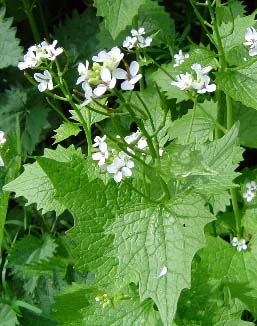
Photo: Toubib at Dutch Wikipedia, CC BY-SA 3.0 · source

Herbaceous plant · Cabbage family (Brassicaceae)
Garlic mustard
Alliaria petiolata
In other languages: Look-zonder-look (Nederlands) · Alliaire officinale (Français)
Grows wild in Belgium.
Garlic mustard is a biennial of the cabbage family that flowers with small white flowers in April and May along woodland edges, hedges, wooded banks and shady verges. It is very common throughout Belgium, especially on moist, rich soil in part shade. You recognise it by its heart-shaped, scalloped leaves, which smell clearly of garlic when crushed, and by the long, thin seed pods that stand upright after flowering. It is one of the most important food plants of the orange-tip butterfly, and the young leaves make a tasty wild kitchen herb.
Light
Partial shade or shade
tolerates little sun
Moisture
Normal
no wet feet
Hardiness
Fully hardy
down to -25 °C
Size
0.8 m
tall, 0.3 m wide
Flowering
April–June
| Height | 0.8 m |
|---|---|
| Native to Belgium | Yes |
| Flowering | April–June |
Identify
How to recognise it
- Growth habit
- Biennial: in the first year a low rosette of kidney-shaped leaves, in the second an upright flowering stem of 30–100 cm.
- Leaf
- Long-stalked; kidney-shaped at the base, triangular to heart-shaped higher up, with a coarsely scalloped edge. Fresh light green and hairless. Smells of garlic when crushed.
- Flower
- White flowers of 5–8 mm with four petals, in clusters at the top. From April to June.
- Fruit/seed
- Thin, four-angled pods of 3–7 cm, angled upwards, with a row of black seeds.
- Roots
- A white taproot that smells of horseradish.
- Confusion with
- Ground-ivy and lesser celandine also have round or heart-shaped leaves, but they do not smell of garlic; ground-ivy also has square stems and small purple flowers. Ramsons smells of garlic too, but has long, lance-shaped leaves and star-shaped flowers.
Flowering: April–June
In your garden
Why grow it?
- An important food plant for the caterpillars of the orange-tip and the green-veined white.
- Flowers early, in April–May, feeding early bees, hoverflies and butterflies.
- Thrives in part shade under shrubs and along hedges, where few other flowers do as well.
- The young leaves taste mildly of garlic and suit salads, pesto or herb butter.
- Self-seeds freely and needs hardly any care.
Garlic mustard: where does it grow best?
- In the wild: woodland edges, hedges, wooded banks, parks, shady verges and rough ground along walls.
- Part shade to shade; in full sun the leaves soon wilt.
- Moist to normal, humus-rich and fertile soil.
- In the garden, ideal along a hedge, under shrubs or in a wild corner.
Goes well with
- Cuckooflower: A second food plant for the orange-tip, for a damper spot.
- Ramsons: Flowers at the same time in part shade and also smells of garlic.
- Red campion: Pink flowers on the same woodland edge, from April to June.
- Herb-Robert: A small pink flower that also likes the shade at the foot of a hedge.
- Hazel: A shrub that provides the part shade garlic mustard loves.
Maintenance
Garlic mustard: when and how to plant it?
- Buy seed of wild origin or a plant from a native plant nursery. Often it turns up of its own accord.
- Sow in August–October, preferably fresh seed, on the surface of loosened soil in part shade: the seed needs a winter to germinate.
- The seedlings appear in March–April and form a rosette in the first year; they only flower the year after.
- Sow two years in a row: then you will have flowering plants every year.
- Watering is only needed during dry spells in the first spring.
- Never dig up plants from the wild: a handful of seed from a friend’s garden is plenty.
Care
- Water
- Rarely needed; only for young rosettes during long dry spells.
- Feeding
- Not needed; a little leaf mould in autumn is enough.
- Letting it seed
- Let the pods ripen: that way the plant renews itself year after year.
- Spreading
- If there are too many, pull up some of the rosettes in spring; always leave a group.
- Caterpillars
- Leave the flowering stems well into summer: orange-tip caterpillars feed on the young pods.
Tip: Leave a group of flowering stems standing until the following spring: that way you help the orange-tip through its whole life cycle, from egg to pupa.
Pruning and mowing
When: Not needed: let the plant complete its life cycle.
How:
- Do not cut during flowering or in June–July, as orange-tip caterpillars are then living on the pods.
- Leave the dead stems all winter: orange-tip pupae overwinter on stems near the food plant.
- If you want fewer seedlings, pull up some of the young rosettes in spring rather than cutting.
Caution: Only clear the dead stems in May, when the new plants are flowering: otherwise you throw away the overwintering orange-tip pupae.
Propagation
- Seed
- Collect ripe pods in July–August and scatter the seed straight away, or store it dry until October. It needs a cold period.
- Self-seeding
- It self-seeds readily. Move young rosettes in autumn or early spring with a good root ball.
Garlic mustard: how does it get through the winter?
Hardy to −25 °C.
- First-year plants overwinter as a green rosette: you can pick leaves even in winter.
- Second-year plants die after setting seed; their dry stems remain standing.
- Orange-tip pupae overwinter on or near those stems.
- Fully hardy, to about −25 °C.
Diseases and pests
- Too many seedlings: On rich soil it can self-seed heavily. Pull up surplus rosettes in spring and eat them.
- Caterpillar damage: Holes in leaves and pods are usually the work of whites and orange-tips: a good sign, so let them be.
- White rust: White, powdery pustules on leaves and stems; harmless. Remove badly affected plants.
- Wilting in sun: In full sun or dry soil the leaves soon droop. Choose a spot in part shade.
Through the year
- March: Rosettes grow fast. Pick young leaves.
- April: Flowering begins. Orange-tips lay eggs on the flower stalks.
- May: Full flower. Last year’s dead stems can now be cleared.
- June: Pods ripen; orange-tip caterpillars feed on them.
- July: Seed ripens. Leave the stems.
- August: Collect and scatter the seed.
- September: Sow in a shady spot.
- October: Sow. Move young rosettes.
- December: Green rosettes and dry stems with overwintering pupae.
You and this species
Did you know?
- Its Dutch name, look-zonder-look, means garlic without garlic: the leaves smell of garlic, but the plant belongs to the mustard and cabbage family.
- Garlic mustard is one of the oldest known kitchen herbs in Europe: archaeologists found traces of it in pottery fragments about 6000 years old in Denmark and Germany.
- The female orange-tip usually lays only one orange egg per flower stalk, as the caterpillars eat each other when they meet.