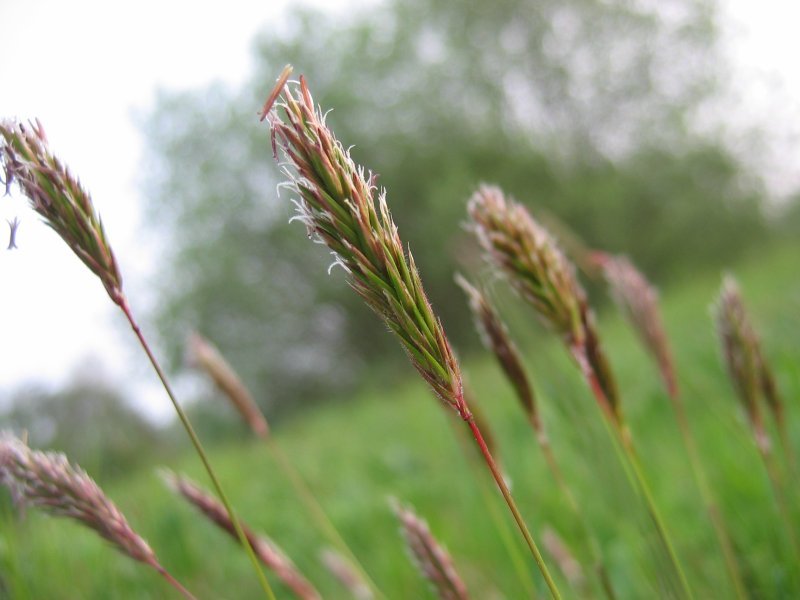
Photo: Kristian Peters -- Fabelfroh 18:00, 27 May 2006 (UTC), CC BY-SA 3.0 · source

Grass-like plant · Grass family (Poaceae)
Sweet vernal grass
Anthoxanthum odoratum
In other languages: Gewoon reukgras (Nederlands) · Flouve odorante (Français)
Grows wild in Belgium.
Sweet vernal grass is a small, tufted grass of 20–50 cm and one of the very first grasses to flower, from as early as April. It grows in unimproved hay meadows, on verges, heaths, dune grassland and in open woodland, on acid to neutral soil, and it is common in Belgium. You recognise it by its short, dense, spike-like panicle, green with purple stigmas at first and later golden brown. When dried it smells strongly of fresh hay and vanilla: sweet vernal grass gives hay its typical scent. In a flower-rich meadow it is a staple and a sign of poor, unfertilised soil.
Light
Sun or partial shade
preferably some sun
Moisture
Dry to normal
no wet feet
Hardiness
Fully hardy
down to -30 °C
Size
0.4 m
tall, 0.2 m wide
Flowering
April–June
| Pruning months | June and September |
|---|---|
| Height | 0.4 m |
| Native to Belgium | Yes |
| Flowering | April–June |
Identify
How to recognise it
- Habit
- Loose tuft of 20–50 cm, with short, upright stems.
- Leaf
- Flat, 3–5 mm wide, fresh green and often slightly hairy. Where the sheath meets the blade there are a few long hairs beside a membranous ligule.
- Flower
- Dense, narrow, spike-like panicle of 2–6 cm, from April to June: green with purple stigmas at first, later golden yellow to brown. Each floret has only two stamens.
- Fruit/Seed
- Small, brown, hairy seeds with short awns, ripening in June.
- Scent
- Crush a leaf or stem: especially when dried, it smells sweetly of hay and vanilla.
- Confusion with
- Meadow foxtail also flowers early, but is taller and has a soft, cylindrical, grey-green spike. Timothy flowers later, from June, with a stiff, cylindrical spike. Neither smells of hay.
Flowering: April–June · Pruning: June and September
In your garden
Why grow it?
- An early bloomer: from April it gives structure to a flower meadow, well before most other grasses.
- When dried it smells wonderfully of hay and vanilla, thanks to a substance called coumarin.
- It grows in loose tufts and leaves room for wild flowers: an ideal grass for a poor-soil flower meadow.
- Grassland butterflies such as the meadow brown lay their eggs on all sorts of grasses; a varied sward including sweet vernal grass helps their caterpillars.
- The seed is food for seed-eating birds such as finches and sparrows.
Sweet vernal grass: where does it grow best?
- In the wild: unimproved hay meadows, verges, heathland, dune grassland, open woodland and woodland edges.
- Sun to partial shade.
- Poor, acid to neutral soil, dry to moist; on rich, fertilised soil it disappears under coarser grasses.
- In the garden: a flower meadow, a poor-soil bank or a patch of lawn that you mow less often.
Goes well with
- Oxeye daisy: White flowers in May–June, the classic of a poor-soil hay meadow.
- Bird’s-foot trefoil: Little yellow flowers for bumblebees and a food plant of the common blue.
- Harebell: Delicate blue bells on the same poor, acid soil.
- Common sorrel: Reddish-brown flower spikes in May and a food plant of the small copper.
- Red fescue: Another fine, poor-soil grass; together they form a soft, flower-rich sward.
Maintenance
Sweet vernal grass: when and how to plant it?
- Never take turf or plants from verges or nature reserves; buy seed of native origin, usually in a mix with other poor-soil grasses and wild flowers.
- Reduce fertility first: remove the rich top layer of soil, or mow for a few years and take the cuttings away. Prepare a fine, weed-free seedbed.
- Sow in September–October or in March–April. Sowing in autumn gives the wild flowers in the mix the cold period that many of them need.
- Scatter the seed thinly, rake it in very lightly and roll or tread it in.
- Keep the seedbed moist until germination, after 2–3 weeks.
- You can also plant small plugs from a native plant nursery, 20–30 cm apart.
Care
- Watering
- Not needed after germination; it tolerates drought well.
- Feeding
- Never: fertiliser lets coarse grasses win and crowds out sweet vernal grass and wild flowers.
- Mowing
- Mow as a hay meadow: at the end of June, when the seed is ripe, and again in September. Always remove the cuttings.
- Letting seed drop
- Leave the hay to dry where it lies for 2–5 days: the seed drops and the grass re-seeds itself.
- Soil
- Do not put compost or mulch on a flower meadow; that keeps the soil poor.
Tip: Pick a small bunch of flowering stems in May or June and let them dry: after a few days your house will smell of fresh hay.
Pruning and mowing
Pruning months: June and September.
When: At the end of June, when the seed is ripe, and again in September.
How:
- Mow with a scythe, brush cutter or bar mower at 5–10 cm, not with a rotary mower that chops everything up.
- Leave the hay for 2–5 days to dry and drop its seed, then rake it away.
- Leave a strip uncut each year as shelter for insects; cut it the following year.
Caution: Do not mow too early: wait until the flowers in the meadow have set seed.
Propagation
- Seed
- In June let a few stems ripen, cut them when brown, dry them and scatter the seed on bare soil in September.
- Division
- In spring or autumn, dig up a tuft, pull it into small pieces and replant them 20 cm apart.
Sweet vernal grass: how does it get through the winter?
Hardy to −30 °C.
- The leaves stay largely green; the tuft overwinters without trouble.
- Fully hardy, to about −30 °C.
- An uncut strip with old stems offers a place to overwinter for insects, spiders and the caterpillars of grassland butterflies.
Diseases and pests
- Disappearing: On rich soil it is crowded out by coarser grasses. Mow and remove the cuttings, never fertilise.
- Hay fever: It flowers early and can trigger hay fever in sensitive people from April. In that case, do not sow it right next to a patio or bedroom window.
- Poor germination: Seed that lies too deep or dries out germinates poorly. Sow on the surface and keep the seedbed moist.
- Rust: Grasses sometimes get orange rust spots in late summer. Harmless to the meadow; mowing and removing the cuttings helps.
Through the year
- March: Sowing is possible now. Keep the seedbed moist.
- April: Starts flowering as one of the very first grasses.
- May: Full flower. The wild flowers in the meadow are coming up.
- June: Seed ripens. First mowing at the end of June; let the hay dry and remove it.
- July: Regrowth. Leave a strip uncut.
- September: Second mowing, remove the cuttings. Good month for sowing.
- October: Sow a flower meadow.
- December: Resting; the tuft stays green.
You and this species
Did you know?
- The hay scent comes from coumarin, a substance released as the grass wilts and dries.
- Anthoxanthum means ‘yellow flower’ in Greek, after the golden colour of the ripe panicle.
- In most grasses each floret has three stamens; in sweet vernal grass it has only two. The stigmas emerge first, before the stamens are ripe, which limits self-pollination.