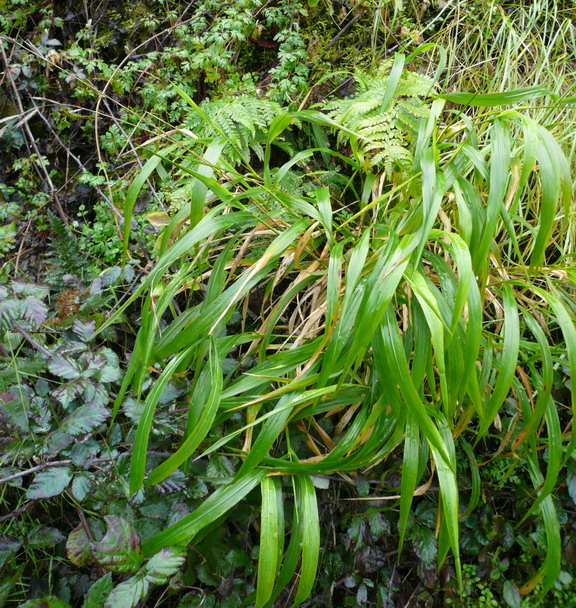
Photo: No machine-readable author provided. Pere prlpz assumed (based on copyright claims)., CC BY-SA 2.5 · source

Grass-like plant · Grass family (Poaceae)
False brome
Brachypodium sylvaticum
In other languages: Boskortsteel (Nederlands) · Brachypode des bois (Français)
Grows wild in Belgium.
False brome is a native woodland grass, 30–90 cm tall, that forms loose, arching tufts in deciduous woods, woodland edges, sunken lanes and along shady hedges. In Belgium it is fairly common on loamy and chalky soils, for instance in the loam belt and in Wallonia; on the poor sands of the Campine it is scarcer. You recognise it by its fresh, yellowish-green, softly hairy leaves that arch gracefully, and by its nodding spike of long, almost stalkless spikelets with straight awns. It flowers from June to August. For a shade garden it is a valuable native ornamental grass, and its leaves feed the caterpillars of, among others, the speckled wood, the ringlet and the large skipper.
Light
Partial shade or shade
tolerates little sun
Moisture
Normal
no wet feet
Hardiness
Fully hardy
down to -30 °C
Size
0.6 m
tall, 0.4 m wide
Flowering
June–August
| Pruning months | March |
|---|---|
| Height | 0.6 m |
| Native to Belgium | Yes |
| Flowering | June–August |
Identify
How to recognise it
- Habit
- Loose tuft of 30–90 cm with arching leaves and ascending to nodding stems; no runners.
- Leaf
- Broadly linear, 6–12 mm, limp and arching, fresh green to yellowish green, with scattered soft hairs.
- Flower
- Narrow, nodding spike with 4–12 elongated spikelets of 2–4 cm, almost without stalks; each lemma ends in a straight awn of about 1 cm. Flowers from June to August.
- Stem
- Round stems with hairy nodes; the leaf sheaths are hairy too.
- Fruit/Seed
- Elongated, awned seeds, ripe in August–September; they easily catch on fur and clothing.
- Confusion with
- Tor-grass is stiffly upright, has tougher leaves and grows in sunny chalk grassland. Hairy brome has a branched, drooping panicle rather than a spike. Bearded couch has a spike with spikelets pressed flat against the stem and almost hairless leaves.
Flowering: June–August · Pruning: March
In your garden
Why grow it?
- Food plant of the speckled wood, the ringlet and the large skipper, three butterflies of woodland edges and hedges.
- One of the few native grasses that thrive in shade and partial shade under trees and shrubs.
- Graceful, arching tufts with fresh green leaves: a native alternative to exotic ornamental grasses.
- The tufts stay standing all winter and shelter overwintering caterpillars and other insects.
- Typical of woodland edges and hedgerows on loamy or chalky soil: it makes a new woodland edge look natural at once.
False brome: where does it grow best?
- In the wild: deciduous woods, woodland edges, clearings, sunken lanes, hedgerows and shady verges.
- Partial shade to shade; in sun only if the soil stays moist.
- Moist, humus-rich soil, preferably loamy or chalky; moderately fertile.
- In the garden: under shrubs, at the edge of a copse, along a hedge or in a shady border.
Goes well with
- Wood anemone: A white carpet of flowers in March–April, before the grass grows up.
- Male fern: Sturdy fronds beside the arching grass in the shade.
- Yellow archangel: Yellow flowers in May for bumblebees, on the same moist woodland soil.
- Nettle-leaved bellflower: Blue bells in summer at the woodland edge.
- Wood avens: Small yellow flowers and hooked fruits in partial shade.
Maintenance
False brome: when and how to plant it?
- Buy plants from a nursery for native plants, or seed of native origin.
- Sow in September–October in pots or directly on loose, weed-free soil and rake the seed in lightly.
- Plant in March–April or September–October, 30–40 cm apart, in groups of 3–5 for a natural look.
- Work some leaf mould into the soil if it is poor or sandy.
- Water during dry spells in the first season; after that it looks after itself.
- Never dig up plants in woods or nature reserves.
Care
- Watering
- Only in the first year during drought. Later rarely needed in shade.
- Feeding
- Not needed; a layer of fallen leaves in autumn is enough.
- Fallen leaves
- Leave autumn leaves between the tufts: they feed the soil, just as in a wood.
- Self-seeding
- It self-seeds readily. If you do not want that, cut off the spikes in August, before the seed is ripe.
- Tidying
- Cut or comb out old, dead leaves only in March, before new growth starts.
Tip: Plant false brome in a small group under a hedge or shrub border and leave the tufts until March: you create a woodland edge where the speckled wood and ringlet lay their eggs.
Pruning and mowing
Pruning months: March.
When: In March, before the new leaves appear.
How:
- Cut the tuft back to 10 cm above the ground, or comb out the dead leaves with gloved fingers.
- Leave the old tufts and stems standing all winter: they protect insects and the caterpillars in the tuft.
- Cut off the spikes in August if you do not want seedlings.
Caution: Do not cut back in autumn: young caterpillars of, among others, the ringlet and the large skipper overwinter in the tufts.
Propagation
- Seed
- Ripens in August–September; sow in autumn and it germinates in spring.
- Division
- In March–April dig up a tuft and split it with a spade into 2–4 pieces.
False brome: how does it get through the winter?
Hardy to −30 °C.
- The leaves turn yellowish brown but stay partly green in mild winters.
- Fully hardy, to about −30 °C.
- Young caterpillars of grassland butterflies, beetles and spiders overwinter in the tufts.
Diseases and pests
- Self-seeding: In a moist, shady garden it seeds itself about freely. Weed out seedlings in spring or cut the spikes off in time.
- Drought: In full sun on dry soil the leaves scorch in summer. Move it to partial shade or mulch with leaf mould.
- Rust: Orange or brown rust on the leaves in late summer; usually harmless. Remove affected leaves when tidying in March.
Through the year
- March: Cut away old leaves. Plant or divide.
- April: Fresh green new leaves appear.
- May: Caterpillars of the ringlet and speckled wood feed on the leaves.
- June: Flowering starts with nodding spikes.
- July: In flower. Speckled woods and ringlets fly along the woodland edge.
- August: Seed ripens; cut off the spikes if you do not want seedlings.
- September: Sow or plant.
- October: The leaves turn yellow; leave fallen leaves in place.
- December: Dormant; leave the tufts standing.
You and this species
Did you know?
- Brachypodium means ‘short little foot’ (Greek brachys and podion): the spikelets sit on very short stalks.
- In the western United States, where it was introduced, false brome is regarded as a troublesome invasive species in forests.
- A close relative, the annual Brachypodium distachyon, is a model plant that scientists use to study cereals such as wheat.