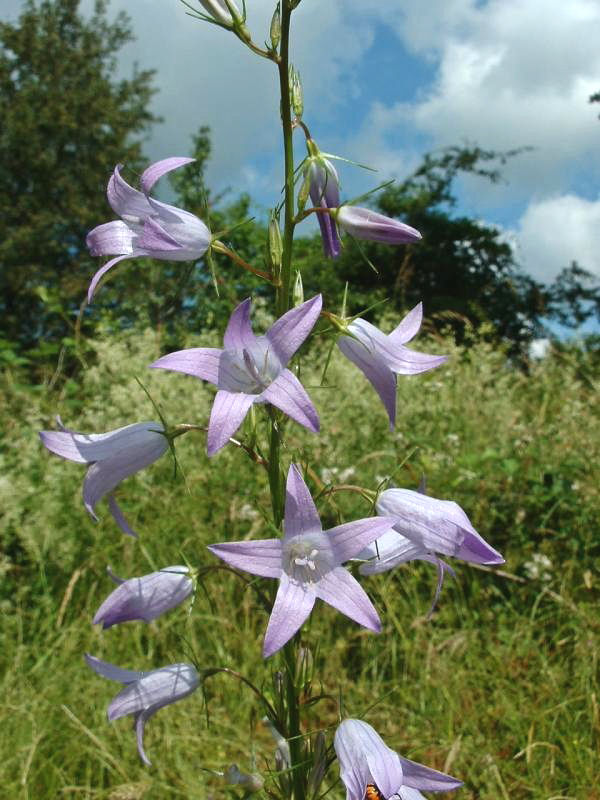
Photo: J.F. Gaffard, CC BY-SA 3.0 · source

Herbaceous plant · Bellflower family (Campanulaceae)
Rampion bellflower
Campanula rapunculus
In other languages: Rapunzelklokje (Nederlands) · Campanule raiponce (Français)
Grows wild in Belgium.
Rampion bellflower is a native, biennial bellflower with long, slender spikes of pale blue to lilac flowers. It grows in sunny, dry places: road verges, dykes, embankments, railway banks, dry grassland and field edges, often on sandy or chalky soil. In Belgium it is not common and is found rather locally. In the first year it forms a rosette of spoon-shaped leaves, in the second an upright stem up to 1 m with narrow leaves and upright, fairly small bells with long, awl-shaped calyx teeth. The thick, white root was once grown as a vegetable, and it is an important food plant for specialist bellflower bees.
Light
Full sun
warm and bright
Moisture
Dry to normal
no wet feet
Hardiness
Fully hardy
down to -25 °C
Size
0.8 m
tall, 0.3 m wide
Flowering
June–August
| Pruning months | September–October |
|---|---|
| Height | 0.8 m |
| Native to Belgium | Yes |
| Flowering | June–August |
Identify
How to recognise it
- Habit
- Biennial: in the first year a leaf rosette, in the second an upright, little-branched stem of 40–100 cm. After setting seed the plant dies.
- Leaf
- Rosette leaves obovate to spoon-shaped, stalked and slightly scalloped; stem leaves narrowly lance-shaped and stalkless. Damaged parts ooze a white milky sap.
- Flower
- In June–August a narrow, long spike or panicle of upright, funnel-shaped bells of 1–2 cm, pale blue to lilac, rarely white. The calyx teeth are long, narrow and awl-shaped.
- Fruit
- An upright capsule that opens by small pores and contains very fine, light seed.
- Roots
- A thick, white, fleshy taproot, a little like a small turnip.
- Confused with
- Spreading bellflower has wider, open bells with star-like spreading lobes in a loose panicle. Creeping bellflower has nodding bells along one side of the spike and spreads aggressively by rhizomes. Peach-leaved bellflower has much larger, cup-shaped flowers.
Flowering: June–August · Pruning: September–October
In your garden
Why grow it?
- Scissor bees, small solitary bees, collect pollen only from bellflowers; one of them is even named after this plant: Chelostoma rapunculi.
- Bumblebees, other wild bees and hoverflies also visit the flowers, and male scissor bees like to spend the night inside the bells.
- It flowers from June into August, in dry, sunny places where little else flowers in summer.
- A plant with a history: the root and young leaves were once eaten as a vegetable, raw or cooked.
- It self-seeds in a suitable spot without becoming invasive.
Rampion bellflower: where does it grow best?
- In the wild: sunny road verges, dykes, embankments, railway banks, dry grassland, field edges and sunny woodland edges.
- Full sun to light partial shade.
- Dry to fairly dry, free-draining soil: sand, sandy loam or chalky soil, preferably not too rich.
- In the garden: a wildflower meadow, a sunny border with other drought lovers, a bank or the edge of a gravel garden.
Goes well with
- Wild marjoram: Flowers at the same time in the same dry, sunny spot and attracts many butterflies.
- Brown knapweed: Purple flower heads next to the blue bells in a wildflower meadow.
- Oxeye daisy: White flowers in June, in the same poor meadow.
- Wild carrot: White umbels in summer, on the same sunny, dry soil.
- Harebell: A lower, finer bellflower that also feeds scissor bees.
Maintenance
Rampion bellflower: when and how to plant it?
- Buy seed or young plants from a nursery specialising in native plants. Never dig up plants from the wild.
- Sow in April–June or in September, where it is to flower or in small pots. The seed is very fine: scatter it on the surface, press it down and do not cover it, as it needs light to germinate.
- Mix the seed with a little fine sand so you can spread it more evenly.
- Plant young plants in autumn or spring, 20–30 cm apart.
- Keep the soil moist until the seedlings or plants are established; after that, watering is rarely needed.
- Sow two years running so there are flowering plants every year: each plant flowers only once.
Care
- Water
- Only until the plants are established. After that it copes well with drought.
- Feeding
- Not needed: on poor soil the stems stay sturdier and grasses have less chance.
- Mowing
- Do not mow a wildflower meadow until September, when the seed is ripe, and remove the cuttings.
- Let it seed
- Leave the stems after flowering until the capsules are brown. That way the plant self-seeds and stays in your garden.
- Bare patches
- Seedlings need some bare soil. A few open patches in the meadow help new rosettes get going.
Tip: To attract scissor bees, grow several bellflowers together, such as rampion bellflower, harebell and nettle-leaved bellflower. A bee hotel with thin holes of a few millimetres nearby also gives them somewhere to nest.
Pruning and mowing
Pruning months: September–October.
When: After the seed has ripened, in September–October.
How:
- Leave the spent stems until the seed is ripe.
- Shake the capsules over the spot where you want new plants, or leave it to the wind.
- Then cut the dead stem at ground level: the plant itself dies after flowering.
- Feel free to leave a few stems standing until spring: they shelter small insects.
Caution: Do not mow over the plants in June–August: the flowering stems would disappear before setting seed.
Propagation
- Seed
- The best method. Sow on the surface in spring or late summer and do not cover. The plant flowers the year after sowing.
- Self-seeding
- Let the seed fall and look for young rosettes in autumn. While they are small you can carefully move them with a good root ball.
Rampion bellflower: how does it get through the winter?
Hardy to −25 °C.
- The first-year rosette spends the winter flat against the ground.
- Hardy to about −25 °C; it copes less well with wet, heavy soil in winter.
- Plants that have flowered die; the dry stems with their capsules stay standing for a while.
Diseases and pests
- Slugs: Young rosettes and seedlings are vulnerable to slugs. Sow in a dry, sunny spot and keep the grass around them short.
- Gone after flowering: That is normal: it is a biennial. Let it seed or sow a little every year.
- Smothered by grass: On rich soil grasses overgrow the rosettes. Make the soil poorer by removing the cuttings and not feeding.
- Root rot: In heavy, wet soil the root rots in winter. Choose a free-draining spot.
- Wrong bellflower: Creeping bellflower looks similar but is very invasive. Buy seed from a reliable supplier and check the flowers.
Through the year
- March: Rosettes start growing again. Top up the sowing if needed.
- April: Sow on the surface, do not cover.
- May: The flowering stem of second-year plants grows. Protect seedlings from slugs.
- June: Flowering begins. Look for scissor bees in the flowers.
- July: Full flower.
- August: Last flowers. The first capsules ripen.
- September: Let the seed fall or collect it. Mow the wildflower meadow. You can sow again.
- October: Cut down dead stems. Plant young plants.
- December: Dormant; the rosettes lie flat on the ground.
You and this species
Did you know?
- In the Brothers Grimm’s fairy tale Rapunzel, a pregnant woman craves ‘rapunzel’ from a witch’s garden. Which plant is meant is not certain: in German, lamb’s lettuce is also called Rapunzel.
- Rapunculus is a diminutive of the Latin ‘rapa’, turnip: a reference to the turnip-like root.
- In French, both the plant and the fairy-tale girl are called ‘Raiponce’.