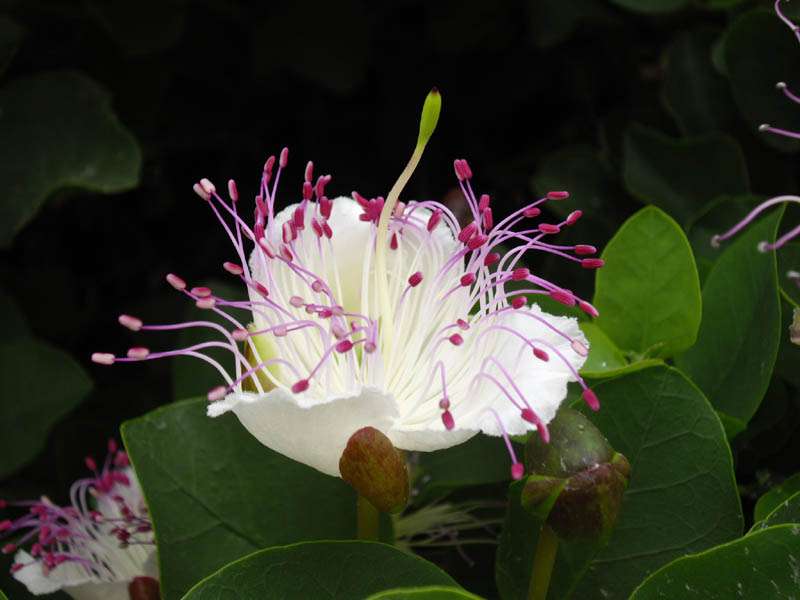
Photo: Ghislain118 http://www.fleurs-des-montagnes.net, CC BY-SA 3.0 · source

Shrub · Caper family (Capparaceae)
Caper
Capparis spinosa
In other languages: Kappertjesstruik (Nederlands) · Câprier (Français)
Grows wild in Europe, but not in Belgium.
Caper is a low, sprawling shrub from the Mediterranean, found from southern Europe and North Africa to central Asia. It grows wild in cracks in rocks and cliffs and on old walls, fortifications and ruins, in places where almost nothing else will grow. You can recognise it by its long, trailing or hanging stems with round, slightly fleshy leaves, often with two small hooked thorns at the base, and by its large white flowers with a tassel of long purplish pink stamens, which last only one day. The capers used in cooking are its pickled flower buds. In Belgium it is only found planted, usually in a pot kept frost-free in winter, or against a hot south-facing wall.
Light
Full sun
warm and bright
Moisture
Dry
tolerates drought
Hardiness
down to -8 °C
protect in harsh winters
Size
0.5 m
tall, 1.5 m wide
Flowering
June–September
| Pruning months | March |
|---|---|
| Height | 0.5 m |
| Native to Belgium | No, planted |
| Flowering | June–September |
Identify
How to recognise it
- Habit
- Low, sprawling shrub of 30–50 cm high and 1–2 m wide, with long stems that trail along the ground or hang over a wall, growing from a thick, woody rootstock.
- Leaves
- Alternate, round to oval, 2–5 cm, slightly fleshy, bluish green to fresh green, with a short stalk. Often two small yellow to brown hooked thorns at the base; some forms lack them.
- Flowers
- Single in the leaf axils, 5–7 cm across, with four white to pale pink petals and dozens of long purplish pink stamens. Each flower opens in the morning and fades within a day. From June to September.
- Fruit
- An elongated green berry of 2–4 cm on a long stalk, the caper berry. When ripe it splits open to show red flesh with many small seeds.
- Roots
- Deep and strong: in the wild they reach far into cracks in rocks and walls in search of water.
Flowering: June–September · Pruning: March
In your garden
Why grow it?
- Spectacular flowers of 5–7 cm, white with a tassel of purplish pink stamens, from June to September.
- Edible: the flower buds are pickled as capers, the young fruits as caper berries.
- The flowers attract large bees, such as bumblebees and carpenter bees.
- Copes with heat, drought and poor soil: a plant for the hottest spot on the patio or in the gravel garden.
- A taste of the Mediterranean on your patio that also needs very little water.
Caper: where does it grow best?
- In the wild: rock crevices, cliffs, old walls, ruins and dry, stony slopes, often close to the sea, always in full sun.
- Full sun and as much warmth as possible; without a warm summer it flowers little.
- Very free-draining, poor, stony soil, chalky or neutral; wet roots are fatal, especially in winter.
- In Belgium: in a terracotta pot with a mix of garden soil, coarse sand and gravel on a sunny patio, or in a dry joint of a south-facing wall or rock garden, with winter protection.
Goes well with
- Rosemary: The same hot, dry soil; blue flowers for bees in spring.
- Thyme: A low, fragrant ground cover for the same sunny pot or gravel garden.
- Lavender: Purple flowers and scent, and just as drought-tolerant.
- Fig: Often grows with capers on old Mediterranean walls; also works in a large pot on the patio.
Maintenance
Caper: when and how to plant it?
- Buy a young plant from a nursery for Mediterranean plants or herbs. Never take plants or cuttings from old walls or rocks in the wild, not even on holiday.
- Plant or repot in May, when there is no more frost, so it has a whole summer to root.
- Use a deep pot with a drainage layer and fill it with equal parts garden soil, coarse sand and gravel or grit.
- Set the plant at the same depth as in the pot, water thoroughly once and then let the soil dry out well.
- In a wall or rock garden: plant it in a dry, south-facing joint or crack, with sand and gravel around the roots.
- Repot as little as possible: it dislikes having its roots disturbed.
Care
- Water
- Little: only when the soil is completely dry, in a pot about once a week in summer. Keep almost dry in winter.
- Feeding
- Not needed in the ground; in a pot at most a little compost in spring.
- Overwintering
- From October, move a pot to a cool, bright, frost-free place, such as an unheated greenhouse or a garage with a window, and give hardly any water. It often drops its leaves; that is normal.
- Harvesting capers
- Pick the buds while still closed, preferably in the morning and every few days: the smaller, the finer. Leave a few for the flowers.
- Warmth
- In summer, put it in the hottest spot: against a wall or on a stone patio.
Tip: Give it a terracotta pot in the hottest, driest spot on your patio and almost forget about it: caper flowers and crops best when it is kept warm and dry.
Pruning and mowing
Pruning months: March.
When: In March, before the new shoots appear; for a pot overwintered indoors, just before it goes back outside.
How:
- Cut all of last year’s stems back to 5–10 cm above the rootstock: it flowers on this year’s new shoots.
- Remove dead and frozen stems completely.
- Do not prune in summer: every shoot then carries buds and flowers.
Caution: There are small, sharp hooked thorns at the base of the leaves: wear gloves when pruning and harvesting.
Propagation
- Seed
- Tricky but possible. Soak fresh seeds in lukewarm water for a day, keep them cold and moist in the fridge for 1–2 months and sow them in April in warm, sandy seed compost. Germination is slow and erratic.
- Cuttings
- In March take woody cuttings of 10–15 cm from last year’s stems and put them in sandy cutting compost in a warm place. They only succeed now and then.
Caper: how does it get through the winter?
Hardy to −8 °C: protect in harsh winters.
- In a cool climate it drops its leaves and the stems die back; the woody rootstock sprouts again in spring.
- Tolerates only light frost, to about −8 °C and only when dry; outdoors it does not survive most Belgian winters without protection.
- Overwinter a pot cool, bright and frost-free, at 5–10 °C, and almost dry.
- Outdoors in a wall or rock garden: protect the base with a layer of gravel and a small roof against winter rain, and cover the plant with fleece in hard frost.
Diseases and pests
- Root rot: Yellow leaves, limp stems and a rotting base from too much water or wet soil. Water less and use a much grittier mix.
- No flowers: Too little warmth or sun, or pruned too late. Put it in the hottest spot and prune early in spring.
- Aphids and mealybugs: Can appear while overwintering indoors. Wipe them off with a damp cloth or spray them off with water.
- Cabbage white caterpillars: Caper is related to the cabbages and has the same sharp-tasting compounds; cabbage white caterpillars may eat the leaves. Pick them off.
Through the year
- January: Overwintering: cool, bright, frost-free and almost dry.
- February: Overwintering. Put seed in the fridge, cold and moist.
- March: Cut back to just above the rootstock. Take cuttings.
- April: New shoots appear. Carefully start watering again. Sow in warm seed compost.
- May: Move the pot outside after the last frost. Plant or repot.
- June: First buds: harvest capers. Flowering begins.
- July: Flowering. Pick capers every few days. Water when the soil is dry.
- August: Flowering. Harvest caper berries.
- September: Last flowers. Break open ripe fruits for seed.
- October: Less water. Bring the pot indoors before the first frost.
- November: Overwintering. Leaf drop and dying stems are normal.
You and this species
Did you know?
- Capers are the still-closed flower buds. Fresh, they are bitter; they only get their typical flavour once pickled in salt or vinegar.
- The Italian island of Pantelleria and the Aeolian island of Salina are famous for their capers.
- Each flower lives less than a day: it opens in the morning and has faded before the next morning.