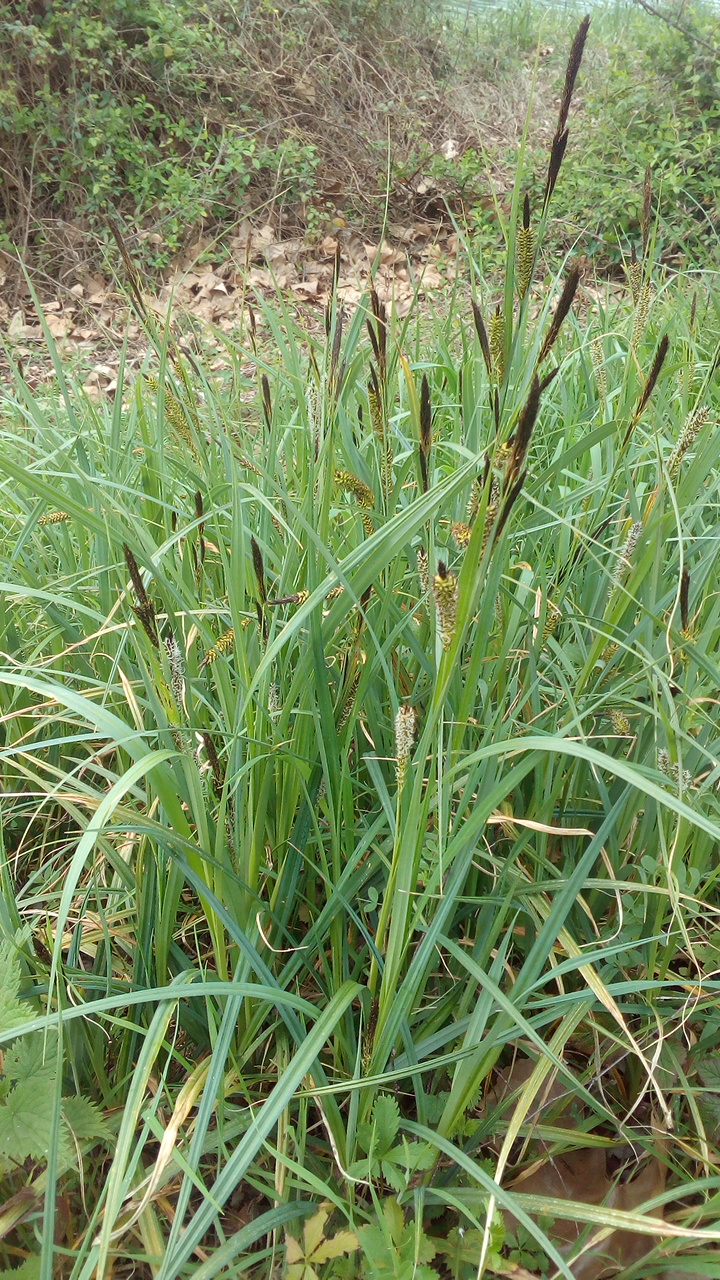
Photo: Florent BECK, CC BY-SA 2.0 fr · source

Grass-like plant · Sedge family (Cyperaceae)
Greater pond-sedge
Carex riparia
In other languages: Oeverzegge (Nederlands) · Laîche des rives (Français)
Grows wild in Belgium.
Greater pond-sedge is one of the largest sedges in Belgium: a native marsh plant, 80–150 cm tall, that forms large, dense stands from thick rhizomes along rivers, ditches and ponds and in marshes. It is fairly common in the polders and river valleys of Flanders and grows on wet, fertile clay and peat, often with its feet in the water. From April to June its thick, dark brown to almost black male spikes stand out, with broad green female spikes below. Its broad, bluish-green leaves with razor-sharp edges give a pond edge a sturdy, natural character. Dense stands of greater pond-sedge offer shelter to marsh birds, amphibians and many invertebrates.
Light
Sun or partial shade
preferably some sun
Moisture
Moist to wet
must not dry out
Hardiness
Fully hardy
down to -30 °C
Size
1.2 m
tall, 1 m wide
Flowering
April–June
| Pruning months | March |
|---|---|
| Height | 1.2 m |
| Native to Belgium | Yes |
| Flowering | April–June |
Identify
How to recognise it
- Habit
- Very robust, upright sedge of 80–150 cm with thick, creeping rhizomes; forms extensive stands.
- Leaf
- Bluish green, 6–20 mm wide, firm, with a prominent midrib and razor-sharp edges; often as long as or longer than the stems.
- Flower
- At the top 3–6 thick, dark brown to almost black male spikes with long-pointed scales; below them 2–5 thick, cylindrical female spikes of 3–10 cm with three stigmas; from April to June.
- Stem
- Sharply three-angled, sturdy, rough on the edges and without nodes.
- Fruit/Seed
- Fairly large, inflated, veined utricles of 5–8 mm with a distinct two-toothed beak; ripe in June–July.
- Confusion with
- Lesser pond-sedge is a little smaller, with narrower leaves, slimmer female spikes and male spikes with blunter scales; its utricles are small and not inflated. Pendulous sedge has long, gracefully drooping spikes and grows in moist, shady woods.
Flowering: April–June · Pruning: March
In your garden
Why grow it?
- Forms broad, dense marginal strips that hold the bank together and break the force of small waves.
- Shelter and nesting cover for marsh birds such as the moorhen and reed bunting, and a safe bank for frogs and toads.
- Dragonflies and damselflies perch on its sturdy leaves and warm up there after emerging.
- Early flowering, with striking dark male spikes in April and May.
- Bluish-green leaves that look fresh all summer and stay standing, straw-coloured, in winter.
Greater pond-sedge: where does it grow best?
- In the wild: banks of rivers, ditches, canals and ponds, marshes, wet meadows and alder carr.
- Sun to partial shade.
- Wet, fertile soil, clay or peat; also grows in shallow water up to about 20–30 cm deep and tolerates flooding.
- In the garden: beside a large pond, in a wet corner or a marsh zone. It is too big for a small pond, unless grown in a sturdy basket.
Goes well with
- Yellow iris: Large yellow flowers in May–June on the same bank.
- Purple loosestrife: Purple flower spikes in summer for bees and butterflies.
- Meadowsweet: Creamy, fragrant plumes against the bluish-green leaves.
- Water mint: Lilac pompons and a fresh scent in the shallow margin.
- Hemp-agrimony: Pink flower heads in August, a butterfly magnet at the water’s edge.
Maintenance
Greater pond-sedge: when and how to plant it?
- Buy plants from a nursery for aquatic or native plants; never dig up plants from banks or nature reserves.
- Plant from April to June, when the water warms up, in wet soil or in water up to 20 cm deep.
- Allow 2–3 plants per m²; they soon join up into a dense fringe.
- In a lined pond, plant in a sturdy basket or container so that the thick rhizomes cannot take over the whole bank.
- Use poor pond soil or sand, not potting compost or fertiliser: these enrich the water and encourage algae.
- Wear strong gloves when planting: the leaf edges cut.
Care
- Watering
- Must always stand wet; keep the water level up with rainwater.
- Feeding
- Never: the plant gets enough nutrients from the water.
- Spreading
- Each spring or in September, cut back the edges with a sharp spade.
- Tidying
- In March lift dead leaves out of the water so the pond does not silt up.
- Gloves
- Always work with gloves and long sleeves.
Tip: Want to see the dark spikes up close in April? Put a small group of greater pond-sedge in a sturdy basket right next to your pondside patio: you keep it in check and still enjoy its early flowers.
Pruning and mowing
Pruning months: March.
When: Late February to late March, before new shoots appear.
How:
- Cut or mow the dead leaves down to 10–15 cm above the ground or water.
- Remove the cut leaves from the pond.
- In large stands leave a section standing each time, so insects and birds keep their cover.
Caution: Do not mow or cut from April to July: birds nest in the dense vegetation then.
Propagation
- Division
- In April–May cut off a piece of rhizome with a few shoots and replant it elsewhere in wet soil.
- Seed
- Ripens in June–July; sow fresh on wet, bare soil. It is slower than division.
Greater pond-sedge: how does it get through the winter?
Hardy to −30 °C.
- The leaves turn straw yellow to brown but stay upright for a long time.
- Fully hardy, to about −30 °C, and tolerant of winter flooding.
- The dense, dead growth shelters insects, spiders and small mammals, and protects the bank from wave action.
Diseases and pests
- Spreading: It can choke a small pond completely. Plant in a basket or cut back every year.
- Cutting leaves: It can give nasty cuts; do not plant it next to a path or play area.
- Silting up: Dead leaves build up in the pond. Clear them every spring.
- Fading: Where the ground dries out in summer, it soon withers. It really belongs in wet ground.
Through the year
- March: Cut away dead leaves and lift them out of the water.
- April: Flowering starts: dark male spikes.
- May: In flower. Plant and divide.
- June: Female spikes swell and turn green; birds nest in the stands.
- July: Seed ripens.
- September: Cut back the edges where it has spread too far.
- November: Leaves turn straw-coloured; leave them as winter shelter.
You and this species
Did you know?
- Riparia comes from the Latin ripa, ‘riverbank’: the sedge of the bank.
- Sedges are not true grasses: they belong to the sedge family, like the papyrus of Egypt.
- Large sedges in marshes used to be mown for bedding for livestock in the stable.