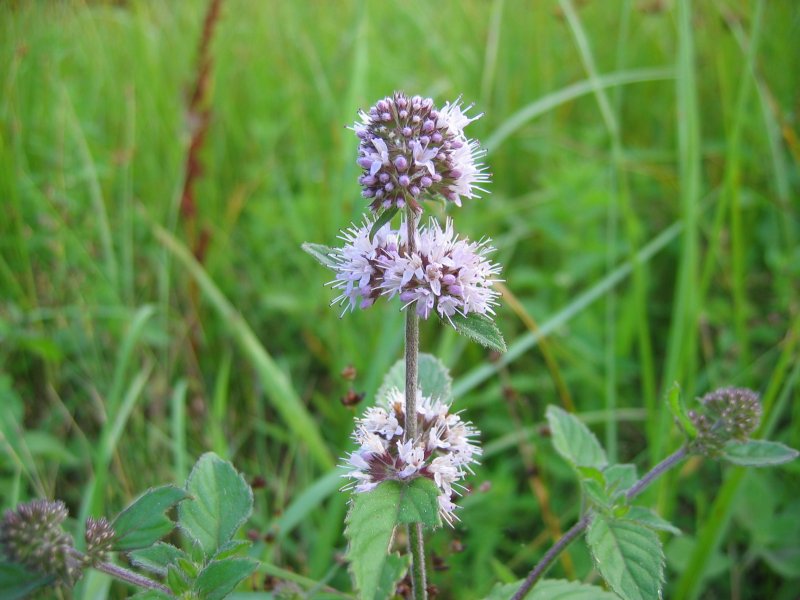
Photo: Kristian Peters -- Fabelfroh 09:40, 12 March 2007 (UTC), CC BY-SA 3.0 · source

Herbaceous plant · Mint family (Lamiaceae)
Water mint
Mentha aquatica
In other languages: Watermunt (Nederlands) · Menthe aquatique (Français)
Grows wild in Belgium.
Water mint is a native mint of wet places: ditch banks, the edges of ponds and streams, marshes, wet hay meadows and alder carr. It is common in Belgium, in Flanders as well as in Wallonia. Recognise it by its square, often reddish stems, its oval, toothed leaves and above all by the round, lilac flower heads at the top of the stem, from July into October. When you walk on it or crush a leaf, you immediately smell a strong peppermint scent. The flowers draw crowds of hoverflies, bees and butterflies, and on a pond edge it is one of the easiest and most useful marginal plants.
Light
Sun or partial shade
preferably some sun
Moisture
Moist to wet
must not dry out
Hardiness
Fully hardy
down to -25 °C
Size
0.5 m
tall, 0.5 m wide
Flowering
July–October
| Pruning months | March |
|---|---|
| Height | 0.5 m |
| Native to Belgium | Yes |
| Flowering | July–October |
Identify
How to recognise it
- Habit
- Perennial with creeping rhizomes and runners; upright stems of 20–60 cm, sometimes taller, forming dense patches.
- Leaves
- Oval, 2–6 cm, toothed and stalked, opposite and usually hairy; often tinged purple. Strong peppermint smell.
- Flowers
- Lilac to pink, in a round head of 1.5–2 cm at the top of the stem, often with one or two whorls below; July to October.
- Stem
- Square, hairy and often reddish to purple.
- Roots
- Creeping rhizomes in mud or wet soil, which let it spread quickly.
- Confusion with
- Corn mint flowers only in whorls in the leaf axils, with no ball at the top. Gypsywort grows in the same places but has deeply toothed leaves, tiny white flowers and no mint smell.
Flowering: July–October · Pruning: March
In your garden
Why grow it?
- Nectar from July to October for hoverflies, honeybees, bumblebees, solitary bees and butterflies.
- The leaves feed the caterpillars of the mint moth, among others, a small purple-and-gold moth.
- Flowers late in the season, when many other waterside plants have finished.
- Its creeping rhizomes bind the soil of pond edges and ditch banks.
- Fragrant leaves for tea or cooking; the familiar peppermint is a hybrid of water mint and spearmint.
Water mint: where does it grow best?
- In the wild: ditch banks, the edges of ponds, streams and rivers, marshes, wet grasslands and alder carr.
- In the garden: on the pond edge or in a bog zone, in wet soil or in shallow water up to about 10 cm deep.
- Sun or light shade; in deep shade it flowers less.
- Moderately to very fertile soil: clay, loam, peat or sand, as long as it stays wet.
Goes well with
- Purple loosestrife: Purple spikes in the same wet spot, another summer nectar source.
- Water forget-me-not: Small pale blue flowers at the water’s edge.
- Yellow iris: Tall, sword-shaped leaves and yellow flowers in May–June.
- Hemp agrimony: Pink flower heads for butterflies in late summer.
- Marsh marigold: Flowers in spring, long before the mint.
Maintenance
Water mint: when and how to plant it?
- Buy a plant from a nursery for native or pond plants and plant it in April–May or in September.
- In the pond, plant it in an aquatic basket with poor soil topped with gravel, so it does not spread over the whole edge.
- Or plant it in the wet margin, with the root ball just below or just above the waterline.
- Allow one plant per 30–40 cm; they soon join up.
- You can also sow in March–April on wet compost without covering the seed; mints hybridise easily, so seedlings may vary.
- Never dig up plants from the wild: a piece of rhizome from a nursery or a garden is enough.
Care
- Water
- Keep the soil wet at all times. In a dry border it does not last long.
- Feeding
- Not needed. Fertiliser in or near a pond mainly feeds algae.
- Spreading
- It spreads by rhizomes. In autumn slice off the edges with a spade, or lift the basket out of the water and reduce the clump.
- Mowing
- Along a ditch or in a wet hay meadow, mow at the end of September or in October and remove the cuttings; always leave a section uncut.
- Harvesting
- Pick the tips from May to September for tea or cooking.
Tip: Grow water mint in an aquatic basket in the pond: you enjoy its flowers and scent without it taking over the whole edge.
Pruning and mowing
Pruning months: March.
When: In March cut back the old stems; in October slice off the edges if needed.
How:
- Leave the faded stems standing in winter: insects overwinter in and among them.
- In March cut them back to just above the ground or the waterline, before the new shoots appear.
- Remove the cuttings from the pond so they do not rot in the water.
- If the clump has grown too large, slice off the outer parts with a spade in October.
Caution: Never mow or cut everything at once: always leave some standing as food and shelter for insects.
Propagation
- Division
- In April or September slice off a piece of the clump with rhizomes and replant it elsewhere.
- Cuttings
- A 10 cm stem cutting in a glass of water forms roots within one to two weeks.
- Seed
- Sow in March–April on wet soil, without covering. Seedlings may vary because of crossing with other mints.
Water mint: how does it get through the winter?
Hardy to −25 °C.
- The stems die back; the rhizomes overwinter in the wet soil and are fully hardy.
- The dry stems with seed heads stay standing and shelter insects.
- If the pond freezes, the plant comes to no harm as long as the rhizomes are in the mud.
Diseases and pests
- Mint rust: Orange to brown pustules on stems and leaves. Cut out affected stems and dispose of them, not on the compost heap.
- Leaf beetles: Small metallic-green beetles and their larvae make holes in the leaves. The damage is usually minor; otherwise pick them off.
- Spreading: It quickly covers a small pond edge. Use an aquatic basket and slice off the edges every autumn.
- Drought: When the water level drops in summer it wilts quickly. Top up the pond with rainwater.
- Hybridising: Water mint crosses easily with other mints. Do not plant garden mints right next to it if you want to keep the wild form.
Through the year
- March: Cut back old stems. Remove cuttings from the pond.
- April: Plant or divide. New shoots appear.
- May: Pick tips for tea. Put cuttings in water.
- June: Rapid growth. Shorten spreading runners.
- July: Flowering begins. Hoverflies and bees on the flowers.
- August: Full flower. Keep the pond topped up.
- September: Flowering. Mow wet meadows at the end of September, leaving part uncut.
- October: Last flowers. Slice off the edges if it spreads too far.
- December: Rest. The stems stay standing for insects.
You and this species
Did you know?
- The familiar peppermint is a natural hybrid between water mint and spearmint.
- The name Mentha refers to Minthe, a nymph in Greek mythology who was turned into a plant.
- In the Middle Ages mint was strewn on the floors of houses and churches: walking on it released a fresh scent.