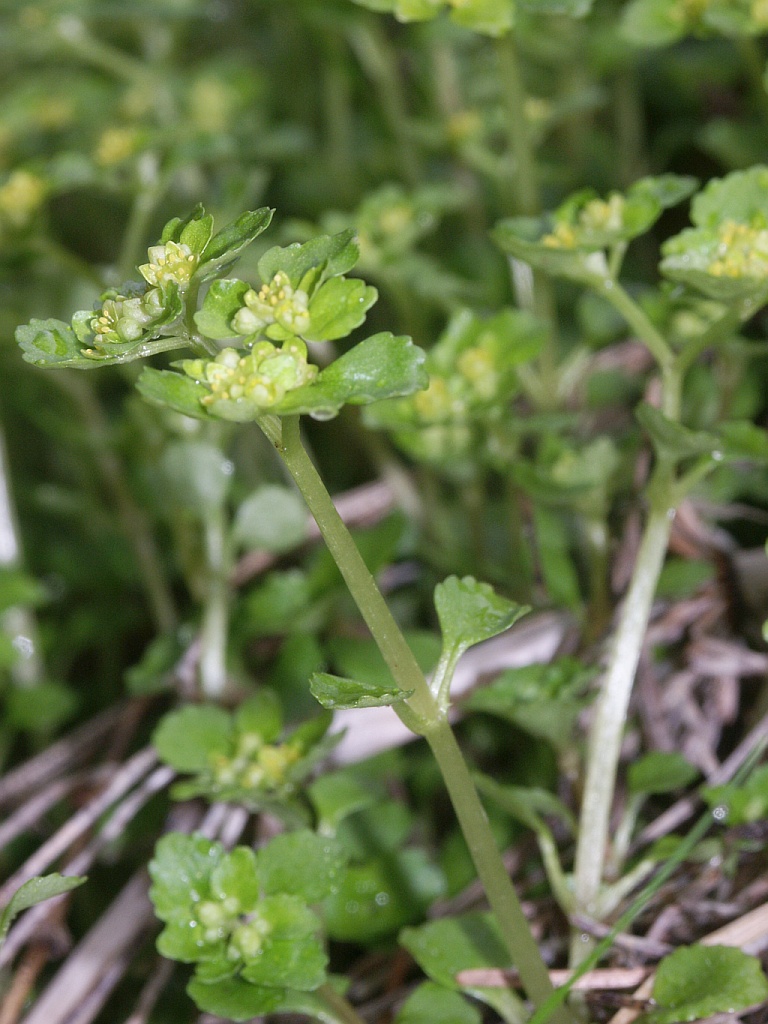
Photo: Wikimedia Commons, CC BY-SA 3.0 · source

Herbaceous plant · Saxifrage family (Saxifragaceae)
Opposite-leaved golden-saxifrage
Chrysosplenium oppositifolium
In other languages: Paarbladig goudveil (Nederlands) · Dorine à feuilles opposées (Français)
Grows wild in Belgium.
Opposite-leaved golden-saxifrage is a low, creeping little plant of springs, small streams and wet, shady woodland. It forms dense, fresh green mats where groundwater seeps out of the soil, usually on acid to neutral ground. In Flanders it is fairly rare and found mainly in spring-fed woods and stream valleys in hilly areas, such as the Flemish Ardennes and the Brabant hills; in the Ardennes it is more common. You can recognise it by its round, scalloped leaves set in opposite pairs and by its tiny golden-green flowers without petals, which glow among yellow-green bracts in early spring. It is a true spring plant: where it grows, you know there is clean, seeping water.
Caution: In Flanders opposite-leaved golden-saxifrage is fairly rare and grows in vulnerable spring-fed woods: do not pick it, never dig it up and do not trample the wet spring areas. Only buy plants from a nursery.
Light
Partial shade or shade
tolerates little sun
Moisture
Moist to wet
must not dry out
Hardiness
Fully hardy
down to -25 °C
Size
0.1 m
tall, 0.3 m wide
Flowering
March–May
| Height | 0.1 m |
|---|---|
| Native to Belgium | Yes |
| Flowering | March–May |
Identify
How to recognise it
- Habit
- Low, creeping perennial of 5–15 cm, forming dense mats with rooting stems.
- Leaf
- In opposite pairs, round to broadly oval, 1–2 cm, with a scalloped edge and a short stalk; fresh green with scattered hairs on top.
- Flower
- Tiny flowers of 3–4 mm without petals, with four yellow-green sepals and eight stamens, in flat clusters among yellow-green bracts; from March to May.
- Fruit/Seed
- An open, cup-shaped capsule with small, glossy seeds that are splashed out by raindrops.
- Stem
- Creeping and rooting at the nodes; the flower stems are short and ascending.
- Look-alikes
- Alternate-leaved golden-saxifrage has alternate, larger, kidney-shaped leaves on long stalks and brighter yellow bracts; it grows more often in limier places. Large bitter-cress and watercress, which grow in the same places, have pinnate leaves and white flowers.
Flowering: March–May
In your garden
Why grow it?
- It flowers as early as March–April, when little else is in flower in wet woodland: tiny flies, midges and small beetles visit the flowers.
- A typical plant of springs: it gives away places where clean groundwater seeps out of the soil.
- It forms a green mat that looks good for most of the year and covers wet, bare patches.
- A lovely ground cover for the wettest, shadiest corner of the garden, where almost nothing else will grow.
- The damp mats give shelter to small creatures such as tiny snails, woodlice and young amphibians.
- Its golden-green bracts give a soft glow along small streams in early spring.
Opposite-leaved golden-saxifrage: where does it grow best?
- In the wild by springs and seepages, along small streams, in wet spring-fed woods and alder carr, on wet rocks and banks.
- Shade to partial shade, under trees and shrubs.
- Soil that is always wet and rich in humus, preferably acid to neutral and with some flowing or seeping water.
- In the garden on a shady pond edge, beside a small stream or a little spring, or in a spot where rainwater from the roof keeps the soil wet.
Goes well with
- Large bitter-cress: White flowers with violet anthers in the same wet places, just after the golden-saxifrage.
- Marsh-marigold: Large, glossy yellow flowers in March–April at the water’s edge.
- Lady-fern: A delicate, fresh green fern for the wet shade above.
- Oxlip: Pale yellow flowers in March–April in the damp woodland next to it.
Maintenance
Opposite-leaved golden-saxifrage: when and how to plant it?
- Never dig up plants in the wild: it is fairly rare in Flanders. Buy them from a nursery for native plants or pond plants.
- Plant in March–April or in September–October, when the soil is wet and cool.
- Set the little plants 15–20 cm apart in wet soil, just above the waterline or in a spot that always stays moist.
- Firm them in well, so that the creeping stems touch the wet soil; they will then root quickly.
- After planting, keep the soil wet at all times and never let it dry out, even in summer.
- In autumn, remove thick layers of fallen leaves so that the low mats are not smothered.
Care
- Water
- Always keep it wet. In a spot without a spring or stream, give rainwater in dry spells, preferably not limy tap water.
- Feeding
- Not needed; feeding only makes the grasses and nettles around the plant stronger.
- Removing leaves
- In late autumn, lift thick layers of fallen leaves off the mats by hand.
- Competition
- Pull out taller plants such as nettles and grasses if they grow over the mats.
- Peace and quiet
- Do not walk on it: the mats and the wet soil are easily damaged by trampling.
Tip: Lead rainwater from a gutter to a shady, shallow hollow filled with gravel and humus: you create a mini spring where opposite-leaved golden-saxifrage and large bitter-cress feel at home.
Pruning and mowing
When: Not needed.
How:
- Leave the mats alone: they stay low by themselves.
- If needed, trim stems that creep over a path or stepping stone.
- Remove fallen leaves by hand rather than with a rake, to spare the mats.
Propagation
- Division
- In March–April or September: cut off a piece of the mat with roots and replant it straight away in a wet spot.
- Rooting stems
- The creeping stems root at the nodes; a small rooted piece establishes easily.
- Seed
- Sow fresh seed in summer on wet, bare soil in the shade and keep the seedbed constantly wet.
Opposite-leaved golden-saxifrage: how does it get through the winter?
Hardy to −25 °C.
- It stays largely green in mild winters; in hard frost the top leaves die back a little.
- Hardy to about −25 °C; seeping spring water rarely freezes.
- The first yellow-green bracts appear as early as February–March.
Diseases and pests
- Drying out: Brown, shrivelled mats in summer. Choose a spot that always stays wet, or give rainwater.
- Slugs and snails: They graze the young leaves. Usually not a big problem; the mat grows back.
- Being smothered: Grasses, nettles or a thick layer of leaves smother the low mats. Weed around them and remove the leaves.
- Too much sun: In full sun the leaves scorch and dry out. Plant it in the shade of trees or shrubs.
Through the year
- February: The first yellow-green bracts appear.
- March: Flowering begins. Plant or divide.
- April: Full flower: golden-green mats along the water.
- May: Last flowers; the cup-shaped fruits ripen.
- June: Raindrops splash out the seeds.
- July: Keep wet in dry weather.
- August: Keep wet; pull out plants that grow over the mats.
- September: Plant or divide.
- November: Lift fallen leaves off the mats.
You and this species
Did you know?
- Chrysosplenium comes from the Greek chrysos, gold, and splen, spleen: the plant was once associated with the spleen.
- The seeds are spread by raindrops: a falling drop splashes them out of the open, cup-shaped capsule some distance away.
- It belongs to the saxifrage family but, unlike most saxifrages, it has no petals: the golden-green colour comes from the sepals and the bracts.