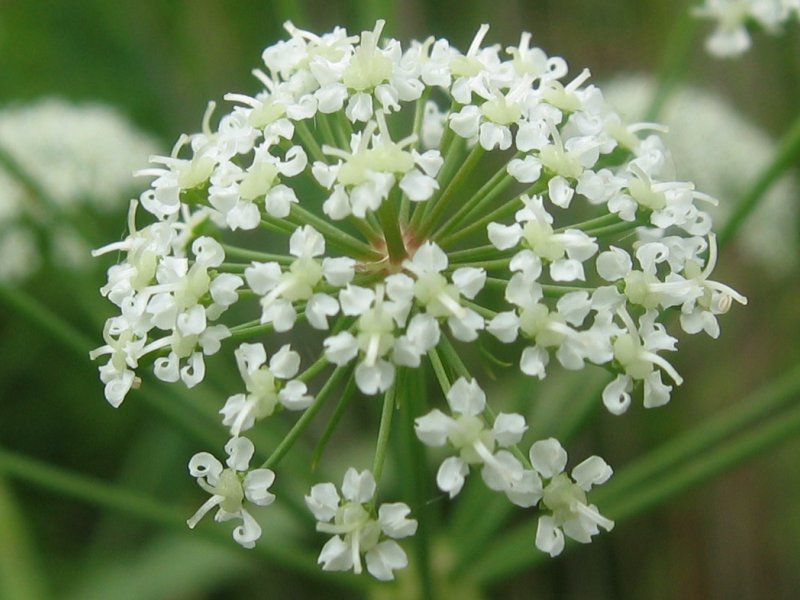
Photo: Kristian Peters -- Fabelfroh 09:00, 2 October 2006 (UTC), CC BY-SA 3.0 · source

Herbaceous plant · Carrot family (Apiaceae)
Cowbane
Cicuta virosa
In other languages: Waterscheerling (Nederlands) · Cicutaire vireuse (Français)
Grows wild in Belgium.
Cowbane is a perennial umbellifer of marshes, the banks of ponds and ditches, reedbeds and floating fens. In Belgium it is rare and found mainly in old marshland and along shallow banks that are slowly filling in. You can recognise it by its hollow, hairless stem, its two to three times pinnate leaves with narrow, sharply toothed segments and above all by its thick rootstock, which shows hollow chambers when cut open and releases a yellowish sap that smells of celery or parsnip. In July–August it carries large white umbels that attract many hoverflies, flies and beetles. It is one of the most poisonous plants in Europe: even a small piece of rootstock can kill a person or an animal.
Caution: Highly poisonous: cowbane is one of the most poisonous plants in Europe. All parts are poisonous, especially the rootstock; even a small piece can kill people and animals. Children, pets and grazing livestock such as cattle, horses and sheep are most at risk. Never eat wild umbellifers or roots: the rootstock smells of celery or parsnip and can be mistaken for them. Wear gloves for any work on the plant, wash your hands afterwards and do not plant it where children play or animals graze. It is rare in Belgium: never dig it up in the wild. If you suspect poisoning, call 112 or the Poison Centre straight away.
Light
Sun or partial shade
preferably some sun
Moisture
Moist to wet
must not dry out
Hardiness
Fully hardy
down to -30 °C
Size
1 m
tall, 0.5 m wide
Flowering
July–August
| Pruning months | March |
|---|---|
| Height | 1 m |
| Native to Belgium | Yes |
| Flowering | July–August |
Identify
How to recognise it
- Habit
- Robust perennial of 50–150 cm with an upright, branched, hollow, hairless and grooved stem, often standing in water.
- Leaf
- Large, two to three times pinnate, with narrow, lance-shaped, sharply toothed segments of 2–10 cm; hairless and fresh green.
- Flower
- Small white flowers in large, domed umbels with 10–30 rays, without bracts below the main umbel but with many narrow bracteoles under the smaller umbels; in July–August.
- Fruit/Seed
- Small, almost globe-shaped, hairless fruits of about 2 mm with broad, flat ridges.
- Roots
- A thick, tuber-like rootstock that shows hollow chambers with cross walls when cut open and releases a yellowish sap smelling of celery or parsnip. This is the most poisonous part.
- Look-alikes
- Greater water-parsnip has once-pinnate leaves with broad, toothed leaflets and no chambered rootstock. Hemlock grows in drier places and has a purple-spotted stem and a mousy smell. Wild celery and parsnip smell similar but have a different leaf shape: mistaking the rootstock for them can be fatal.
Flowering: July–August · Pruning: March
In your garden
Why grow it?
- Large white umbels in July–August full of hoverflies, flies, beetles and wasps.
- A rare, characteristic plant of banks that are filling in and of floating fens, which are precious and vulnerable marsh habitats.
- The hollow stems give insects shelter among the reeds in winter.
- A plant to know well: anyone who recognises it avoids deadly mix-ups with edible umbellifers.
- An impressive sight at the water’s edge, up to 1.5 m tall, with finely cut leaves.
Cowbane: where does it grow best?
- In the wild in marshes, reedbeds, floating fens, alder carr and along the shallow banks of ponds, lakes and ditches.
- Often with its base in shallow water or on floating mats of vegetation.
- Sun to light partial shade.
- Wet, nutrient-rich, peaty or silty soil.
- In a garden only suitable for a large wildlife pond with a shallow marsh zone, well away from places where children play or animals graze.
Goes well with
- Yellow iris: Yellow flowers in May–June in the same shallow marsh zone.
- Purple-loosestrife: Purple spikes in July–August next to the white umbels.
- Bogbean: White, fringed flowers in spring in the shallow water.
- Marsh cinquefoil: Dark red flowers on floating mats, just as in floating fens.
Maintenance
Cowbane: when and how to plant it?
- Think carefully about whether you want it at all: only plant cowbane by a large wildlife pond that is fenced off from small children, pets and livestock.
- Never dig up plants in the wild, where it is rare: buy them from a specialist nursery for native water plants.
- Plant in April–May in the shallow marsh zone, with the base in 0–20 cm of water, 50 cm from other plants.
- Wear gloves when planting, do not touch the rootstock with bare hands and wash your hands afterwards.
- Put a clear label next to the plant, so that nobody mistakes it for an edible umbellifer.
- No watering is needed as long as the marsh zone stays wet.
Care
- Water
- It must always stand wet; in a dry summer top up the pond with rainwater.
- Feeding
- Not needed; the silt in a pond contains enough nutrients.
- Let it seed
- It self-seeds on wet banks. Cut off the umbels after flowering, wearing gloves, if you do not want new plants.
- Safety
- Always work with gloves. Never leave plant remains in a field or near animals; dispose of them with the green waste.
- Filling in
- Keep the marsh zone open by thinning reeds and bulrushes every few years.
Tip: Learn to recognise cowbane by its narrow, sharply toothed leaflets and its large white umbels at the water’s edge, and never cut into the rootstock without gloves. When in doubt: do not touch it and do not pick it.
Pruning and mowing
Pruning months: March.
When: In March: only then cut away the dead stems, so that they give insects shelter in winter.
How:
- Cut the old stems just above the water, always wearing gloves.
- If you do not want seedlings, cut off the umbels in August, before the fruits ripen.
- Do not leave plant remains in the pond or in a field.
- After the work, wash your hands and your secateurs.
Caution: During maintenance, never dig into the rootstock without gloves: it is the most poisonous part of the plant.
Propagation
- Seed
- Sow fresh seed in autumn in a tray of wet, silty soil left outdoors: it germinates after winter. Wear gloves.
- Division
- In spring, cut off a piece of rootstock with a bud and plant it in the marsh zone, always wearing gloves.
- Spread by water
- The small fruits can float and spread along the bank; bear this in mind with a pond that connects to a stream or ditch.
Cowbane: how does it get through the winter?
Hardy to −30 °C.
- Leaves and stems die back in autumn; the plant overwinters as a thick rootstock in the wet silt.
- Fully hardy, to about −30 °C.
- The hollow, dead stems give insects shelter among the reeds.
- The rootstock stays poisonous in winter too: take care when clearing silt from the pond.
Diseases and pests
- Toxicity: All parts, and especially the rootstock, are highly poisonous. Keep children, dogs and livestock away from the plant.
- Mix-ups: The rootstock smells of celery or parsnip. Never eat wild umbellifers or roots that you do not know for certain.
- Clearing silt: When cleaning out a pond, pieces of rootstock can come up. Work with gloves and never spread the silt on a field.
- Aphids: On young umbels. Ladybirds and hoverfly larvae clear them up.
- Being crowded out: Reeds and bulrushes can overwhelm it. Thin them out every few years.
Through the year
- March: Cut away dead stems, wearing gloves.
- April: New leaves appear. Plant in the marsh zone.
- May: Plant. Keep the marsh zone wet.
- June: The flower stems grow.
- July: Flowering begins: large white umbels.
- August: Full flower, hoverflies on the umbels. Cut off umbels before they set seed if you wish.
- September: The fruits ripen. Sow in a tray.
- October: The leaves die back.
- November: Leave the hollow stems for insects.
You and this species
Did you know?
- The English name cowbane means roughly cow’s death: livestock that eat the plant can die from it.
- The hemlock used to execute Socrates in ancient Athens was not this species but hemlock, Conium maculatum.
- The poison in cowbane is called cicutoxin and acts on the nervous system.