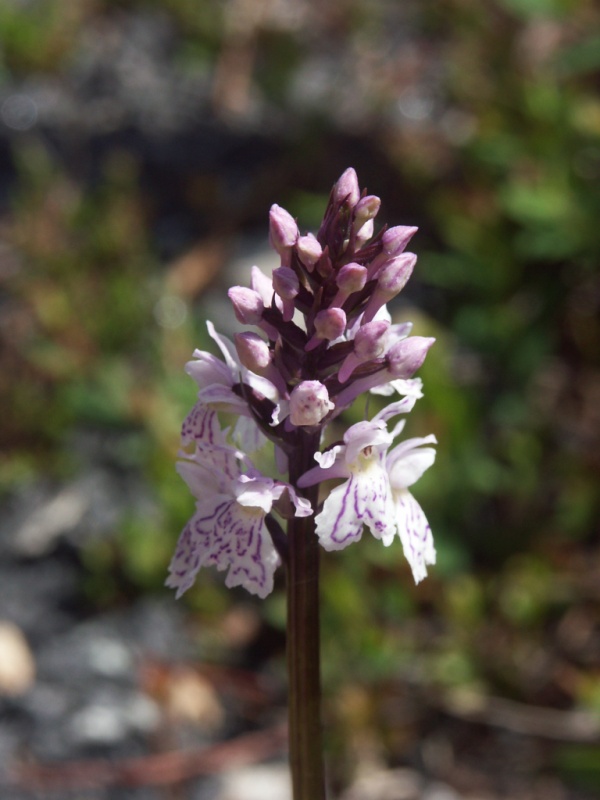
Photo: Wikimedia Commons, CC BY-SA 3.0 · source

Herbaceous plant · Orchid family (Orchidaceae)
Heath spotted-orchid
Dactylorhiza maculata
In other languages: Gevlekte orchis (Nederlands) · Orchis tacheté (Français)
Grows wild in Belgium.
The heath spotted-orchid is a native orchid of damp, acid and very nutrient-poor soil: wet heath, acid grassland, purple moor-grass meadows and the edges of bogs. In Belgium it is rare and has declined sharply; you mainly still find it in the Campine and the Ardennes. It looks like the common spotted-orchid, but its flowers are paler, white to pale lilac with fine purple dots and dashes, and the lip is broad and rounded, with a small middle lobe. The leaves are narrow and usually finely spotted. It flowers in June–July, is a sign of intact nature and, like all wild orchids, it is protected.
Caution: Protected and rare species: like all wild orchids, the heath spotted-orchid must not be picked or dug up. Only buy nursery-raised plants from a specialist grower. Wild plants that are dug up almost always die anyway.
Light
Sun or partial shade
preferably some sun
Moisture
Normal to wet
must not dry out
Hardiness
Fully hardy
down to -25 °C
Size
0.3 m
tall, 0.15 m wide
Flowering
June–July
| Pruning months | September |
|---|---|
| Height | 0.3 m |
| Native to Belgium | Yes |
| Flowering | June–July |
Identify
How to recognise it
- Habit
- Perennial orchid, 15–40 cm tall, sometimes taller, with a slender, solid stem. Underground there are hand-shaped, divided tubers.
- Leaf
- Narrowly lance-shaped and pointed, usually with small, round to oval dark spots; the lower leaves are narrower than in the common spotted-orchid.
- Flower
- In June–July a fairly short spike, pyramidal at first, later more rounded, white to pale lilac, finely dotted and streaked with purple. The lip is broad and rounded, with a small, short middle lobe that barely or does not project beyond the side lobes.
- Fruit
- Elongated capsules with thousands of dust-like seeds.
- Roots
- Two hand-shaped, divided tubers and a few thin roots, which live together with fungi in the soil.
- Confused with
- Common spotted-orchid grows on chalky to neutral soil and has a deeply three-lobed lip with a large, pointed middle lobe, and broader, blunt lower leaves. The two species sometimes hybridise.
Flowering: June–July · Pruning: September
In your garden
Why grow it?
- A graceful orchid with pale, finely marked flowers: a jewel of wet heath and acid grassland.
- A characteristic species of poor, acid and damp soil: where it grows, nature is still in good condition.
- Bumblebees, bees and flies visit the flowers; like the common spotted-orchid it attracts pollinators without offering nectar.
- It belongs to a rich plant community that includes cross-leaved heath, tormentil and devil’s-bit scabious.
- In a damp heather garden you can recreate a small piece of heathland with nursery-raised plants.
Heath spotted-orchid: where does it grow best?
- In the wild: wet and damp heath, acid grassland, purple moor-grass meadows, bog edges and open spots in damp, acid woodland.
- Sun to light partial shade.
- Damp to wet, acid and very nutrient-poor soil: sand or peat.
- In the garden: only suitable for a damp heather garden or a wet, poor area with acid soil; it does not survive in ordinary garden soil.
Goes well with
- Cross-leaved heath: Pink bells in summer on the same wet, acid soil.
- Tormentil: Small yellow stars between the orchids.
- Devil’s-bit scabious: Blue pompons in late summer and food plant of the marsh fritillary.
- Marsh gentian: Deep blue trumpets in August–September; also rare, so only nursery-raised plants.
- Heather: Pink flowers in late summer on the slightly drier edges.
Maintenance
Heath spotted-orchid: when and how to plant it?
- Only buy heath spotted-orchids from a specialist nursery that raises them from seed; never take them from the wild.
- Choose a spot with acid, poor soil that stays moist all year, such as a wet heather garden. Do not add compost or potting compost.
- Plant in September–October or in March, at the same depth as in the pot, keeping the root ball intact: it holds the soil fungi.
- Plant a few 15–20 cm apart among low heathland plants, not in tall grass.
- Water with rainwater if the soil dries out in spring; tap water is often too limy.
- Never dig up plants from the wild: wild orchids are protected and plants that are dug up almost always die.
Care
- Water
- Keep the soil moist with rainwater; never let it dry out in May–June.
- Feeding
- Never: even a little fertiliser or compost makes the soil too rich.
- Mowing
- Mow in September, after seed set, and remove the cuttings.
- Encroachment
- Keep invading grasses, birch, pine and brambles in check, so the spot stays open and light.
- Patience
- Plants do not flower every year. New plants from seed need several years.
Tip: Always use rainwater and never compost for a heath spotted-orchid: it lives on acid, very poor soil, and the lime or nutrients in tap water and compost soon make the spot unsuitable.
Pruning and mowing
Pruning months: September.
When: No pruning. Mow in September, after seed set.
How:
- Leave the spent spikes until the capsules are brown and open.
- Then mow and remove the cuttings, to keep the soil poor.
- Mark the plants with a stick so you do not mow them by mistake.
- Pull up young birch and pine before they start to cast shade.
Caution: Do not mow over the plants in May–August: you would lose that year’s flowers and seed.
Propagation
- Seed
- In the wild it spreads by dust-like seed that only germinates with the right soil fungus. Let the capsules ripen; in a good spot new plants appear after a few years.
- Laboratory
- Nurseries sow orchids in a laboratory on a nutrient medium. This does not work at home, and division is not recommended.
Heath spotted-orchid: how does it get through the winter?
Hardy to −25 °C.
- After seed set the plant dies back above ground and overwinters as a tuber.
- Hardy; a wet winter is no problem in a spot that is naturally wet.
- In April–May the new leaves appear.
Diseases and pests
- Drying out: The biggest threat: in a dry spring it declines. Keep the spot moist and water with rainwater.
- Enrichment: Fertiliser, compost or limy water make the soil unsuitable. Use only rainwater and always remove the cuttings.
- Encroachment: Grasses, birch and brambles overgrow the spot. Mow every year and pull up tree seedlings.
- Slugs: They eat young shoots and buds. Check in the evening in spring and remove them.
- Failed transplanting: Plants dug up lose their soil fungi and almost always die. Only buy nursery-raised plants.
Through the year
- March: Plant nursery-raised plants. Check that the soil is moist.
- April: The first leaves appear. Watch out for slugs.
- May: The flower spike grows. In dry weather, water with rainwater.
- June: Flowering. Look and photograph, do not pick.
- July: Last flowers; the capsules ripen.
- August: The seed disperses.
- September: Mow and remove the cuttings. Plant nursery-raised plants.
- October: Remove young birch and brambles.
You and this species
Did you know?
- Maculata means ‘spotted’ and refers to the dark spots on the leaves.
- The common spotted-orchid was long regarded as a subspecies of the heath spotted-orchid; today most botanists treat them as two species.
- As in all orchids, the seed is as fine as dust and only germinates with the help of a soil fungus.