Photo: Jensflorian, CC BY-SA 3.0 · source

Herbaceous plant · Plantain family (Plantaginaceae)
Foxglove
Digitalis purpurea
In other languages: Vingerhoedskruid (Nederlands) · Digitale pourpre (Français)
Grows wild in Belgium.
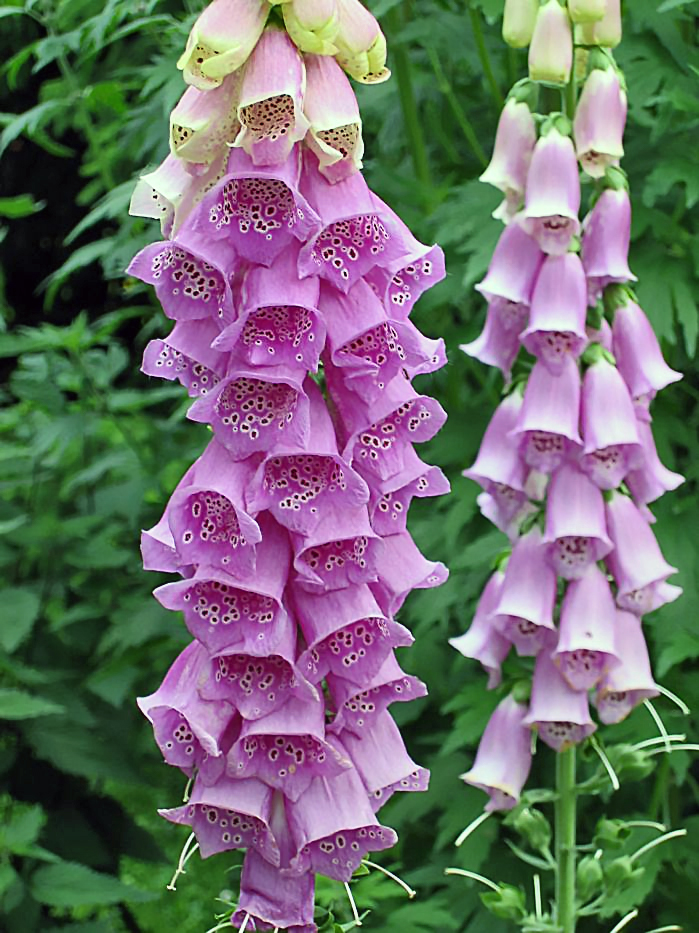
Foxglove is a stately biennial whose long spikes of purple-pink bells tower over woodland clearings in June and July. It grows on acid loamy or sandy soil: in felled areas, woodland edges, sunken lanes and heaths, mainly in the Ardennes and more scattered elsewhere in the country. You can recognise it by its large rosette of soft, downy leaves and its one-sided spike of drooping, thimble-shaped flowers, spotted inside with dark marks ringed in white. Bumblebees climb right inside the flowers to reach the nectar. It is beautiful in a woodland garden, but every part of the plant is highly poisonous.
Caution: Highly poisonous: every part, including the seeds. Even small amounts are dangerous to children, dogs, cats, horses and livestock. Don’t plant it where small children play or animals graze, wear gloves when handling it, and never mistake its leaves for comfrey.
Light
Sun or partial shade
preferably some sun
Moisture
Normal
no wet feet
Hardiness
Fully hardy
down to -25 °C
Size
1.2 m
tall, 0.4 m wide
Flowering
June–August
| Pruning months | August |
|---|---|
| Height | 1.2 m |
| Native to Belgium | Yes |
| Flowering | June–August |
Identify
How to recognise it
- Habit
- Biennial (sometimes living a few years): a large leaf rosette in the first year, one or a few upright flowering stems of 1–1.5 m, sometimes up to 2 m, in the second.
- Leaf
- Large, oval to lance-shaped, 15–30 cm, with scalloped edges, wrinkled and softly downy, especially on the grey-green underside.
- Flower
- Dozens of drooping, tubular bells 4–5 cm long on one side of the stem, purple-pink, rarely white. Inside, dark purple spots ringed with white, and hairs. They open from the bottom upwards.
- Fruit/Seed
- Egg-shaped capsules full of tiny, dust-like seeds that are spread by wind and rain and stay viable in the soil for years.
- Stem
- Round, sturdy, unbranched and covered in soft down.
- Look-alikes
- The rosette resembles that of comfrey, but comfrey has rough, bristly hairs and no felty underside; this mix-up has caused serious poisonings. Mulleins have thicker, woollier leaves and yellow flowers. Small yellow foxglove has small, pale yellow flowers and grows on limestone.
Flowering: June–August · Pruning: August
In your garden
Why grow it?
- One of the best plants for bumblebees: the large bells are exactly their size, and they crawl right inside.
- Spectacular 1–1.5 m spikes for half shade, where few other wild plants flower so tall and so colourfully.
- Seeds itself and so brings surprises every year to a woodland garden or a hedge bank.
- A typical plant of woodland clearings: it appears in great numbers when the wood is opened up, from seed that has waited in the soil for years.
- The leaf rosette is a fine green accent in winter too.
Foxglove: where does it grow best?
- In the wild: felled areas, clearings and edges of broadleaved and conifer woods, sunken lanes, heath edges and banks.
- Half shade or light shade is ideal; in full sun it does well if the soil doesn’t dry out.
- Acid to neutral, humus-rich, loose soil: sand or loam. It does less well on chalky soil.
- In the garden: a woodland edge, a hedge bank, under tall trees or at the back of a border in half shade.
- Moist but free-draining soil; in waterlogged clay the rosettes rot in winter.
Goes well with
- Male fern: Fresh green fronds at its feet, in the same half shade.
- Honeysuckle: Climbs through the woodland edge behind and scents the evening air.
- Rosebay willowherb: Another plant of woodland clearings, with pink spikes in July–August.
- Columbine: Flowers just before the foxglove and also seeds itself.
- Wood anemone: A white carpet in spring, long before the bells appear.
Maintenance
Foxglove: when and how to plant it?
- Buy young plants or seed of the wild species from a native plant nursery. Never dig plants up from the wild.
- Sow from May to July in pots or a seed tray: scatter the fine seed on moist compost and don’t cover it, as it needs light to germinate.
- Keep moist; seedlings appear after 2–3 weeks. Prick them out into individual pots as soon as you can handle them.
- Plant the rosettes out in their final position in September–October, 30–45 cm apart and preferably in small groups.
- Prefer to sow directly? Do it in autumn on a bare, loosened patch and let nature take its course.
- Water during dry spells in the first few weeks. It will flower the following year.
Care
- Water
- Only in dry spells, especially for young rosettes. An established plant in half shade looks after itself.
- Feeding
- Not needed. A layer of leaf mould in autumn keeps the soil loose and rich in humus.
- Self-seeding
- Let a few stems ripen their seed: that way you get new plants every year, as the mother plant dies after flowering.
- Bare patches
- Seedlings only germinate on bare or loose soil. In autumn, rake open a small patch around the old plants.
- Thinning seedlings
- In autumn or spring, pull out seedlings that are too crowded, wearing gloves; leave 30–45 cm between plants.
Tip: Sow two years running, or let seed fall every year: then you will always have both rosettes and flowering plants, with no ‘gap year’ in the flowering.
Pruning and mowing
Pruning months: August.
When: After flowering, in August, once the seed has dropped.
How:
- If you want it to self-seed, leave the stems until the capsules are brown and open, then cut them off.
- If you cut the main stem just after flowering, the plant sometimes produces smaller side spikes and may live another year.
- Pull up spent, dead plants roots and all and put them on the compost heap.
Caution: Wear gloves when cutting and pulling up plants and wash your hands afterwards: every part is poisonous.
Propagation
- Seed
- Sow from May to July without covering (it needs light to germinate). Plant out in autumn; flowers the following year.
- Self-seeding
- The easiest way: let seed fall and move the young rosettes to where you want them in autumn.
Foxglove: how does it get through the winter?
Hardy to −25 °C.
- In its first year it overwinters as a leaf rosette that nearly always stays green.
- After flowering and setting seed in its second year, the plant usually dies.
- Hardy to about −25 °C; in winter, wet, poorly drained soil is a bigger danger than frost.
Diseases and pests
- Disappears after flowering: Normal for a biennial. Let seed fall every year or sow some yourself, and you will always have flowering plants.
- Slugs: Nibble young rosettes in spring and autumn. Established plants suffer little.
- Leaf spot: Brown spots on older leaves in wet weather. Remove affected leaves and keep plenty of air around the plants.
- Aphids: Sometimes on the flower stems. Ladybirds usually clear them up.
- Poisoning: Children, dogs and cats may put leaves or flowers in their mouths. Don’t plant it where small children play or where animals graze.
Through the year
- March: Rosettes start growing again. Thin out crowded seedlings.
- May: Flower stems shoot up. You can sow in pots from now on.
- June: Flowering begins. Bumblebees crawl into the bells.
- July: Full flower. Sow for flowers next year.
- August: Last flowers; seed ripens. Cut down stems that have shed their seed.
- September: Plant out rosettes 30–45 cm apart. Rake open bare patches for seedlings.
- October: You can still plant. Leaf mould around the rosettes.
- December: Green rosettes in winter.
You and this species
Did you know?
- The name Digitalis comes from the Latin digitus, finger: the flowers fit over a fingertip like a thimble. The German botanist Leonhart Fuchs gave it this name in 1542.
- The spots inside the flower act as a runway: they guide bumblebees to the nectar, and on the way the bee pollinates the flower.
- Foxgloves often appear in great numbers in a felled woodland: the seed survives in the soil for years and germinates as soon as light reaches the ground again.