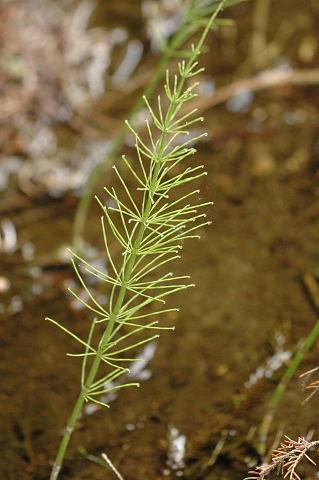
Photo: James K. Lindsey, CC BY-SA 3.0 · source

Fern · Horsetail family (Equisetaceae)
Marsh horsetail
Equisetum palustre
In other languages: Lidrus (Nederlands) · Prêle des marais (Français)
Grows wild in Belgium.
Marsh horsetail is a small, slender horsetail of wet grasslands, marshes, ditch banks, wet dune slacks and riverbanks. In Belgium it is fairly common in wet places, from the polders and river valleys to the Campine and the Ardennes. You recognise it by its thin, deeply grooved green stems of 20–60 cm, with regular whorls of a handful of side branches, and its loose sheaths with black, white-edged teeth. The blunt spore cone sits at the tip of an ordinary green stem, sometimes on the side branches too. It is the most poisonous native horsetail and notorious among farmers in hay meadows, but in a wildlife garden it belongs to true wet grassland, together with marsh marigold and ragged-Robin.
Caution: Poisonous to grazing animals, especially horses and cattle, even when dried in hay or silage. Do not plant it near pastures or hay meadows and never use cuttings containing it as fodder or bedding. Not edible. Never dig up plants from the wild.
Light
Sun or partial shade
preferably some sun
Moisture
Normal to wet
must not dry out
Hardiness
Fully hardy
down to -30 °C
Size
0.5 m
tall, 0.5 m wide
| Pruning months | March and September |
|---|---|
| Height | 0.5 m |
| Native to Belgium | Yes |
Identify
How to recognise it
- Growth form
- Flowerless perennial with slender, upright green stems from a deep, creeping rhizome; grows in loose groups.
- Stem
- 20–60 cm tall and 1–3 mm thick, with 5–10 deep ridges; the central hollow is small. Regular whorls of side branches angled upwards, sometimes unbranched.
- Leaf
- Fused into loose, slightly flared green sheaths around the nodes, with 4–12 black teeth with a broad, white, papery edge.
- Spores
- In May–July a blunt, blackish spore cone of 1–3 cm at the tip of an ordinary green stem, sometimes on the side branches too; there are no separate fertile stems.
- Roots
- Black, branched rhizomes that can go deep into the wet soil; broken pieces regrow.
- Confusion with
- Field horsetail grows on drier ground, has separate brown fertile stems in March–April, and the first segment of its side branches is longer than the stem sheath; in marsh horsetail it is shorter. Water horsetail is much thicker, smooth and almost entirely hollow.
Pruning: March and September
In your garden
Why grow it?
- It belongs to species-rich wet hay meadows and marshes, and indicates wet soil with a high water table.
- A fine, graceful structure among marsh plants and grasses at a pond edge or in a wet corner.
- The groups of stems and the wet ground beneath them shelter frogs, toads and other small animals.
- A living fossil: horsetails have existed for hundreds of millions of years and are related to the tree-sized plants of the coal forests.
- In a wildlife garden with a wet corner it often turns up by itself, a sign that the ground really is wet.
Marsh horsetail: where does it grow best?
- In the wild: wet hay meadows and pastures, marshes, ditch banks, wet dune slacks, riverbanks and wet woodland edges.
- Wet to waterlogged soil with a high water table, from clay and loam to sand and peat.
- Sun to partial shade.
- In the garden: only suitable for a wet meadow corner, a bog area or a pond edge, well away from pastures and from hay for animals.
Goes well with
- Marsh marigold: Golden-yellow flowers in April in the same wet meadow.
- Cuckooflower: Lilac flowers in April–May and a food plant for the orange-tip butterfly.
- Ragged-Robin: Pink, ragged flowers in May–June among the fine stems.
- Water forget-me-not: Sky-blue little flowers along the wet edge, all summer long.
Maintenance
Marsh horsetail: when and how to plant it?
- Think carefully: marsh horsetail is poisonous to livestock. Do not plant it in or next to a pasture or hay meadow whose grass goes to animals.
- Never dig up plants from the wild. Ask at a nursery for native aquatic and marsh plants; in a wet wildlife garden it also often appears by itself.
- Plant in April–May in wet soil at the pond edge or in a bog area, in a planting basket if you want to contain it.
- Set the rhizome 3–5 cm deep and firm the soil well; allow 3–5 plants per square metre.
- Keep the soil wet throughout the first year.
Care
- Water
- The soil must stay wet; in a bog area or by a pond this takes care of itself.
- Feeding
- Not needed: on wet, poor soil the vegetation stays rich in species.
- Mowing
- Mow a wet meadow corner once a year in September, or in July and September, and remove the cuttings. Never use them as fodder or bedding for animals.
- Spreading
- It spreads slowly by deep rhizomes. Keep pulling out stems beyond where you want it: this weakens the rhizome.
- Old stems
- Leave them standing in winter as shelter and cut them in March.
Tip: Not sure whether it is marsh horsetail or field horsetail? Look at the lowest segment of a side branch: if it is shorter than the sheath on the stem beside it, it is marsh horsetail.
Pruning and mowing
Pruning months: March and September.
When: In September when mowing the wet corner; at the pond edge, cut the old stems in March.
How:
- Mow or cut the stems just above the ground and remove the cuttings.
- In the wet corner, always leave an uncut strip as a refuge for small animals.
- Put the cuttings, without rhizomes, on the compost heap, never with hay or bedding for animals.
- At the pond edge: in March, cut the old brown stems before the new ones appear.
Caution: Marsh horsetail stays poisonous when dried in hay: never give cuttings containing it to horses, cattle or other plant-eating animals.
Propagation
- Dividing the rhizome
- In April–May, dig off a piece of rhizome with young stems and replant it straight away in wet soil.
- Spores
- In May–July. The green spores stay viable for only a short time; scatter them at once on wet, bare soil. Tricky and slow.
Marsh horsetail: how does it get through the winter?
Hardy to −30 °C.
- The stems die back in autumn; the plant overwinters as a rhizome deep in the wet soil.
- Fully hardy, to about −30 °C.
- Leave the old stems and part of the wet meadow standing in winter as shelter for small animals.
- In April the new green stems come up again.
Diseases and pests
- Poisonous to livestock: The biggest problem in hay meadows: even dried, it stays harmful. Keep it out of hay and pasture, and dispose of the cuttings separately.
- Spreading: The rhizomes go deep and are hard to dig out. Plant it in a basket or keep pulling out new stems.
- Drying out: When the water table drops, it disappears or stays small. It really needs a wet spot.
- Confusion with field horsetail: Field horsetail is a persistent weed in vegetable gardens and on drier ground. Look at the side branches and the sheaths to tell them apart.
Through the year
- March: Cut old stems at the pond edge.
- April: New stems come up. Plant or divide.
- May: Spore cones at the stem tips.
- June: Spores. Pull out stems beyond where you want them.
- July: Last spore cones. Keep the soil wet in dry spells.
- September: Mow the wet corner and remove the cuttings, never as fodder.
- October: The stems discolour and die back.
- December: Resting underground.
You and this species
Did you know?
- Its Dutch name, lidrus, means ‘jointed rush’: the stem is made of segments that you can pull apart at the nodes.
- Palustre means ‘of the marsh’.
- The poisonous substance in marsh horsetail is not broken down by drying: that is why it stays harmful in hay, unlike buttercups, for example, which become harmless once dried.