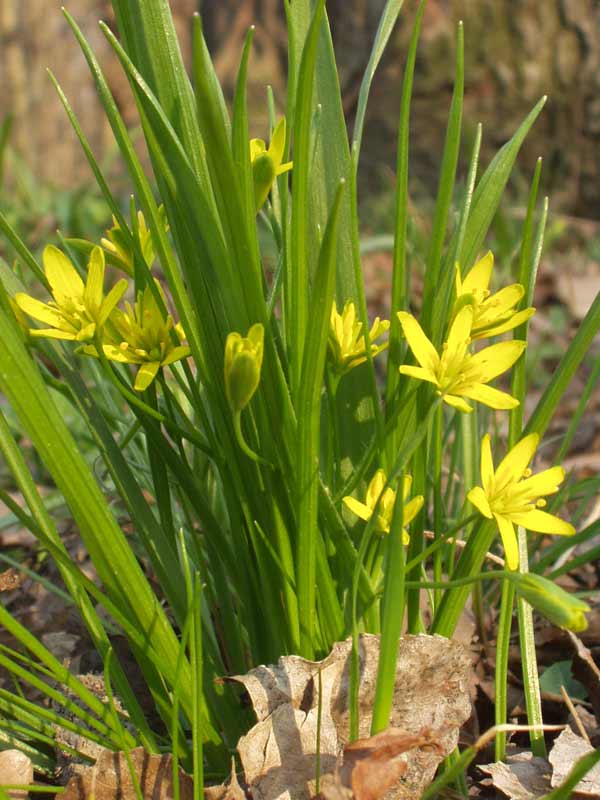
Photo: Wikimedia Commons, CC BY-SA 2.5 · source

Herbaceous plant · Lily family (Liliaceae)
Yellow star-of-Bethlehem
Gagea lutea
In other languages: Bosgeelster (Nederlands) · Gagée jaune (Français)
Grows wild in Belgium.
Yellow star-of-Bethlehem is a small native bulb of damp, nutrient-rich deciduous woodland, hedgerows and old parks, often in river and stream valleys. In Belgium it is fairly rare and typical of ancient woodland, mainly on loam and clay. In March and April, before the trees come into leaf, a small umbel of 1–7 yellow, star-shaped flowers appears above a single broad, glossy basal leaf. The outside of the petals is green, so when the flowers close in dull weather they become almost invisible. After flowering the plant withdraws into its bulb, and by June there is nothing left to see above ground.
Caution: A rare woodland plant: never dig it up or pick it in the wild. Only buy bulbs from a grower.
Light
Partial shade or shade
tolerates little sun
Moisture
Normal to wet
must not dry out
Hardiness
Fully hardy
down to -30 °C
Size
0.15 m
tall, 0.1 m wide
Flowering
March–April
| Height | 0.15 m |
|---|---|
| Native to Belgium | Yes |
| Flowering | March–April |
Identify
How to recognise it
- Habit
- Small bulbous plant, 10–25 cm tall, with a single basal leaf and a flowering stem topped by a small umbel.
- Leaf
- A single linear basal leaf 7–15 mm wide, flat, glossy and somewhat fleshy, with a hooded tip. Two leaf-like bracts sit just below the flowers.
- Flower
- In March–April 1–7 star-shaped flowers 1.5–2.5 cm across, with six petals: bright yellow inside, green outside. They open mainly in sunny weather.
- Fruit/Seed
- A small, three-angled capsule; often little or no seed is formed.
- Roots
- A small bulb, often surrounded by bulbils, which are its main way of multiplying.
- Look-alikes
- Lesser celandine has glossy, heart-shaped leaves and flowers with 8–12 petals. Meadow gagea grows in open, sandy places and has narrower, channelled leaves. When not in flower the leaf resembles that of wild garlic, but wild garlic has broader leaves that smell of garlic.
Flowering: March–April
In your garden
Why grow it?
- One of the first woodland flowers: the yellow stars in March–April feed early bees, flies and other insects.
- Typical of ancient woodland and hedgerows: where it grows, there has often been woodland for a very long time.
- It takes up no space: after flowering it disappears below ground, leaving the spot to other plants in summer.
- Perfect in a woodland garden or under a hedge, together with other spring flowers.
- A modest but special plant for anyone who likes to bring rare woodland flora into the garden.
Yellow star-of-Bethlehem: where does it grow best?
- In the wild: damp, nutrient-rich deciduous woodland, floodplain woods, woods on slopes, hedgerows and old parks, often with wood anemone and lesser celandine.
- It likes soil that is moist in spring: loam or clay, rich in humus, neutral to slightly chalky.
- In the garden: under deciduous trees or shrubs that still let light through in spring, in partial to full shade.
- Leave fallen leaves in place: in woodland it grows in a leaf litter that keeps the soil moist and open.
Goes well with
- Wood anemone: White flowers at the same time, on the same humus-rich woodland soil.
- Lesser celandine: Shiny yellow flowers in March–April; it also disappears in summer.
- Oxlip: Pale yellow flowers in April, in damp woods and hedgerows.
- Moschatel: A small green woodland plant that flowers in the same spring and also vanishes in summer.
- Hazel: A shrub that lets light through in spring and keeps the soil cool in summer.
Maintenance
Yellow star-of-Bethlehem: when and how to plant it?
- Never dig up bulbs in the wild: the species is rare and the bulbs are tiny and easily damaged.
- Buy bulbs or potted plants from a nursery specialising in native plants or a specialist bulb grower. They are not widely available, so look for a reliable supplier.
- Plant bulbs in September–October, 5–8 cm deep, in small groups 5–10 cm apart.
- Plant potted plants after flowering or in autumn, at the same depth as in the pot, with the root ball intact.
- Mix a little leaf mould into the soil and water after planting.
- Be patient: it often takes a few years before the plants flower well.
Care
- Watering
- Only after planting and in a dry spring. In summer it is dormant and needs no water.
- Feeding
- Do not feed; a layer of fallen leaves or leaf mould in autumn is enough.
- Let it die back
- Let the leaf yellow and wither naturally after flowering; this is how the bulb restocks its reserves.
- Mowing
- If it grows in grass, do not mow until June, when the leaf has gone.
- Leave undisturbed
- Do not dig or hoe the spot: the bulbs are shallow and invisible in summer.
Tip: Plant it among wood anemones and lesser celandine under a hazel or another deciduous shrub: there it gets light in spring and the soil stays cool in summer.
Pruning and mowing
When: Not needed: the plant disappears below ground by itself by June.
How:
- Never cut off the leaf while it is still green; let it die back completely.
- Do not mow or rake the spot until June.
- Leave fallen autumn leaves as a natural mulch.
Caution: Mowing too early weakens the bulbs: after a few years they stop flowering.
Propagation
- Bulbils
- The main method. Small bulbils form around the main bulb. Carefully separate them in June–July, once the leaf has died back, and replant them straight away 5 cm deep.
- Seed
- Little seed is produced. If you have some, sow it as soon as it is ripe in a pot of humus-rich compost and leave it outside over winter. Flowering only after several years.
Yellow star-of-Bethlehem: how does it get through the winter?
Hardy to −30 °C.
- From June until late winter there is nothing to see above ground: the bulb is resting in the soil.
- In February, sometimes as early as January, the leaf emerges; it tolerates frost and snow.
- Fully hardy, even in severe frost.
Diseases and pests
- Few flowers: Many plants produce only a leaf and no flowers; this is normal for this species. In a spot that is too dark or dry it flowers even less.
- Slugs: They may nibble leaves and flowers. Damage is usually limited; a natural garden with hedgehogs and ground beetles helps.
- Dug up by accident: In summer you cannot see it. Mark the spot with a stick or a stone.
- Smothered: Dense evergreen ground covers such as ivy or periwinkle can smother it. Keep the spot open.
Through the year
- January: Resting. Sometimes the first leaf tips appear.
- February: The leaf emerges.
- March: Flowering begins: yellow stars in sunny weather.
- April: Flowering. Watch for early bees and flies on the flowers.
- May: The leaf turns yellow. Do not mow.
- June: The plant disappears. Replant bulbils.
- September: Plant bulbs.
- October: Plant bulbs. Mulch with leaf mould or fallen leaves.
- November: Leave fallen leaves in place.
You and this species
Did you know?
- The genus Gagea is named after the English botanist Sir Thomas Gage (1781–1820).
- The green outside of the petals makes the closed flowers almost invisible in bad weather; in sunshine they open into yellow stars.
- Many plants do not flower for years and multiply mainly by bulbils; that is why they often grow in dense groups with lots of single leaves.