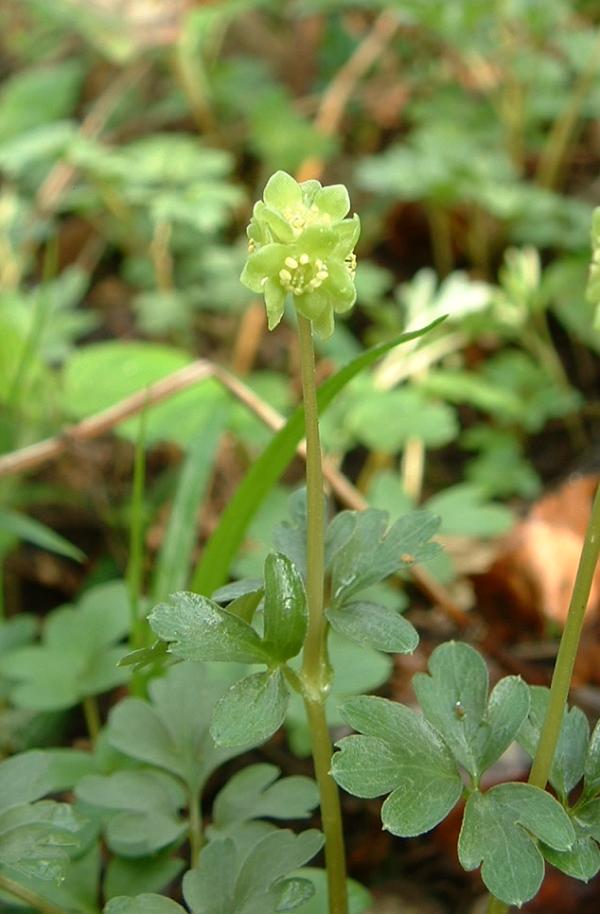
Photo: Wikimedia Commons, CC BY-SA 3.0 · source

Herbaceous plant · Moschatel family (Adoxaceae)
Moschatel
Adoxa moschatellina
In other languages: Muskuskruid (Nederlands) · Moscatelline (Français)
Grows wild in Belgium.
Moschatel is a small, delicate spring plant, 5–15 cm tall, that grows in damp deciduous woodland, on wooded banks, along streams and at the foot of hedges. In Belgium it is fairly common in woods on rich, moist soil, especially in the loam region and the south of the country, but rare on poor sandy soil. You recognise it by its pale green leaves, twice divided into threes, and above all by its flower head: five small green flowers arranged in a cube, four facing sideways and one facing up, like the faces of a town hall clock. The flowers have a faint musky scent, especially in the evening and in damp weather. By June the plant has disappeared again: it is a true spring ephemeral that makes use of the short light period before the trees come into leaf.
Light
Partial shade or shade
tolerates little sun
Moisture
Normal to wet
must not dry out
Hardiness
Fully hardy
down to -30 °C
Size
0.1 m
tall, 0.2 m wide
Flowering
March–May
| Height | 0.1 m |
|---|---|
| Native to Belgium | Yes |
| Flowering | March–May |
Identify
How to recognise it
- Growth form
- Small, hairless perennial, 5–15 cm, with a creeping rhizome and underground runners. After a few years it forms loose little carpets.
- Leaf
- Pale green to bluish green, slightly fleshy, twice divided into threes with rounded lobes. The flowering stem carries two smaller, opposite leaves.
- Flower
- A head of 6–8 mm made of five small green flowers: four side flowers with five lobes and one top flower with four lobes. Faint musky scent. Flowers from March to May.
- Fruit/Seed
- After flowering the stem bends over and a small, green, fleshy fruit forms. Ripe fruits are rarely seen: the plant spreads mainly by runners.
- Roots
- A white, scaly rhizome just below the surface, with thin runners that form new plants.
- Confusion with
- Wood anemone has more finely cut leaves and large white flowers. Hollowroot (Corydalis cava) has blue-green, finely divided leaves and purple or white spikes. In flower, moschatel is unmistakable with its green five-sided ‘clock’.
Flowering: March–May
In your garden
Why grow it?
- One of the first woodland flowers: in March–April the flowers attract small flies, little beetles and other early insects.
- A neat, low ground cover for a damp, shady corner under shrubs, which is out of everyone’s way in summer.
- It often grows in old, undisturbed woods and hedgerows: where you find it, the woodland floor has usually been left alone for a long time.
- A surprising little plant to study with a hand lens: the cube-shaped flower head with five ‘faces’ is unique in our flora.
- Little work: once settled, it spreads quietly by underground runners.
Moschatel: where does it grow best?
- In the wild in damp deciduous woods, woods on slopes, hedgerows, sunken lanes and along streams, often with wood anemone and lesser celandine.
- Half shade to shade: under deciduous trees and shrubs, which still let plenty of light through in spring.
- Humus-rich, loose, moist soil, preferably loam or clay with plenty of leaf litter; not on dry sand.
- In the garden: under a hedge, between shrubs or on the shady side of a woodland strip, where the soil is not dug over.
Goes well with
- Wood anemone: Flowers at the same time, with white stars above the green carpet.
- Oxlip: Pale yellow flowers in the same damp half shade.
- Hollowroot: Purple or white spikes in March–April and, like moschatel, gone by summer.
- Lords-and-ladies: Large, glossy leaves in spring; also a plant of damp deciduous woods.
- Male fern: Fills the space in summer, while moschatel rests underground.
Maintenance
Moschatel: when and how to plant it?
- Buy pot-grown plants from a nursery specialising in native plants; seed is hard to find and slow to germinate.
- Plant in September–October, or very early in spring, when the first leaves are just appearing.
- Set them in a small group of five to ten, 15–20 cm apart, with the rhizome just below the surface.
- Mix in some leaf mould, water after planting and keep the soil moist during the first spring.
- In autumn, cover the spot with a thin layer of fallen leaves: this mimics the woodland floor where it grows naturally.
- Never dig up moschatel in the wild: buy it from a nursery or ask for a piece from someone who already has it in the garden.
Care
- Water
- Only in a dry spring. In summer the plant is dormant and needs nothing.
- Feeding
- Not needed. Leave the leaf litter in place: that is food enough.
- No digging
- Do not hoe or dig where it grows: the rhizomes lie just below the surface. Mark the spot so you do not forget it in summer.
- Spreading
- It spreads slowly and is not invasive. Rather keep vigorous neighbours such as ivy, bramble or nettle in check, so it does not get smothered.
- Leaves
- Leave fallen leaves in autumn: they keep the soil moist and loose and protect the rhizome.
Tip: Plant moschatel where you will never need to dig, for example under a hedge or between ferns: that way it can quietly grow into a little carpet over the years.
Pruning and mowing
When: Not needed: moschatel dies back by itself in June and retreats underground.
How:
- Do not cut or mow anything in spring: the leaves wither by themselves and feed the rhizome for next year.
- Leave the dead leaves and leaf litter in place; they break down quickly.
- If you want the spot tidy in summer, mow only from July onwards, with the mower set high.
Caution: Do not mow or weed in March–May, when the plant is above ground: you would weaken it.
Propagation
- Division
- In September–October or just after flowering, lift a piece of the mat with its rhizome and replant it elsewhere at the same depth. It establishes easily.
- Seed
- Ripe seed is rare. If you find some, sow it straight away in a pot of leaf mould and leave the pot outside over winter: germination is slow.
Moschatel: how does it get through the winter?
Hardy to −30 °C.
- In winter there is nothing to see: the rhizome rests below the soil and the leaf litter.
- Fully hardy; severe frost is no problem.
- As early as February the first leaves appear, often together with lesser celandine and wood anemone.
Diseases and pests
- Gone in summer: Not a problem: that is how the plant lives. Put a small stick by the spot so you do not dig into it by accident.
- Smothered: Ivy, bramble or large plants can crowd it out. Cut them back around the spot in autumn.
- Drought: On dry soil or in a sunny corner it fades away. Move it to a cool, moist spot under shrubs.
- Rust: Sometimes small yellow or brown spots on the leaves caused by a rust fungus. Usually harmless: the plant dies back anyway.
Through the year
- February: The first pale green leaves push up through the leaf litter.
- March: Flowering begins. Look at the five ‘clock faces’ with a hand lens.
- April: Full flower; in the evening you can smell the musky scent. Do not weed or mow.
- May: Last flowers; the stems bend over with small green fruits.
- June: The leaves wither and the plant retreats underground.
- July: Dormant. Mark the spot so you do not dig there.
- September: Plant, or move a piece of the mat.
- October: Plant. Leave fallen leaves where they are.
- November: Spread a thin layer of leaves or leaf mould over the spot.
You and this species
Did you know?
- The scientific name Adoxa means ‘without glory’ in Greek: a nod to the small, inconspicuous green flower.
- Its other English name, ‘town hall clock’, comes from the four flowers that face four ways like the faces of a clock tower, while the fifth looks up to the sky.
- Moschatel long stood in a small family of its own. DNA studies showed that it is related to elder and viburnum, which are now often placed in the same family.