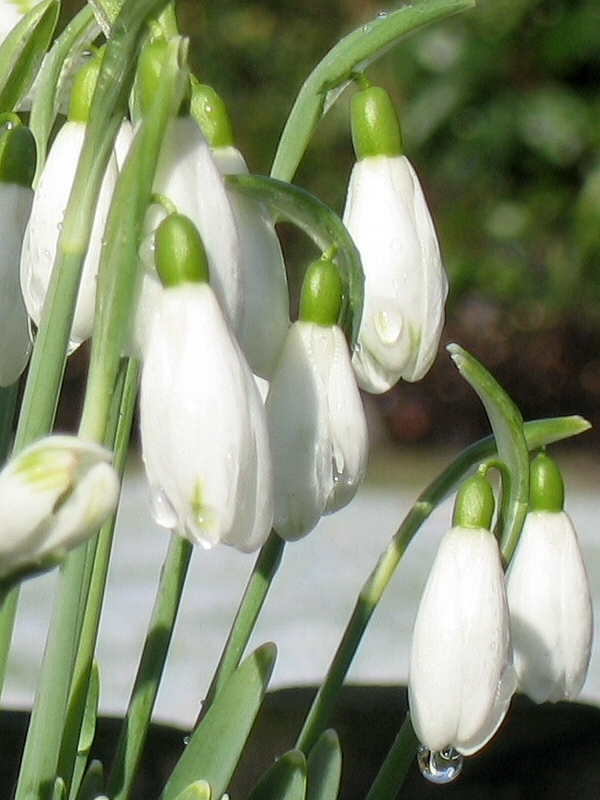
Photo: Tbc at Dutch Wikipedia, CC BY-SA 3.0 · source

Herbaceous plant · Daffodil family (Amaryllidaceae)
Snowdrop
Galanthus nivalis
In other languages: Gewoon sneeuwklokje (Nederlands) · Perce-neige (Français)
Grows wild in Belgium.
The snowdrop is a small bulb that shows its white, nodding flowers as early as January and February, often before the snow has gone. It is native to the woods of central and southern Europe; in Belgium it has been naturalised for centuries in old parks, castle grounds, churchyards, stream valleys and broadleaved woods around old country houses. You can recognise it by its two narrow, grey-green leaves and its hanging flower, with three long white outer tepals and three shorter inner ones marked with a green patch. On mild winter days it is one of the first sources of food for honeybees. In a garden it slowly spreads into broad carpets.
Caution: Poisonous: especially the bulb, but also the leaves and flowers. The bulbs can be mistaken for onions or shallots. Keep children and pets, such as dogs that like digging, away from them. Never take snowdrops from the wild or from old parks; buy only cultivated bulbs.
Light
Partial shade or shade
tolerates little sun
Moisture
Normal
no wet feet
Hardiness
Fully hardy
down to -30 °C
Size
0.15 m
tall, 0.1 m wide
Flowering
January–March
| Height | 0.15 m |
|---|---|
| Native to Belgium | No, naturalised |
| Flowering | January–March |
Identify
How to recognise it
- Habit
- Bulb 10–20 cm tall that forms dense clumps through offsets.
- Leaf
- Usually two narrow, strap-shaped leaves 5–15 cm long per bulb, grey-green with a slight bloom, flat.
- Flower
- One hanging white flower per stem, 1.5–2.5 cm long. Three long white outer tepals and three shorter inner ones with a green V- or U-shaped mark near the tip. Lightly scented.
- Fruit/Seed
- A small, round green capsule that bends down to the ground in spring. The seeds carry a fatty appendage and are carried off by ants.
- Roots
- A small white bulb 1–2 cm across with roots at the base; it forms offsets every year.
- Look-alikes
- Spring snowflake is larger, with six equal tepals that each have a green or yellow spot at the tip, and flowers slightly later. Cultivated snowdrops such as Galanthus elwesii have broader leaves and larger flowers.
Flowering: January–March
In your garden
Why grow it?
- Flowers in the middle of winter, from January to March, when almost nothing else is in flower.
- On mild days, a welcome source of pollen and nectar for honeybees and early bumblebees.
- After a few years it forms a white carpet under trees and shrubs, without any care.
- Disappears below ground in May–June, leaving room for ferns and summer plants.
- A classic plant of old gardens and castle parks, with a long history.
Snowdrop: where does it grow best?
- In the wild and naturalised: damp broadleaved woods, stream valleys, old parks, castle gardens, churchyards and hedgerows.
- Half shade to shade under deciduous trees and shrubs: in winter and early spring there is plenty of light there.
- Moist, humus-rich soil that doesn’t dry out in summer: loam or clay with plenty of leaf mould. Damp soil is no problem.
- In the garden: under a hedge, a tree or shrubs, in a woodland garden or in the grass of a lawn that is mown late.
Goes well with
- Winter aconite: Yellow cups at the same time as the white bells.
- Lesser celandine: Takes over with yellow stars once the snowdrops are over.
- Wood anemone: A white carpet in March–April in the same spot.
- Hollowroot: Purple or white spikes in March, also under shrubs.
- Ferns: Fill the space in summer while the snowdrops are resting.
Maintenance
Snowdrop: when and how to plant it?
- Buy cultivated bulbs or pot-grown plants from a garden centre or nursery. Never dig up snowdrops in the wild, not even in an old park.
- Ideally plant them ‘in the green’: in March, just after flowering, leaves and all. They establish far better that way than dry bulbs.
- Plant dry bulbs in September, as soon as possible after buying them, because they dry out quickly.
- Plant 5–8 cm deep, in groups of 5–10 bulbs, 5–10 cm apart.
- Mix some leaf mould into the soil and water after planting.
- Always let the leaves die back by themselves after flowering: the bulb needs them to build up strength for next year.
Care
- Water
- Not needed, except after planting in the green in a dry spring.
- Feeding
- Not needed. A layer of leaf mould in autumn is enough.
- Mowing
- In a lawn, mow only once the leaves have yellowed, from late May or in June.
- Division
- If clumps become too crowded and flower less, divide them after flowering.
- Self-seeding
- Let the seed capsules ripen: ants spread the seed, and new plants appear after a few years.
Tip: Been given a clump by a neighbour, or already have some in your garden? Plant them ‘in the green’, just after flowering: snowdrops establish far better that way than dry bulbs from a bag.
Pruning and mowing
When: Not needed. Let the leaves die back naturally in May–June.
How:
- Never cut or mow green leaves, and don’t tie them in knots.
- Don’t remove spent flowers if you want them to self-seed.
Propagation
- Dividing in the green
- In March, just after flowering: lift a clump, split it into small groups or single bulbs and replant straight away at the same depth.
- Seed
- Sow ripe seed straight away in May–June, in a pot or where it is to grow. Seedlings take three to five years to flower.
Snowdrop: how does it get through the winter?
Hardy to −30 °C.
- Leaves and buds appear as early as December–January; the flowers tolerate frost and snow.
- In frost the stems sometimes go limp, but they straighten up again when it thaws.
- The flowers open in mild weather and stay closed in the cold.
- Fully hardy.
Diseases and pests
- Grey mould: Fluffy grey mould on leaves and flowers in mild, wet winters. Remove affected bulbs and plants and replant in a more airy spot.
- Narcissus fly: The maggot hollows out the bulb from inside. Throw away soft, rotten bulbs and don’t replant in the same spot.
- Dried-out bulbs: Dry bulbs that have sat in a bag for a long time often fail to come up. Plant in the green instead, or buy fresh bulbs in September.
- Fewer flowers: Clumps too crowded or too much shade from evergreen plants. Divide after flowering and choose a lighter spot under deciduous trees.
Through the year
- January: Flowering begins. Honeybees on mild days.
- February: Full flower.
- March: Last flowers. Plant and divide in the green.
- April: Leave the leaves; seed capsules ripen.
- May: Leaves turn yellow. Sow seed.
- June: Resting below ground. Only now mow the lawn.
- September: Plant dry bulbs.
- October: Spread leaf mould.
- December: The first tips push through the soil.
You and this species
Did you know?
- Galanthus comes from the Greek gala, milk, and anthos, flower; nivalis means ‘of the snow’.
- In English they are also called Candlemas bells, after Candlemas on 2 February, when they are often in full flower.
- There are hundreds of named garden forms. Enthusiasts, known as ‘galanthophiles’, sometimes pay large sums for a single bulb of a rare form.