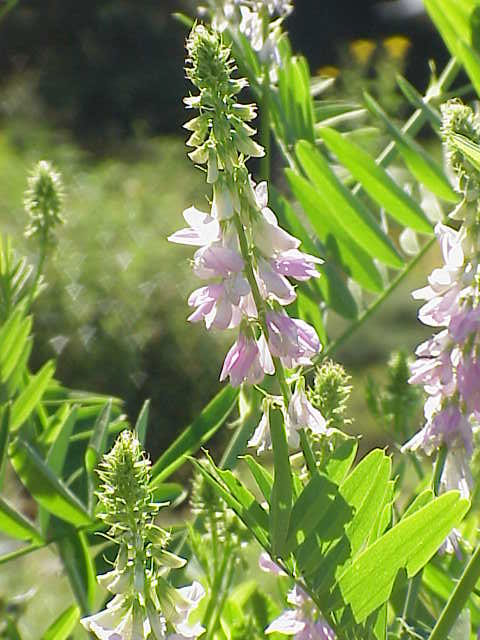
Photo: Wikimedia Commons, CC BY-SA 3.0 · source

Herbaceous plant · Pea family (Fabaceae)
Goat’s-rue
Galega officinalis
In other languages: Galega (Nederlands) · Galéga officinal (Français)
Grows wild in Belgium.
Goat’s-rue is a robust perennial of the pea family, with pinnate leaves and upright spikes of white to lilac flowers. It is native to southern and eastern Europe and western Asia; here it was once grown as a fodder plant and ornamental and it has become locally naturalised along rivers and railways, on waste ground and rough verges. You can recognise it by its hollow stems, its 9–17 narrow leaflets with a tiny point and the long flower spikes held above the leaves. From June to September it is a real magnet for bees and bumblebees. Take care, though: the whole plant is poisonous, especially to sheep and other livestock.
Caution: Poisonous. The whole plant, even dried in hay, is poisonous to grazing animals, especially sheep, and also to horses, rabbits and guinea pigs; people, and children in particular, must not eat the leaves, pods or seeds. Do not plant it in or next to a pasture and never feed cuttings to animals. It self-seeds easily: cut off the faded spikes before the pods ripen.
Light
Sun or partial shade
preferably some sun
Moisture
Normal to wet
must not dry out
Hardiness
Fully hardy
down to -25 °C
Size
1.2 m
tall, 0.8 m wide
Flowering
June–September
| Pruning months | March and August |
|---|---|
| Height | 1.2 m |
| Native to Belgium | No, naturalised |
| Flowering | June–September |
Identify
How to recognise it
- Habit
- Perennial in a loose clump 0.6–1.5 m tall, with many upright, branched stems.
- Leaf
- Pinnate, with 9–17 lance-shaped leaflets of 1.5–5 cm tipped with a tiny bristle point; two arrow-shaped stipules at the base.
- Flower
- Upright, long-stalked spikes of 5–15 cm with pea flowers of about 1 cm, white, lilac or bluish lilac, from June to September.
- Fruit/Seed
- Narrow, cylindrical pods of 2–5 cm, straight and slightly constricted between the seeds; brown when ripe.
- Stem
- Hollow, hairless and grooved; slightly woody at the base.
- Look-alikes
- Vetches have tendrils at the leaf tip and climb; goat’s-rue stands upright and has no tendrils. Crown vetch has pink and white flowers in round heads. Wild liquorice has creamy yellow flowers and sprawls more over the ground.
Flowering: June–September · Pruning: March and August
In your garden
Why grow it?
- Flowers for three months, with plenty of nectar and pollen for honeybees, bumblebees and solitary bees.
- Like other members of the pea family, it fixes nitrogen from the air in nodules on its roots.
- A sturdy, airy plant for the back of a natural border or a rough corner on moist soil.
- Its hollow stems, left standing over winter, give shelter to insects.
- A historic plant: once grown as livestock fodder because people believed it increased milk yield.
Goat’s-rue: where does it grow best?
- In the wild on riverbanks, railway embankments, waste ground and rough, damp verges.
- Full sun to light partial shade; it flowers most freely in sun.
- Fertile, moisture-retentive soil: loam or clay, also slightly chalky; it tolerates short wet spells.
- Allow 60–80 cm per plant; it forms a sizeable clump with a deep root.
- Not in or next to a pasture with sheep, horses or other livestock, and preferably not right beside a stream, where it easily seeds itself further.
Goes well with
- Purple loosestrife: Purple spikes on the same moist soil, for bees and butterflies.
- Hemp-agrimony: Flowers in late summer and attracts many butterflies.
- Meadowsweet: Creamy white, fragrant plumes in the same moist border.
- Wild carrot: White umbels for hoverflies and small beetles, contrasting with the spikes.
Maintenance
Goat’s-rue: when and how to plant it?
- Buy a plant from a perennial nursery, or sow it yourself; never dig up plants from the wild.
- Sow in March–April: soak the hard seed overnight in lukewarm water and sow in small pots, 1 cm deep. It germinates in 2–3 weeks.
- Plant out in May, or plant bought plants in April–May or September–October, 60–80 cm apart.
- Choose the final spot straight away: because of its deep taproot it does not transplant well.
- Water during dry spells for the first few weeks; after that it looks after itself.
- Put in a plant support or a few canes when planting: after rain the clump easily flops open.
Care
- Watering
- Only in the first year during drought. After that only in long dry spells.
- Feeding
- Not needed: it takes nitrogen from the air itself. Fertiliser makes it floppy.
- Support
- A ring or a few canes in May keep the clump together.
- Spreading
- It self-seeds freely. Cut off the faded spikes before the pods ripen and pull up unwanted seedlings while young, roots and all.
- Faded spikes
- Cutting them off after the first flush often gives a second, smaller flowering.
Tip: Cut the flower spikes back after the first flush: this stops it seeding everywhere and often gives you a second flowering in September.
Pruning and mowing
Pruning months: March and August.
When: Faded spikes in August, before the seed ripens. The old stems in March, before the new shoots appear.
How:
- In August, cut the faded spikes back to above a healthy leaf so that no seed drops.
- Leave the hollow stems standing over winter as shelter for insects.
- In March, cut all the old stems back to 5–10 cm above the ground.
- Wear gloves and do not put the cuttings in a pasture or near animals.
Caution: Never give prunings or cuttings to rabbits, guinea pigs, sheep or other livestock: it stays poisonous even when dried.
Propagation
- Seed
- In March–April in small pots, after soaking overnight in lukewarm water. Seedlings often flower in their second year.
- Division
- Young clumps can be carefully split with a sharp spade in March; older plants with a deep taproot do not tolerate this well.
Goat’s-rue: how does it get through the winter?
Hardy to −25 °C.
- Dies back above ground in autumn and reshoots from the rootstock in spring.
- Fully hardy, to about −25 °C.
- Leave the hollow stems until March: insects overwinter in them and birds find shelter.
Diseases and pests
- Self-seeding: Seedlings appear everywhere nearby. Cut off faded spikes in time and pull up seedlings while young.
- Flopping: After rain or wind the clump falls open. Put in a support in May and choose a sunny spot on soil that is not too rich.
- Powdery mildew: White powder on the leaves in late summer. Harmless; give it space and cut back affected stems after flowering.
- Poisonous to animals: Dangerous to livestock and rodents. Do not plant it where animals graze and never feed cuttings.
Through the year
- March: Cut back the old stems. Sow in pots.
- April: New shoots. Plant or plant out.
- May: Put in plant supports. Plant out seedlings.
- June: Start of flowering: bees and bumblebees.
- July: Full flower. Water during long droughts.
- August: Cut off faded spikes before the seed ripens.
- September: Last flowers. Planting is possible.
- October: Plant. The plant dies back above ground.
- November: Leave the hollow stems standing for insects.
You and this species
Did you know?
- The name Galega comes from the Greek gala, ‘milk’: people used to believe the plant increased the milk yield of cows and goats.
- A substance called galegine was extracted from goat’s-rue. Research on it led, in the twentieth century, to the development of a well-known medicine; the plant itself is poisonous.
- Goat’s-rue works with a soil bacterium of its own, which forms the root nodules where nitrogen is fixed only on Galega species.