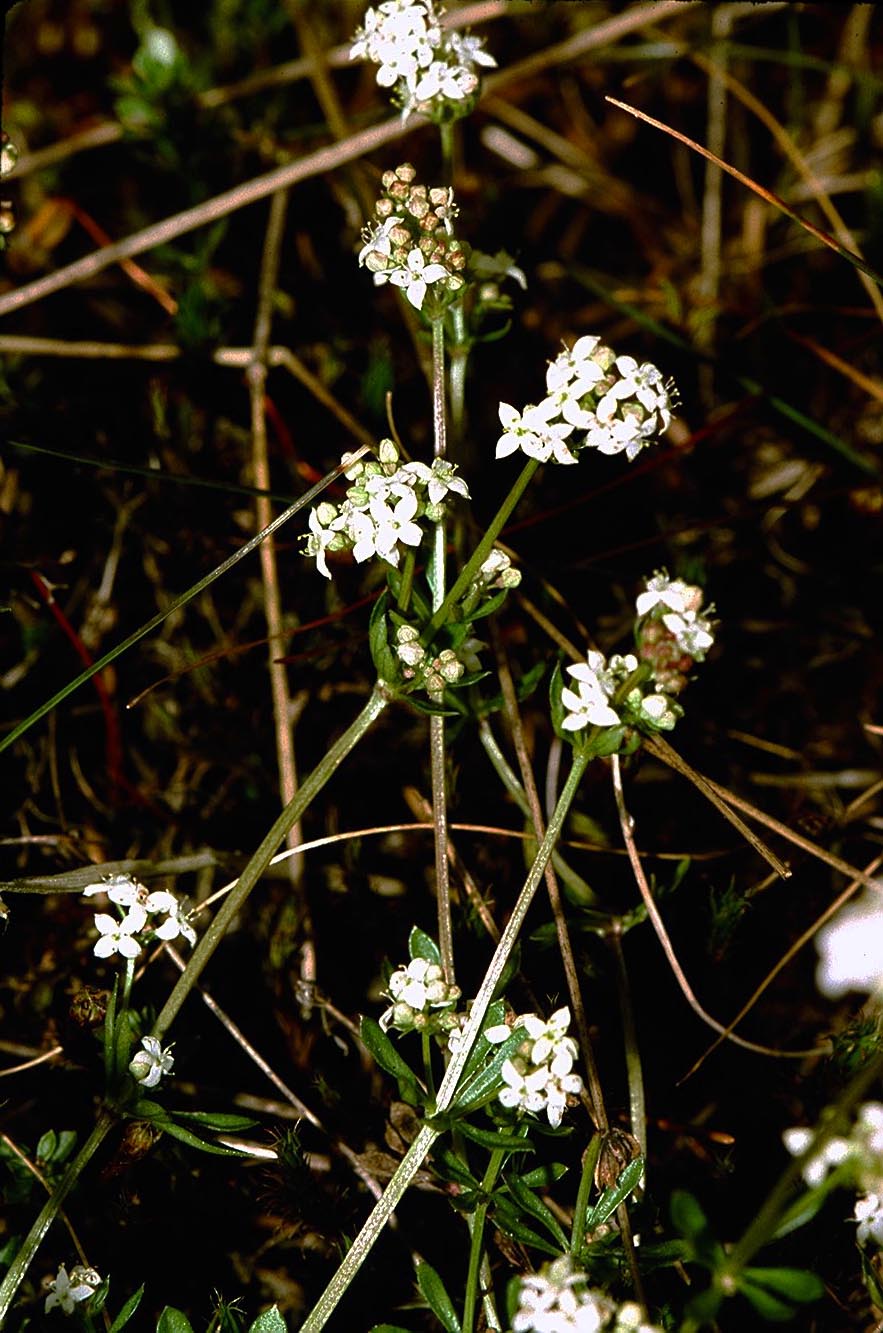
Photo: Wikimedia Commons, CC BY-SA 3.0 · source

Herbaceous plant · Bedstraw family (Rubiaceae)
Heath bedstraw
Galium saxatile
In other languages: Liggend walstro (Nederlands) · Gaillet des rochers (Français)
Grows wild in Belgium.
Heath bedstraw is a low, mat-forming bedstraw of acid, nutrient-poor soil. In Belgium it is found mainly in the Campine and the Ardennes, on heathland, in poor grassland, along woodland paths and in open oak and birch woods on sand or acid loam; it is absent from chalky soils. You can recognise it by its creeping, square little stems with whorls of four to six small, obovate leaves and by its dense clusters of tiny white flowers from June to August, with a sweet, rather heavy scent. The small fruits are covered in pointed warts. In a heather garden it forms fresh green mats between heather and grasses, and small flies and little beetles visit its flowers.
Light
Sun or partial shade
preferably some sun
Moisture
Dry to normal
no wet feet
Hardiness
Fully hardy
down to -30 °C
Size
0.15 m
tall, 0.4 m wide
Flowering
June–August
| Pruning months | September |
|---|---|
| Height | 0.15 m |
| Native to Belgium | Yes |
| Flowering | June–August |
Identify
How to recognise it
- Habit
- Low and mat-forming, 10–20 cm tall, with many creeping non-flowering stems and ascending flowering stems.
- Leaf
- In whorls of 4–6 (sometimes more), obovate to lance-shaped, 7–10 mm, with a tiny bristle tip; the edge has minute forward-pointing prickles.
- Flower
- Dense clusters of white flowers of 3–4 mm with four lobes, from June to August; sweet, rather heavy scent.
- Fruit/Seed
- Small, hairless paired fruits of about 2 mm, densely covered in pointed warts.
- Stem
- Square, hairless and smooth, thin and creeping; often roots at the nodes.
- Look-alikes
- Slender bedstraw looks very similar but grows on chalky soil and has narrower leaves and fruits without pointed warts. Marsh bedstraw grows on wet ground and has blunt leaves without a bristle tip. Hedge bedstraw is much larger and taller.
Flowering: June–August · Pruning: September
In your garden
Why grow it?
- A characteristic plant of heathland and poor, acid grassland, habitats that have declined sharply in Belgium.
- Its flowers attract small flies, hoverflies and little beetles; spiders and small insects shelter among the mats.
- Forms fresh green, low mats that cover bare sandy soil, even in winter.
- Ideal for a heather garden, a sandy bank or between stones on acid soil, where few other flowering plants thrive.
- A useful indicator: where heath bedstraw grows, the soil is acid and poor.
Heath bedstraw: where does it grow best?
- In the wild on dry and wet heath, in poor, acid grassland, along woodland paths, in open oak and birch woods and on sandy banks.
- Sun to partial shade.
- Acid, nutrient-poor soil: sand, acid loam or humus-rich heathland soil; never lime.
- In the garden it suits a heather garden, between heather and grasses, a sandy edge or between stones on acid soil.
Goes well with
- Heather: The classic heathland plant, on the same acid soil, with nectar for bees in late summer.
- Tormentil: Small yellow flowers in the same poor, acid grasslands.
- Sheep’s-bit: Blue pompons on dry sandy soil, loved by bees.
- Wavy hair-grass: A fine, glossy grass of acid soil that goes well with the mats.
Maintenance
Heath bedstraw: when and how to plant it?
- Buy plants from a native plant nursery or sow your own; never dig up plants from the wild.
- Sow in September–November outdoors or in a tray of acid, sandy soil left outside: the seed needs a cold spell and germinates in spring.
- Scatter the seed on the surface, press it in and cover with at most a thin layer of sand.
- Plant pot-grown plants in March–April or October, 25–30 cm apart. Use no lime, no fertiliser and no compost containing lime.
- Water during dry spells for the first few weeks, ideally with rainwater; after that it is rarely needed.
Care
- Watering
- Only in the first year during drought, ideally with rainwater; tap water is often limy.
- Feeding
- Never: fertiliser and lime make the soil too rich, after which grasses smother it.
- Soil
- Keep the soil acid and poor. Leave fallen oak and birch leaves where they lie.
- Weeding
- Pull out grass, brambles and tree seedlings that appear, so the mats stay in the light.
- Trimming
- Not needed; you may lightly shorten the faded stems in September if you want compact mats.
Tip: Always give heath bedstraw rainwater and never lime or fertiliser: acid, poor soil is the secret of sturdy green mats.
Pruning and mowing
Pruning months: September.
When: Not needed. Possibly a light trim in September, after flowering.
How:
- Snip off the faded flowering stems just above the mat with scissors.
- Leave the creeping green stems: the mat grows on from them.
- In a heather garden it is enough to trim the heather every few years and leave the bedstraw alone.
Propagation
- Seed
- Sow outdoors in autumn on acid, sandy soil; the seed germinates after winter, in March–April.
- Division
- In March or October, cut off a piece of the mat with roots and plant it elsewhere.
- Rooted stems
- Creeping stems root at the nodes: cut off a rooted stem and plant it in a small pot of acid soil.
Heath bedstraw: how does it get through the winter?
Hardy to −30 °C.
- The creeping non-flowering stems stay largely green: a fresh mat among the brown heath.
- Fully hardy, to −30 °C and below.
- Small insects and spiders overwinter among the mats.
Diseases and pests
- Yellow leaves: A sign of lime in the soil or in the water. Use rainwater, no lime, and only plant it on acid soil.
- Being smothered: On enriched soil, grasses and brambles take over. Never feed and weed in time.
- Drying out: Seedlings and young plants dry out quickly in a dry spring. Water during drought in the first year.
- Too much shade: Under a dense tree canopy it grows thin and hardly flowers. Keep the spot open and light.
Through the year
- March: Plant and divide. Seedlings from an autumn sowing appear.
- April: New growth. Water during drought in the first year.
- May: Pull out grass and brambles between the mats.
- June: Start of flowering.
- July: Full flower: small flies and little beetles on the flowers.
- August: Last flowers; the fruits ripen.
- September: Possibly lightly shorten the faded stems. Sow.
- October: Plant, divide and sow.
- November: The green mats stay through the winter.
You and this species
Did you know?
- In 1917 the British ecologist Arthur Tansley showed, with this species and a related bedstraw of chalky soil, that each wins the competition on its own soil type: a classic experiment in plant ecology.
- Saxatile means ‘growing among rocks’, but here it grows mainly on heathland and acid grassland.
- Bedstraws belong to the same family as coffee and madder: the Rubiaceae.