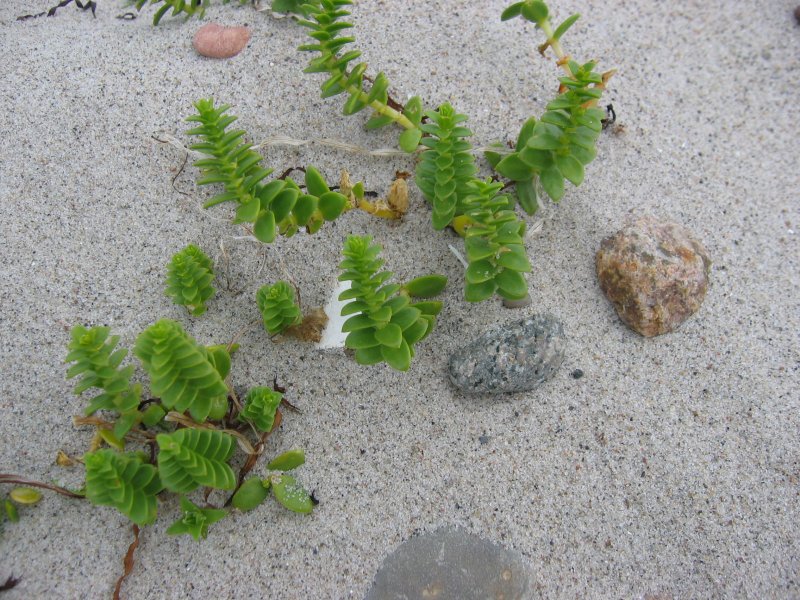
Photo: Kristian Peters -- Fabelfroh 19:07, 16 August 2005 (UTC), CC BY-SA 3.0 · source

Herbaceous plant · Pink family (Caryophyllaceae)
Sea sandwort
Honckenya peploides
In other languages: Zeepostelein (Nederlands) · Pourpier de mer (Français)
Grows wild in Belgium.
Sea sandwort is a low, fleshy perennial of beaches and the foredunes. It forms carpets of glossy, yellowish-green leaves in four rows on sand and shingle, just above the high-tide line. In Belgium it grows locally along the coast, on stretches of beach that are still natural, especially on the strandline and in the embryo dunes, the first low dunes on the beach. You recognise it by its thick, pointed, opposite leaves arranged crosswise around the stem, its small greenish-white flowers and its round, pea-like fruits. With its creeping rhizomes it traps blowing sand and so helps to build new dunes.
Light
Full sun
warm and bright
Moisture
Dry to normal
no wet feet
Hardiness
Fully hardy
down to -25 °C
Size
0.15 m
tall, 0.5 m wide
Flowering
May–August
| Height | 0.15 m |
|---|---|
| Native to Belgium | Yes |
| Flowering | May–August |
Identify
How to recognise it
- Habit
- Low, creeping perennial, 5–25 cm tall, with long rhizomes that form dense mats.
- Leaf
- Thick, fleshy, oval and pointed, 6–18 mm long, glossy yellowish-green; opposite and so crowded that the stem seems leafy in four rows.
- Flower
- Small, 6–10 mm, with five greenish-white petals, from May to August. Male and female flowers are usually on separate plants.
- Fruit/Seed
- Round, yellowish-green capsule of 6–10 mm that looks like a pea, with a few fairly large seeds.
- Stem
- Fleshy, trailing to ascending stems that root in the sand and keep growing up through it.
- Confused with
- Glasswort has no real leaves and grows on mudflats and salt marshes. Sea milkwort has tiny pink flowers and grows on wet, salty ground. Garden purslane has rounded leaves and yellow flowers.
Flowering: May–August
In your garden
Why grow it?
- A true pioneer: it traps sand and so takes the first step towards new dunes.
- Tolerates salt, sea wind, blasting sand and the occasional flooding by sea water.
- The small flowers provide nectar for flies and other small insects on the beach.
- A handsome, fleshy ground cover for anyone with a sand garden by the sea.
- The leaves are edible and were once eaten as a vegetable in northern coastal regions; never pick them in the dunes.
Sea sandwort: where does it grow best?
- In the wild: sandy and shingle beaches just above the high-tide line, the strandline and embryo dunes.
- Full sun, in the wind.
- Bare, limy sand with some salt and nutrients from washed-up seaweed; the roots reach down to moisture deep below.
- In the garden: only in a sand garden or a large container of coarse sand, preferably on the coast; inland it struggles, mainly because of competition and heavy soil.
Goes well with
- Sand couch: Another pioneer of embryo dunes: together they trap the first sand.
- Sea rocket: Lilac flowers on the strandline, in the same strip of bare sand.
- Sea holly: Silvery-blue, spiny plant for a dry sand garden by the sea.
- Marram grass: The dune grass that binds the sand behind the first low dunes.
Maintenance
Sea sandwort: when and how to plant it?
- Look for plants at a nursery that grows native coastal and beach plants; seed is rarely for sale.
- Never dig up plants on the beach or in the dunes: dunes are protected habitats and the plants hold the sand together.
- Plant in April–May in pure, coarse sand in a sunny, open spot, 30–40 cm apart.
- Set the plant a little deeper than it was in the pot: it copes well with being buried by sand.
- Water in dry spells for the first few weeks, after that only during long hot periods.
- In a pot or container: use sand with a little fine gravel, no potting compost.
Care
- Water
- Rarely needed once established, as the roots go deep. Water a potted plant now and then.
- Feeding
- Not needed. On the beach it feeds on washed-up seaweed; it needs nothing more.
- Salt and wind
- Salt and sea wind are no problem; in such places it is actually stronger than other plants.
- Weeding
- Keep grasses and other plants away: sea sandwort copes poorly with competition.
- Sand
- Leave wind-blown sand where it lands; the plant simply grows up through it.
Tip: Plant sea sandwort in pure sand without potting compost and let the sand blow over it: the more often it gets buried, the better it grows.
Pruning and mowing
When: Not needed.
How:
- Just let the plant grow; dead stems break down in the sand.
- In a garden, only remove wind-blown litter and weeds from between the mats.
- If the mat gets too big, cut off a piece in spring when replanting.
Propagation
- Cuttings and division
- In April–May cut a piece of rhizome with shoots from your own plant and set it in moist sand; it roots readily.
- Seed
- In autumn sow ripe seed from your own plants in a pot of sand and stand it outside; it germinates in spring.
Sea sandwort: how does it get through the winter?
Hardy to −25 °C.
- The parts above ground largely die back in autumn; the rhizomes overwinter in the sand.
- In spring new shoots appear, often through a layer of freshly blown sand.
- Hardy to about −25 °C; it grows as far north as Arctic coasts.
- Winter storms can wash away some of the plants; they usually recover from the rhizomes.
Diseases and pests
- Trampling: On busy beaches it gets flattened. Keep to the paths and leave the little dunes on the beach alone.
- Beach cleaning: Mechanical beach cleaning removes the strandline and the plants. Natural stretches of beach are therefore important.
- Competition: In a garden, grasses soon overgrow it. Weed around the plant regularly.
- Heavy soil: On loam, clay or potting compost it rots. Use only pure sand.
Through the year
- March: New shoots appear in the sand.
- April: Plant or divide in pure sand.
- May: First greenish-white flowers.
- June: Full flower; the mats grow denser.
- July: Flowers and the first pea-like fruits.
- August: Last flowers; the fruits ripen.
- September: Sow ripe seed from your own plants in a pot of sand.
- November: The stems die back; the rhizomes rest in the sand.
You and this species
Did you know?
- The genus is named after the 18th-century German botanist Gerhard August Honckeny.
- Sea sandwort grows along cold and temperate coasts of much of the northern hemisphere, right into the Arctic.
- Its Dutch and French names compare it to purslane because of its fleshy leaves, although the two plants are not related.