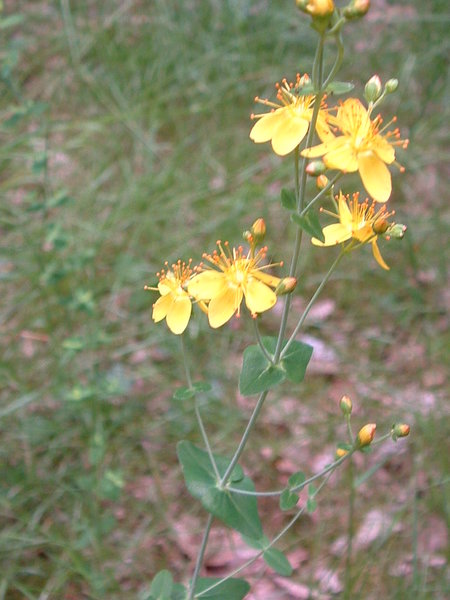
Photo: Wikimedia Commons, CC BY-SA 3.0 · source

Herbaceous plant · St John’s-wort family (Hypericaceae)
Slender St John’s-wort
Hypericum pulchrum
In other languages: Fraai hertshooi (Nederlands) · Millepertuis élégant (Français)
Grows wild in Belgium.
Slender St John’s-wort is a graceful native St John’s-wort of poor, acid soils: heath edges, open, dry oak and birch woods, woodland rides, hedge banks and thin verges on sand, acid loam or rocky ground. In Belgium it grows mainly in the Campine (Kempen) and the Ardennes; elsewhere it is fairly rare. You can recognise it by its slender, round, hairless stems, often flushed red, with small heart-shaped leaves that half clasp the stem, and by its golden-yellow flowers with red buds and tiny black glands along the petal edges. It flowers from June to September and attracts wild bees and hoverflies that collect its pollen. An elegant plant for a heather garden or a thin, acid woodland edge.
Caution: Like other St John’s-worts, it contains substances in its black glands that can make the skin sensitive to sunlight. Grazing animals that eat a lot of it can develop skin problems; do not eat it yourself. In a garden the risk is small.
Light
Sun or partial shade
preferably some sun
Moisture
Dry to normal
no wet feet
Hardiness
Fully hardy
down to -25 °C
Size
0.4 m
tall, 0.25 m wide
Flowering
June–September
| Pruning months | March and October |
|---|---|
| Height | 0.4 m |
| Native to Belgium | Yes |
| Flowering | June–September |
Identify
How to recognise it
- Habit
- Graceful perennial, 20–60 cm tall, with one or a few slender, upright stems that branch at the top into a loose panicle of flowers.
- Leaf
- Small, 0.5–1.5 cm, broadly oval to triangular, opposite, with a heart-shaped base that half clasps the stem; hairless, with fine translucent dots visible against the light.
- Flower
- Golden yellow, about 1.5 cm across, with five petals that are flushed red underneath and edged with tiny black glands. The buds are red. The sepals are blunt, with black-stalked glands along the edge.
- Fruit/Seed
- A small, egg-shaped capsule with three valves and many tiny seeds.
- Stem
- Slender, round and smooth, without ridges or wings; hairless and often flushed red.
- Look-alikes
- Perforate St John’s-wort has two raised lines on the stem, larger flowers and oblong leaves that do not clasp the stem. Pale St John’s-wort grows on more chalky soil and has pale yellow flowers in a dense cluster and larger leaves. Hairy St John’s-wort is clearly hairy. Trailing St John’s-wort has prostrate stems and smaller flowers.
Flowering: June–September · Pruning: March and October
In your garden
Why grow it?
- Golden-yellow flowers with a red tinge and striking red buds, from June to September: a long flowering season on poor soil.
- The flowers have no nectar but plenty of pollen: a food source for wild bees, bumblebees and hoverflies.
- St John’s-worts are food plants for a few specialist insects, such as leaf beetles of the genus Chrysolina.
- A typical plant of acid woodland edges and heath, perfect with heather, broom and oaks.
- It stays slender and does not spread: suitable for a small garden or a rock garden on acid soil.
Slender St John’s-wort: where does it grow best?
- In the wild: heath edges, open, dry oak and birch woods, woodland rides, hedge banks, slopes and thin verges on sand, acid loam or rocky ground.
- It likes poor, acid, well-drained soil that is dry to moderately moist; on chalk or rich soil it disappears.
- In the garden: sun to light partial shade, for example on the sunny edge of a copse or among heather.
- Lovely in a heather garden, an acid woodland edge, on a sandy bank or in a rock garden with acid soil.
Goes well with
- Heather: Flowers purple in August–September on the same poor, acid soil.
- Tormentil: Small yellow flowers all summer long, typical of heath edges.
- Heath bedstraw: A carpet of tiny white flowers on acid soil, at the foot of the St John’s-wort.
- Wood sage: Greenish-yellow flower spikes in summer on the same dry, acid soil, popular with bees.
- Wavy hair-grass: A fine, glossy grass for acid woodland edges that gives the plant a natural setting.
Maintenance
Slender St John’s-wort: when and how to plant it?
- Buy seed or plants from a nursery specialising in native plants. Never dig up plants in the wild.
- Sow in September–October or in March on the surface of a pot of poor, sandy seed compost and do not cover the seed: it needs light to germinate. Stand the pot outside and keep it moist.
- The seedlings are small and slow-growing: prick them out only when they have a few pairs of leaves.
- Plant in April or in September–October, in a group of 3–7 plants, 20–25 cm apart.
- If your soil is too rich, first create a poor patch: remove the topsoil or mix in plenty of sand.
- Water in dry spells for the first few weeks; after that it is no longer needed.
Care
- Watering
- Only after sowing or planting, in dry spells. Established plants cope with dry summers.
- Feeding
- Never: fertiliser and lime make the soil too rich and not acid enough. Poor soil keeps it strong and slender.
- Competition
- Keep tall grass, brambles and birch and oak seedlings away so it gets enough light.
- Mowing
- Mow a thin verge or heath edge once a year, in October or March, and remove the cuttings.
- Self-seeding
- Leave the stems with ripe capsules: the fine seed falls around the plant and germinates on bare, sandy patches.
Tip: Give it a sunny, sandy spot on the edge of a copse or heather bed, with no tall grass around it, and never feed it: that way it stays slender and flowers freely for years.
Pruning and mowing
Pruning months: March and October.
When: In March, or as early as October if you do not want to leave the stems over winter.
How:
- First leave the faded stems until the capsules are brown and have released their seed.
- Then cut the old, dry stems close to the ground; spare any new shoots at the base.
- Preferably leave some stems standing all winter as shelter for small insects.
- Remove the cuttings so the soil stays poor.
Caution: Do not cut or mow in summer: you would lose flowers and seed.
Propagation
- Seed
- Sow in September–October or in March on the surface of sandy seed compost, do not cover, and leave the pot outside. Plants usually flower from the second year.
- Self-sown seedlings
- On bare, sandy ground, seedlings sometimes appear around the plant. Move them while young, with a small root ball.
Slender St John’s-wort: how does it get through the winter?
Hardy to −25 °C.
- The flowering stems wither in autumn; the plant overwinters as buds at the base.
- Hardy to about −25 °C.
- The dry stems with their capsules stay standing for a long time and give shelter to small insects.
- It dislikes heavy, wet soil in winter: the base rots there.
Diseases and pests
- Disappears after a few years: On soil that is too rich or in tall grass it gets crowded out. Make the soil poorer and keep the surroundings open and low.
- Slugs: In spring they eat young shoots and seedlings. Protect them for the first few weeks and let toads and ground beetles do their work.
- Rust: Orange spore pustules on the leaves. Cut off and remove affected stems; the plant usually survives.
- Rotting: On heavy, wet soil the base rots in winter. Choose a sandy, well-drained spot.
Through the year
- March: Cut off old stems. Sowing is possible.
- April: New shoots. Plant. Watch out for slugs.
- June: Red buds and first flowers.
- July: Full flower. Wild bees collect pollen.
- August: Flowering and first capsules.
- September: Last flowers. Collect and sow seed. Planting is possible.
- October: Plant. Cut the stems or leave them for winter.
- December: Rest. The dry stems give shelter.
You and this species
Did you know?
- Pulchrum is Latin for ‘beautiful’; the Dutch name ‘fraai hertshooi’ means much the same.
- Hold a leaf up to the light and you will see tiny translucent dots: oil glands typical of St John’s-worts. They also explain the French name millepertuis, ‘a thousand holes’.
- The name St John’s-wort refers to St John’s Day (24 June), when St John’s-worts start to flower. In the past, St John’s-wort, especially the perforate species, was hung above the door around that day to ward off evil.