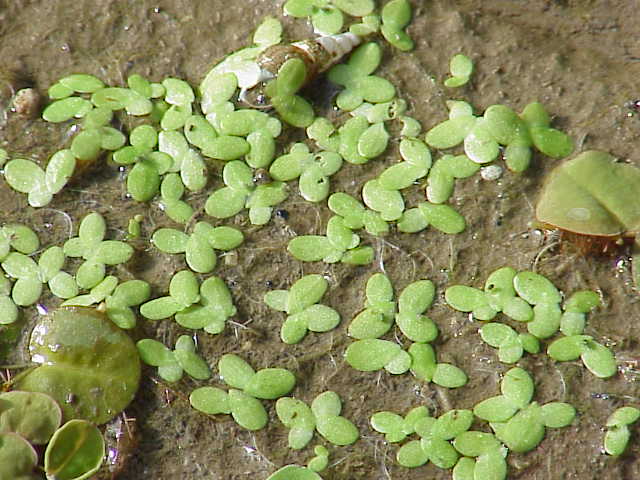
Photo: Kurt Stüber [1], CC BY-SA 3.0 · source

Herbaceous plant · Arum family (Araceae)
Common duckweed
Lemna minor
In other languages: Klein kroos (Nederlands) · Petite lentille d’eau (Français)
Grows wild in Belgium.
Common duckweed is one of the smallest flowering plants in our region: each ‘plant’ is a tiny floating oval frond, 2–4 mm long, with a single root hanging down into the water. On still, nutrient-rich water in ditches, pools, ponds and canals it forms a green carpet in summer; it is very common throughout Belgium. You can recognise it by the flat, pale green, usually oval discs, each with exactly one root, often joined in groups of two to four. Ducks, coots and moorhens eat it, and many small water creatures shelter among and beneath the fronds. In a garden pond it is welcome, as long as it does not cover the whole surface.
Light
Sun or partial shade
preferably some sun
Moisture
Moist to wet
must not dry out
Hardiness
Fully hardy
down to -25 °C
Size
0.02 m
tall, 1 m wide
Flowering
June–July
| Pruning months | May–September |
|---|---|
| Height | 0.02 m |
| Native to Belgium | Yes |
| Flowering | June–July |
Identify
How to recognise it
- Growth habit
- Floating water plant without a stem or true leaves: each plant is a flat, oval frond floating on the surface. Two to four fronds often stay joined together.
- Leaf
- The frond is 2–4 mm long, pale green on both sides and flat, with three very faint veins. It is not a true leaf but a fused stem and leaf.
- Roots
- Exactly one unbranched rootlet per frond, a few centimetres long, hanging freely in the water.
- Flower
- Rarely flowers: minute flowers without petals are hidden in a small slit at the edge of the frond, mostly in hot summers.
- Fruit/Seed
- Seed is only rarely formed here; duckweed multiplies almost entirely by new fronds growing out of old ones.
- Confusion with
- Greater duckweed is larger, up to 1 cm, with a purple underside and a bunch of roots. Fat duckweed has a swollen, spongy underside. The non-native least duckweed is smaller and narrower, with a single vein. Water fern is a tiny reddish fern with fine scales. Rootless duckweed is much smaller still and has no roots.
Flowering: June–July · Pruning: May–September
In your garden
Why grow it?
- Food for ducks, coots, moorhens and geese: it is not called duckweed for nothing.
- Gives shade and shelter to tadpoles, water beetles, water snails and young fish.
- Food plant of the small china-mark, a little moth whose caterpillar lives in a case made of duckweed fronds.
- Takes up nutrients from the water and, together with the shade it casts, holds back the growth of floating algae.
- Duckweed scooped from the pond is an excellent nitrogen-rich addition to the compost heap or a mulch for the vegetable garden.
Common duckweed: where does it grow best?
- In the wild on still or slow-flowing, nutrient-rich water: ditches, pools, ponds, moats, canals and marshes.
- Full sun to partial shade; under trees it grows more slowly.
- It thrives best on water rich in nutrients, for example where manure, waste water or lots of fallen leaves end up.
- The wind pushes duckweed to one side of the pond; on sheltered water it forms a closed blanket.
Goes well with
- Yellow water-lily: Large floating leaves that cast shade and compete with duckweed for light.
- Rigid hornwort: A submerged plant that keeps the water clear and takes nutrients away from duckweed.
- Frogbit: A floating plant with small white flowers, a pretty neighbour on still water.
- Yellow iris: A marginal plant for the pond edge, among which duckweed finds shelter.
- Flowering rush: Umbels of pink flowers in the marginal zone in summer.
Maintenance
Common duckweed: when and how to plant it?
- In a garden pond, duckweed usually turns up on its own: water birds and new pond plants bring it in.
- If you do want it, ask someone with a pond for a handful or buy it from a nursery for water and marginal plants. Never scoop it from nature reserves or protected ponds.
- Rinse it first in a bucket and check there is no least duckweed or water fern among it: you don’t want those non-native species in your pond.
- Simply place it on the water, preferably among the marginal plants, between May and August when the water is warm.
- Add submerged plants such as rigid hornwort at the same time, so that duckweed does not take over.
- Never tip surplus duckweed or other pond plants into ditches, streams or other natural waters.
Care
- Skimming
- Scoop part of it off with a fine net or a rake when it covers more than about half of the water, so that submerged plants keep their light.
- Feeding
- Never. The fewer nutrients in the water, the less duckweed. Feed fish sparingly and keep lawn and border fertiliser out of the pond.
- Pond plants
- Submerged plants and plants with floating leaves such as yellow water-lily compete with duckweed for light and nutrients.
- Leave to drain
- Leave skimmed duckweed on the edge for a day so that small water creatures can crawl back. Then it can go on the compost heap.
- Topping up
- Top up the pond with rainwater rather than tap water, and keep fallen leaves out with a net in autumn.
Tip: Lay a long plank or batten across the water and pull it slowly towards the edge: in a few minutes you gather most of the duckweed, and it makes free compost straight away.
Pruning and mowing
Pruning months: May–September.
When: From May to September, whenever duckweed covers more than about half of the water surface.
How:
- Skim the duckweed off with a fine-meshed net, a rake or a plank pulled across the water.
- Work from one side: the wind and a plank help to herd the duckweed together.
- Always leave some duckweed behind: it belongs in a living pond.
- Leave the skimmed duckweed on the bank for a day, then put it on the compost heap or use it as mulch.
Caution: Don’t let a pond stay completely covered for months: under a closed layer of duckweed, water plants get no light and the water can run short of oxygen.
Propagation
- New fronds
- Each frond grows new fronds from its sides, which break away after a while. In warm, nutrient-rich water a layer of duckweed can double in a few days.
- Hitchhiking
- Duckweed spreads with water birds, on their feet and feathers, and with pond plants, nets and boots. Rinse nets and boots before using them in other water.
Common duckweed: how does it get through the winter?
Hardy to −25 °C.
- In autumn, some of the fronds fill with starch and sink to the bottom, where they overwinter.
- Common duckweed survives under ice and in cold water; in spring the fronds float back up and carry on growing.
- In mild winters some duckweed also stays floating on the surface.
Diseases and pests
- Complete cover: A sign of too many nutrients in the water. Skim regularly, feed fish less, keep fallen leaves out of the pond and add more submerged plants.
- Non-native species: Least duckweed and water fern can grow just as densely and are harder to get rid of. Skim them off thoroughly and never take them to other water.
- Blocked pump: Duckweed can end up in a pump or filter. Fit a fine screen over the intake and clean it regularly.
- Invisible water: A layer of duckweed looks like a lawn: small children and dogs cannot see there is water underneath. Provide a barrier or a clearly visible edge.
Through the year
- March: The first fronds float up from the bottom.
- April: Growth starts. Check the pond for non-native duckweeds.
- May: Fast growth. Introduce duckweed to a new pond if you want. Skim where needed.
- June: Skim if more than half is covered. Flowers are only rarely seen.
- July: Full growth. Skim and add to the compost heap.
- August: Skim. Look for the cases of the small china-mark among the duckweed.
- September: Last skimming. A net over the pond against falling leaves.
- October: Fronds sink to the bottom to overwinter.
- December: Resting on the bottom of the pond.
You and this species
Did you know?
- Duckweed belongs to the arum family: its distant relatives include lords-and-ladies and the arum lily.
- It is one of the fastest-growing flowering plants: in warm, nutrient-rich water a layer of duckweed can double its area in a few days.
- Because duckweed is rich in protein and grows so fast, it is being studied as animal feed and for cleaning waste water.