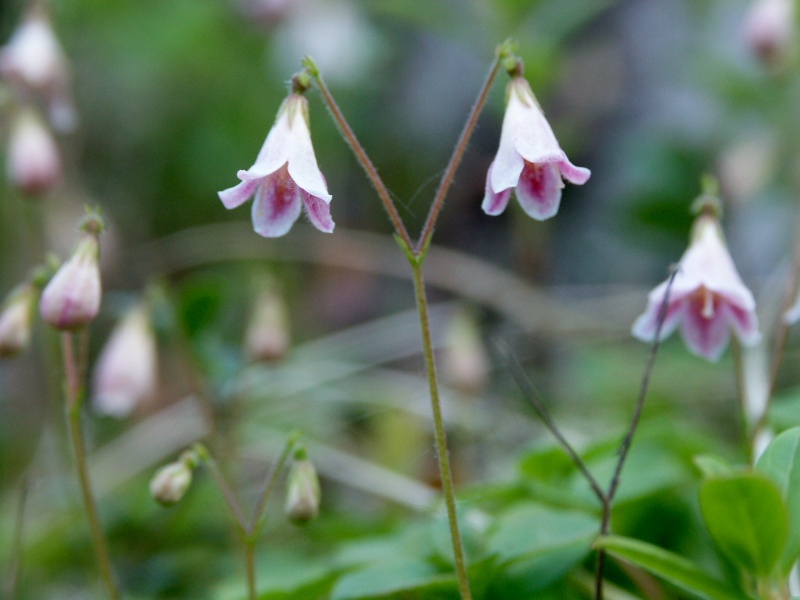
Photo: Henripekka Kallio, CC BY-SA 3.0 · source

Dwarf shrub · Honeysuckle family (Caprifoliaceae)
Twinflower
Linnaea borealis
In other languages: Linnaeusklokje (Nederlands) · Linnée boréale (Français)
Grows wild in Europe, but not in Belgium.
Twinflower is a small evergreen dwarf shrub whose long, creeping stems form a carpet on the forest floor. In the wild it grows in the coniferous forests of Scandinavia, Scotland, the Alps and other cool parts of the northern hemisphere, on acid, mossy ground. It does not grow wild in Belgium; here you only see it in the odd garden or botanical collection. You recognise it at once by its pinkish-white, scented bells, which hang in pairs from a forked stalk. It was the favourite plant of the Swedish botanist Carl Linnaeus, and it bears his name. In a cool, shady rock garden or heather garden it is a little gem, though a demanding one.
Caution: Rare in much of Europe and protected in many places: never pick or dig up plants in the wild, not even on holiday. Buy them only from a nursery.
Light
Partial shade or shade
tolerates little sun
Moisture
Normal
no wet feet
Hardiness
Fully hardy
down to -35 °C
Size
0.1 m
tall, 0.6 m wide
Flowering
June–August
| Pruning months | April |
|---|---|
| Height | 0.1 m |
| Native to Belgium | No, planted |
| Flowering | June–August |
Identify
How to recognise it
- Growth form
- Evergreen dwarf shrub 5–10 cm tall, with thin, woody, creeping stems, sometimes over a metre long, that root at the nodes.
- Leaf
- Small, round to broadly oval, 0.5–1.5 cm, opposite, with a few shallow teeth near the tip; glossy dark green and slightly hairy.
- Flower
- Bells of about 1 cm, white to pale pink with pink stripes inside, scented; always two nodding flowers at the top of an upright, forked stalk 5–10 cm long, from June to August.
- Fruit/seed
- A small, dry, one-seeded fruit surrounded by sticky glandular hairs that cling to animal fur. In gardens it rarely sets fruit.
- Roots
- Shallow roots at the nodes of the creeping stems, in the top layer of leaf litter and moss.
- Confusion with
- Cowberry also has small, glossy leaves and pinkish-white bells, but its flowers are in small clusters at the shoot tips, its leaves are alternate with rolled edges, and red berries follow.
Flowering: June–August · Pruning: April
In your garden
Why grow it?
- Graceful, nodding bells, always in pairs, with a sweet scent.
- An evergreen carpet: the small, glossy leaves stay on the stems all year.
- The flowers are visited by small bees, hoverflies and other small flies.
- A piece of botanical history: this is the plant of Linnaeus, the father of scientific plant names.
- Ideal for a cool, acid spot under conifers or in a shady rock garden, where few other plants flower.
Twinflower: where does it grow best?
- In the wild: conifer and birch woods rich in moss and litter, heaths and mountain forests in northern Europe, the Alps and Scotland.
- Acid, humus-rich, loose soil that never dries out but is not waterlogged either.
- Partial to light shade; in full sun the leaves scorch and the plant dries out.
- In the garden: a cool, sheltered spot under conifers or rhododendrons, in a shady rock garden or in a raised bed of acid, humus-rich soil.
- It dislikes heat: in hot summers it does better on the north side of a wall or shrub.
Goes well with
- Bilberry: Likes the same acid, humus-rich soil and adds height above the carpet.
- Cowberry: A second evergreen dwarf shrub, with pink bells and red berries.
- May lily: A small woodland plant with white flowers in May, for the same cool spot.
- Chickweed wintergreen: A delicate white star-shaped flower from the same northern forest.
- Hard fern: An evergreen fern for cool, acid woodland soil.
Maintenance
Twinflower: when and how to plant it?
- Buy a plant from a nursery specialising in alpine or woodland plants; never dig up plants in the wild, not even on holiday.
- Plant in April or September, when the soil is cool and moist.
- Prepare loose, acid soil: mix leaf mould and conifer needles into sandy soil. Use no lime and no fresh manure.
- Plant shallowly, with the creeping stems flat on the ground, and pin a few stems down with a small hook so they root faster.
- Water with rainwater and keep the soil evenly moist during the first year.
- Allow 30–40 cm between plants; after a few years they join up into a carpet.
Care
- Water
- In dry spells, water with rainwater; tap water is often limy. Never let the soil dry out, especially in summer.
- Feeding
- Not needed. A thin layer of leaf mould or needle litter in autumn is enough.
- Mulching
- In spring, scatter a little conifer needle litter or leaf mould between the stems: it keeps the soil cool and moist.
- Weeding
- Keep vigorous plants such as grasses and nettles away: twinflower is weak and easily smothered.
- Space
- Let the creeping stems spread freely; they root at the nodes and fill bare patches.
Tip: Use only rainwater and a mulch of conifer needles: that way you recreate the cool, acid forest floor of Scandinavia.
Pruning and mowing
Pruning months: April.
When: Not needed; at most a little tidying in April.
How:
- In April, cut out dead or dried-up stems.
- You can shorten stems that grow over the path or into other plants; use the cut pieces as cuttings.
- Otherwise leave the carpet alone: every trim costs growth.
Propagation
- Layering
- The easiest way: creeping stems root by themselves at the nodes. In April or September, cut off a rooted piece and replant it elsewhere.
- Cuttings
- In June–August, take 5–8 cm cuttings from the creeping stems and put them in a moist mix of sand and leaf mould, under plastic in the shade.
- Seed
- Rarely possible: the plant sets little fruit, especially if only one clone is present.
Twinflower: how does it get through the winter?
Hardy to −35 °C.
- Evergreen: the small, glossy leaves stay on the stems all winter.
- Very hardy: in northern Scandinavia it survives severe frost, especially under snow.
- Frost without snow and drying east winds are harder on it: a loose layer of conifer branches or dry leaves protects the carpet.
Diseases and pests
- Drying out: Brown, withered stems after a hot, dry summer. Choose a cooler spot, water with rainwater and mulch with litter.
- Smothering: Grasses and vigorous plants quickly grow over it. Weed by hand and keep the carpet open.
- Lime: Yellow leaves and little growth on chalky soil or when watered with hard tap water. Use rainwater and acid, humus-rich soil.
- Waterlogging: In stagnant water the stems rot. Make sure the soil is loose and free-draining.
- No flowers: Too much shade or too much heat. A spot with morning sun and light shade for the rest of the day helps.
Through the year
- March: Check the spot. In dry weather, start watering with rainwater.
- April: Cut out dead stems. Plant or detach rooted stems. Mulch with leaf mould or needle litter.
- May: New growth. Weed between the stems.
- June: First bells appear. Water in dry spells.
- July: Full flower. Take cuttings. Water with rainwater when dry.
- August: Last flowers. Take cuttings.
- September: Plant or move rooted stems.
- October: A thin layer of leaf mould or litter between the stems.
- December: Evergreen carpet. In frost without snow, cover with conifer branches.
You and this species
Did you know?
- Carl Linnaeus called this his favourite plant. His colleague Jan Frederik Gronovius named the genus Linnaea after him, and in many portraits Linnaeus holds a sprig of twinflower.
- Linnaeus wrote, with some self-mockery, that it was a lowly, insignificant plant that flowers only briefly, just like himself.
- It is the provincial flower of Småland, the Swedish province where Linnaeus was born.