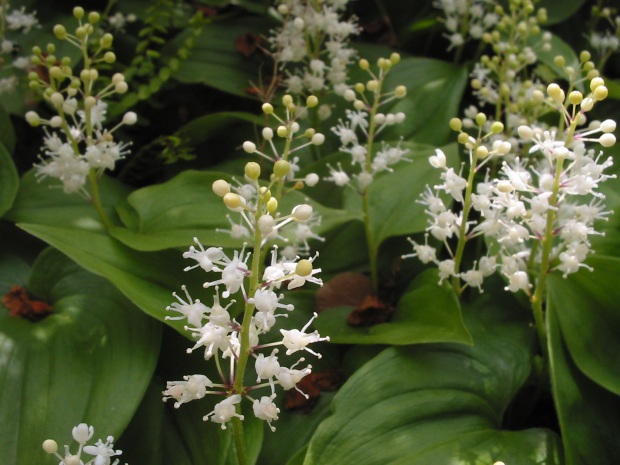
Photo: Bouba at French Wikipedia, CC BY-SA 3.0 · source

Herbaceous plant · Asparagus family (Asparagaceae)
May lily
Maianthemum bifolium
In other languages: Dalkruid (Nederlands) · Maïanthème à deux feuilles (Français)
Grows wild in Belgium.
May lily is a small woodland perennial that usually has two glossy, heart-shaped leaves on a short stem and, in May–June, a little spike of fragrant white flowers. It grows in broadleaved and mixed woodland on acid, humus-rich sandy or loamy soil, often with bilberry and wood sorrel. In the Campine, the Ardennes and in ancient woods elsewhere it is locally fairly common, but it is absent from large parts of the country. With its creeping rootstock it forms carpets in which many plants have only one leaf and do not flower. In late summer small berries appear, first green with red speckles and then bright red. It is a typical plant of ancient woodland and a lovely ground cover for a shady garden on acid soil.
Caution: The berries and other parts of May lily are considered mildly poisonous: don’t eat them and teach children not to pick them. Don’t confuse May lily with the highly poisonous lily of the valley either. Never dig it up in the woods: buy it from a nursery.
Light
Partial shade or shade
tolerates little sun
Moisture
Normal
no wet feet
Hardiness
Fully hardy
down to -30 °C
Size
0.15 m
tall, 0.3 m wide
Flowering
May–June
| Height | 0.15 m |
|---|---|
| Native to Belgium | Yes |
| Flowering | May–June |
Identify
How to recognise it
- Growth habit
- Low perennial 5–20 cm tall with a thin, creeping rootstock; forms carpets of non-flowering plants with one leaf and flowering stems with two, sometimes three leaves.
- Leaf
- Heart-shaped, 3–8 cm, pointed, glossy fresh green, with curved veins and a short stalk; the leaves are alternate on the stem.
- Flower
- An upright spike 2–5 cm long at the top, with ten to over twenty small, white, fragrant flowers. Each flower has four tepals and four stamens; May–June.
- Fruit/Seed
- Round berries 4–6 mm across, first green with red or purple speckles, bright red when ripe in August–September.
- Roots
- Thin, creeping, branched rootstock just below the leaf litter.
- Confusion with
- Lily of the valley has two large, elongated leaves and hanging white bells; it is highly poisonous. Wood anemone and wood sorrel have divided leaves. May lily: small, glossy, heart-shaped leaves and an upright spike of tiny flowers.
Flowering: May–June
In your garden
Why grow it?
- Fragrant white flowers in May–June, visited by small bees, flies and little beetles.
- Red berries in late summer, which are spread mainly by birds.
- A true ancient woodland plant: where May lily grows, the wood has often been woodland for a very long time.
- A low, green ground cover for shade under trees on acid soil, where little else will grow.
- Delicate and small: a plant to look at up close, with flowers built in fours.
May lily: where does it grow best?
- In the wild in broadleaved and mixed woodland on acid, humus-rich, fairly moist soil: oak and beech woods, birch woods, woodland edges and old wooded banks.
- Partial shade to shade; in full sun the leaves scorch.
- Acid to slightly acid, humus-rich sandy or loamy soil with a layer of leaf litter; no lime.
- In the garden: under shrubs and trees in a woodland garden, with ferns and other woodland plants.
Goes well with
- Wood anemone: A white carpet in March–April, just before May lily flowers.
- Bilberry: Grows on the same acid woodland soil and gives berries for birds.
- Wood sorrel: Low, fresh green ground cover of acid, moist woodland soil.
- Lady fern: Delicate ferns that rise above the low May lily.
- White wood-rush: A fine, grass-like woodland plant of acid soil, with small white flowers in June.
Maintenance
May lily: when and how to plant it?
- Buy plants from a nursery for native or woodland plants. Never dig up May lily in the woods: it is a vulnerable plant of ancient woodland.
- Plant in September–October or in March, when the soil is moist.
- Lay the pieces of rootstock flat, a few centimetres deep and 15–20 cm apart, in soil enriched with leaf mould.
- Water after planting and keep the soil moist in the first year.
- Cover the soil with a layer of fallen leaves: that is the woodland floor May lily loves.
- Be patient: it grows slowly for the first few years and only flowers well once it is established.
Care
- Watering
- Water during drought in the first year; after that only in very dry summers.
- Feeding
- Not needed. Leave the fallen leaves of the trees in place: that is food enough.
- Leaf litter
- Don’t rake up autumn leaves under the trees; they keep the soil acid, moist and rich in humus.
- Spreading
- Not invasive. In a good spot it spreads slowly; if needed, keep it in check by cutting off a piece at the edge.
- Leave undisturbed
- Don’t dig the soil around the plants: the rootstocks lie close to the surface.
Tip: Leave the autumn leaves under your trees: May lily grows best in a real woodland floor of rotted leaves. Plant ten or so clumps together from the start and you will get a carpet sooner.
Pruning and mowing
When: Not needed: the leaves die back by themselves in autumn.
How:
- Simply leave dead leaves where they fall; they turn into humus.
- Don’t pick off the faded stems if you want the berries for the birds.
Propagation
- Division
- In September–October or March, cut off a piece of the carpet with its rootstock and replant it elsewhere at once.
- Seed
- In autumn, sow seed from ripe berries, cleaned of their pulp, in a pot outdoors. The seed needs a cold period and germinates slowly, sometimes only after a year or more.
May lily: how does it get through the winter?
Hardy to −30 °C.
- The leaves die back in autumn; the plant overwinters with its rootstock under the leaf litter.
- Fully hardy, even in severe winters.
- Red berries may stay on the plant for a while in autumn.
Diseases and pests
- Slow to start: Normal: it can take a few years before a carpet forms. Plant a little closer and add leaf mould.
- Few flowers: Many single-leaved plants do not flower; that is simply how it is. Too much shade or drought reduces flowering further.
- Slugs: They can nibble the young leaves in April. The plant usually recovers; in a woodland garden, hedgehogs and ground beetles eat many slugs.
- Yellow leaves: On chalky or too dry soil. Choose an acid, humus-rich spot and mulch with leaves.
Through the year
- March: Plant or divide. Leave the leaf litter in place.
- April: New leaves appear.
- May: Flowering begins: fragrant white spikes.
- June: Last flowers.
- August: The berries turn from speckled green to red.
- September: Ripe berries. Plant or divide.
- October: The leaves die back. Leave autumn leaves in place.
- November: Resting under the leaf litter.
You and this species
Did you know?
- Maianthemum means ‘May flower’ and bifolium ‘two-leaved’: the plant flowers in May, with two leaves on the stem.
- Most monocots have their flower parts in threes, but May lily’s flowers are built in fours: four tepals and four stamens.
- May lily is an ancient woodland indicator: it spreads so slowly that you mainly find it in woods that have existed for a very long time.