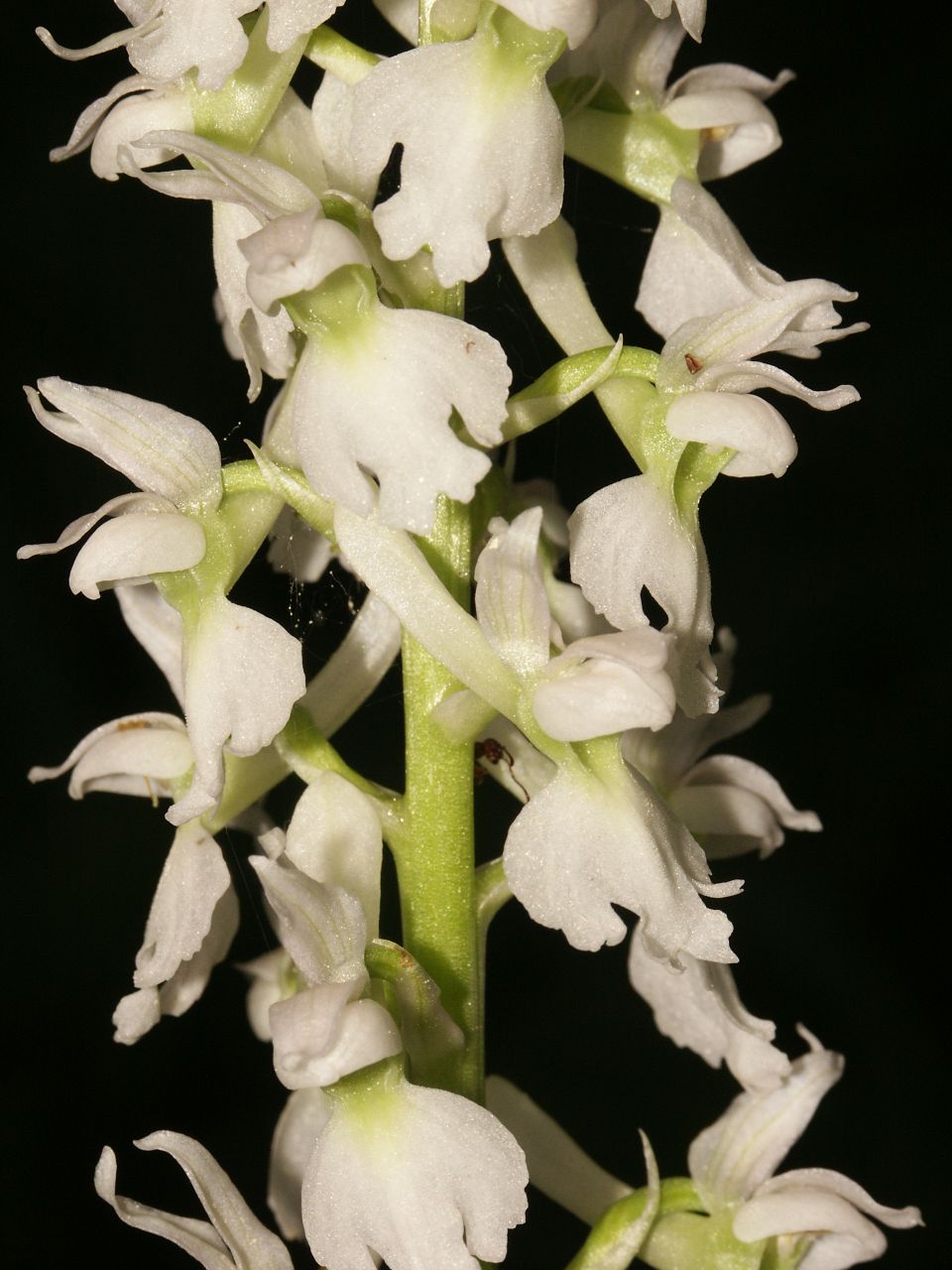
Photo: Wikimedia Commons, CC BY-SA 3.0 · source

Herbaceous plant · Orchid family (Orchidaceae)
Early-purple orchid
Orchis mascula
In other languages: Mannetjesorchis (Nederlands) · Orchis mâle (Français)
Grows wild in Belgium.
The early-purple orchid is one of the first wild orchids to flower in Belgium: from late April its purple flower spikes rise above the fresh spring greenery. It grows in deciduous woods, coppice, woodland edges, sunken lanes and chalk grassland, usually on chalky loam or clay. In the south of the country it is locally fairly common on limestone; in Flanders it is rare, with sites in the Voeren area among others. You can recognise it by the glossy leaf rosette, often with dark purple spots, and by the purple flowers with a horizontal or upturned spur and side sepals that stand up like little wings. Like all wild orchids, it is protected in Belgium: a plant to admire, not to pick.
Caution: All wild orchids are protected by law in Belgium. Do not pick the flowers and never dig up plants or tubers in the wild; only buy plants raised from seed in a nursery.
Light
Sun or partial shade
preferably some sun
Moisture
Normal
no wet feet
Hardiness
Fully hardy
down to -25 °C
Size
0.35 m
tall, 0.15 m wide
Flowering
April–June
| Pruning months | July |
|---|---|
| Height | 0.35 m |
| Native to Belgium | Yes |
| Flowering | April–June |
Identify
How to recognise it
- Growth habit
- Perennial orchid with tubers, 15–50 cm tall, with a leaf rosette at the base and a single unbranched flowering stem.
- Leaf
- 3–8 oblong, glossy green leaves of 5–15 cm, often with dark purple to blackish spots, but sometimes unspotted; higher up, a few smaller leaves sheathe the stem.
- Flower
- A loose to fairly dense spike of 10–50 purple to pink flowers, rarely white. The lip has three lobes and a paler centre with dark spots; the spur is about as long as the ovary and points horizontally or upwards. The two side sepals stand up like little wings. From late April to early June.
- Fruit/Seed
- An upright capsule full of thousands of dust-fine seeds without food reserves, carried away by the wind.
- Tubers
- Two egg-shaped tubers underground: the old one feeds the flowering, while the new one grows for next year.
- Confusion with
- Green-winged orchid has unspotted leaves and a hood of sepals with green veins. Dactylorhiza orchids such as common spotted-orchid and broad-leaved marsh-orchid usually flower later, have leaves high up the stem and a spur that points downwards. Lady orchid is much sturdier, with a dark hood and a pale, spotted lip.
Flowering: April–June · Pruning: July
In your garden
Why grow it?
- One of the first orchids of the year: it flowers from late April into June, together with cowslips and bluebells.
- Bumblebee queens and bees visit the flowers, even though they find no nectar there: the plant lures them with colour and scent and so hands over its pollen packets.
- A typical plant of old, chalky woods, coppice and unimproved grassland: where it grows, the soil has not been fertilised or disturbed for a long time.
- One of the least demanding native orchids for a nature garden on chalky soil, as long as you buy nursery-raised plants.
- A plant with a long history: its tubers were once dried and ground into salep, a starchy flour used in drinks and dishes.
Early-purple orchid: where does it grow best?
- In the wild: deciduous woods, coppice, woodland edges, sunken lanes, banks and chalk grassland, usually on chalky loam or clay.
- Part shade under deciduous trees or sun in unimproved grassland; in deep shade it flowers poorly.
- Well-drained, moderately moist to fairly dry soil, chalky to neutral and low in nutrients: never fertilise.
- In the garden: in a wildflower meadow on chalky soil, under hazels or along a sunny woodland edge, in a spot where the soil is never dug.
Goes well with
- Cowslip: Yellow flowers at the same time, on the same chalky soil.
- Bluebell: A blue carpet under the trees in spring, beside the purple spikes.
- Wood anemone: Flowers just a little earlier, in the same open woodland.
- Hazel: Gives light shade in spring; ideal as coppice above the orchids.
- Woodruff: Woodland ground cover with small white flowers in May.
Maintenance
Early-purple orchid: when and how to plant it?
- Only buy plants raised from seed by a specialist nursery, never plants taken from the wild.
- Plant in September–October, when the plant is dormant, or in spring with a whole, undamaged root ball from the pot. Plant at the same depth as in the pot, without damaging the tubers or roots.
- Choose chalky, well-drained soil; on acid sand, mix some chalky loam or limestone grit into the planting hole.
- Plant several in a small group, 15–20 cm apart: it looks more natural and improves the chance of pollination.
- Water after planting and keep the soil lightly moist for the first few weeks, but never soggy. No fertiliser and no potting compost.
- Never dig up orchids in the wild: it is forbidden, and dug-up plants nearly always die because they lose their fungal partner.
Care
- Watering
- Not needed once established. Only water now and then during a long dry spell in spring, while it is growing and flowering.
- Feeding
- Never. Manure, compost and fertiliser favour grasses and harm the soil fungi the orchid depends on.
- Mowing
- Do not mow a meadow with orchids until mid-July, when the seeds have been shed, and remove the cuttings.
- Rest
- Let the leaves die back by themselves after flowering: they feed the new tuber. Mark the spot so you do not dig there in summer.
- Competition
- Keep brambles, nettles and tall grasses away; pull them out carefully without touching the tubers.
Tip: Plant a small group of three to five nursery-raised plants in one spot rather than single plants: the flowers stand out more, and bumblebees are more likely to pollinate them so that seed is set.
Pruning and mowing
Pruning months: July.
When: No pruning, just mowing: from mid-July, once the seeds have blown out of the capsules.
How:
- Do not cut off spent flower stems: leave them until the capsules turn brown and split open.
- Mow the grassland or woodland edge around the plants from mid-July and remove the cuttings, so the soil stays poor.
- Let the leaves turn yellow and wither by themselves; this happens in June–July.
- Thin out shrubs and trees above the plants in winter, so enough light reaches the woodland floor in spring.
Caution: Never mow during growth and flowering, from late winter to mid-July: the plant needs its leaves to fill its new tuber.
Propagation
- Seed
- Let the capsules split open on the plant in June–July. The dust-fine seeds only germinate with a suitable soil fungus, and it takes many years before a seedling flowers. You can scatter ripe seed from your own garden near existing plants.
- Tubers
- An older plant sometimes forms two new tubers and so, very slowly, grows into a small clump. Digging it up to divide it is not recommended: it does not tolerate it well.
Early-purple orchid: how does it get through the winter?
Hardy to −25 °C.
- After flowering the leaves die back; in summer and autumn the plant rests underground as a tuber.
- The new leaf rosette can appear as early as late winter, often among the first green leaves on the woodland floor.
- Fully hardy: the tuber is safe in the ground.
Diseases and pests
- Slugs and snails: They eat the young leaves and flower buds. In a natural spot with hedgehogs, thrushes, frogs and ground beetles the damage usually stays limited; otherwise, pick them off in the evening.
- Rabbits, deer and wild boar: Rabbits and deer eat the flower stems, wild boar dig up the tubers. In the garden, a small cage of chicken wire protects the plant.
- No flowers: Young and newly planted plants sometimes skip a year, as they also do after a dry spring or in shade that is too deep. Give it time and enough light.
- Disappearing: On fertilised or dug soil it soon disappears. Never fertilise and leave the soil around the plant undisturbed.
Through the year
- February: The first leaf rosettes may appear. Watch out for slugs.
- March: The leaves grow. Pick off slugs.
- April: First flower spikes in late April. Do not mow.
- May: Full flower. Bumblebees visit the flowers.
- June: Last flowers; the capsules swell and the leaves turn yellow.
- July: The seeds blow away. From mid-July, mow and remove the cuttings.
- September: Plant nursery-raised plants. The plant rests underground.
- October: Plant. Leave fallen leaves under the shrubs.
- December: Dormant. If needed, thin out shrubs above for more spring light.
You and this species
Did you know?
- Orchis comes from the Greek orchis, ‘testicle’: the name refers to the two round tubers. The word orchid comes from it too.
- Fresh flowers smell sweet, but older flowers, especially in the evening, smell of tomcat.
- Many experts believe that the ‘long purples’ in Ophelia’s garland, in Shakespeare’s Hamlet, were early-purple orchids.