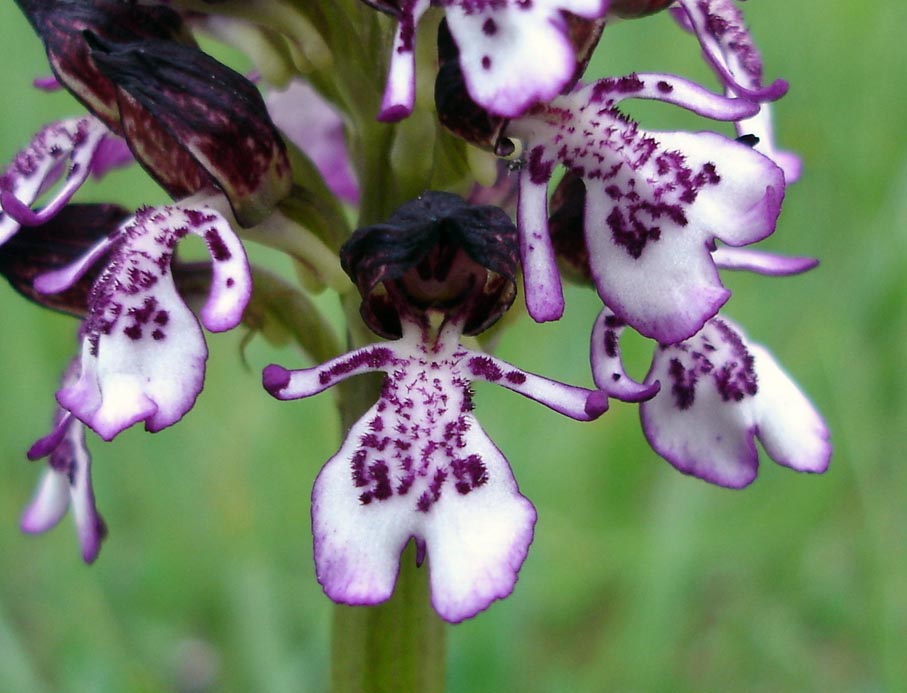
Photo: Wikimedia Commons, CC BY-SA 3.0 · source

Herbaceous plant · Orchid family (Orchidaceae)
Lady orchid
Orchis purpurea
In other languages: Purperorchis (Nederlands) · Orchis pourpre (Français)
Grows wild in Belgium.
The lady orchid is one of the largest and most beautiful wild orchids in Belgium, with a thick flower spike on a stem 30–80 cm tall. Each flower looks like a little lady: a dark purple bonnet, two narrow arms and a wide, pale skirt dotted with purple. It grows on chalky soil in open deciduous woods, woodland edges, scrub, chalk grassland and old quarries. In the south of the country, especially in the limestone regions of Wallonia, it is locally fairly common; in Flanders it is rare, with sites mainly in the Voeren area. In May you can recognise it by its broad, glossy, light green, unspotted leaves and the sturdy spike with dark buds at the top and pale open flowers below. Like all wild orchids, it is protected in Belgium.
Caution: All wild orchids are protected by law in Belgium. Do not pick the flowers and never dig up plants or tubers in the wild; only buy plants raised from seed in a nursery.
Light
Sun or partial shade
preferably some sun
Moisture
Dry to normal
no wet feet
Hardiness
Fully hardy
down to -25 °C
Size
0.5 m
tall, 0.2 m wide
Flowering
May–June
| Pruning months | August |
|---|---|
| Height | 0.5 m |
| Native to Belgium | Yes |
| Flowering | May–June |
Identify
How to recognise it
- Growth habit
- Sturdy perennial orchid with tubers, 30–80 cm tall, with a leaf rosette at the base and a single thick, unbranched flowering stem.
- Leaf
- 3–6 broad, oval to oblong leaves of 10–20 cm, glossy light green and unspotted, in a rosette; higher up, a few smaller leaves sheathe the stem.
- Flower
- A dense, cylindrical spike of dozens of flowers that open from the bottom up. Sepals and petals together form a dark purplish-brown, speckled hood; the lip is white to pale pink, dotted with tufts of purple hairs, with two narrow ‘arms’ and a broad ‘skirt’ split in two. The spur is short and points downwards. From early May to early June.
- Fruit/Seed
- An upright capsule with thousands of dust-fine seeds, scattered by the wind in summer.
- Tubers
- Two egg-shaped tubers underground: one feeds the flowering, the other grows for next year.
- Confusion with
- Military orchid is smaller, with a pale grey to pinkish hood and a lip with narrow arms and legs. Monkey orchid has even thinner, curled ‘limbs’. Lizard orchid flowers later, in June–July, and has a long, twisted, ribbon-like lip and a goat-like smell. Early-purple orchid is purple all over, with often spotted leaves and an upturned spur.
Flowering: May–June · Pruning: August
In your garden
Why grow it?
- One of the most striking native orchids: a sturdy spike full of flowers that from a distance looks like a small dark candle.
- Bees and other insects visit the flowers, even though they give no nectar; this way they carry the pollen packets on to another plant.
- A typical plant of chalky woodland edges, scrub and slopes; in a suitable spot a single plant can go on flowering for many years.
- Decorative even outside the flowering season: the large, glossy leaf rosette stands out at once among the young greenery in spring.
- A special addition to a nature garden on chalky soil with an open woodland edge, as long as you buy nursery-raised plants.
Lady orchid: where does it grow best?
- In the wild: open deciduous woods, woodland edges, coppice, scrub, chalk grassland with a few shrubs, road verges and old limestone quarries.
- Part shade or light shade is ideal, for example at the edge of a group of shrubs; it also tolerates sun if the soil does not get too dry.
- Chalky, well-drained soil, moderately dry to moderately moist and low in nutrients, as on limestone, marl or chalky loam.
- In the garden: along the light edge of a shrubbery or under open shrubs such as hazel and wild privet, on chalky soil that you never dig or fertilise.
Goes well with
- Cowslip: Yellow flowers in April, on the same chalky soil.
- Early-purple orchid: Flowers a little earlier in the same kind of places; together they lengthen the orchid season.
- Hazel: Light spring shade along the woodland edge; ideal as coppice.
- Wild privet: Native shrub of chalky woodland edges, with fragrant white flowers in June–July and black berries for the birds.
- Wild marjoram: Takes over flowering in summer and attracts many butterflies and bees.
Maintenance
Lady orchid: when and how to plant it?
- Only buy plants raised from seed in a specialist nursery; the choice is small, but it is the only right way.
- Plant in September–October, when the plant is dormant, or in spring with a whole, undamaged root ball from the pot. Plant at the same depth as in the pot.
- Choose chalky, well-drained soil. On acid soil it rarely succeeds; if needed, make a raised bed with chalky loam and limestone grit.
- Leave 25–30 cm between plants, so the broad leaf rosettes do not shade each other.
- Water well and keep the soil lightly moist for the first few weeks. Never give manure, compost or potting compost.
- Never dig up orchids in the wild: it is forbidden, and dug-up plants nearly always die because they lose their fungal partner.
Care
- Watering
- Not needed once established. Only water now and then during a long dry spell in spring, while it is growing and flowering; in summer it is dormant and the soil may dry out.
- Feeding
- Never. Fertiliser makes grasses and tall weeds stronger and harms the soil fungi the orchid depends on.
- Light
- Keep the shrubs and trees above it open: thin them in winter if the shade becomes too heavy. In deep shade it stops flowering.
- Mowing
- Do not mow the woodland edge or grassland around the plants until August, when the seeds have been shed, and remove the cuttings.
- Rest
- Let the leaves die back by themselves after flowering: they fill the new tuber. Mark the spot with a stick so you do not dig there in summer.
Tip: Plant it along the light edge of a group of shrubs on chalky soil and thin those shrubs a little every few winters: with enough spring light it will keep flowering year after year.
Pruning and mowing
Pruning months: August.
When: No pruning, just mowing: from August, once the seeds have blown away.
How:
- Leave the spent stems until the capsules turn brown and split open.
- Mow the surroundings from August and remove the cuttings, so the soil stays poor.
- Thin out shrubs and trees above it in winter, so enough light reaches the plant in spring.
- Never cut off the leaves: let them wither by themselves in July.
Caution: Never mow or cut between March and the end of July: the plant needs its leaves to fill its new tuber, and the seed still has to ripen.
Propagation
- Seed
- In July the capsules split open and release dust-fine seeds. They only germinate with a suitable soil fungus, and it takes many years before a seedling flowers. In the garden, simply let the seed ripen on the plant.
- Tubers
- An old plant sometimes forms an extra tuber and so, very slowly, grows into a small group. Digging it up to divide it is not recommended: it does not tolerate it well.
Lady orchid: how does it get through the winter?
Hardy to −25 °C.
- After flowering the leaves die back; the plant spends summer and winter underground as a tuber.
- In late winter or early spring the new, glossy leaf rosette appears.
- Fully hardy: the tuber is safe in the ground.
- A thin layer of fallen leaves from the shrubs above may stay in place and protects the soil.
Diseases and pests
- Slugs and snails: They eat the young leaves and flower buds. Pick them off in the evening; hedgehogs, thrushes and ground beetles help too.
- Deer, rabbits and wild boar: Deer and rabbits eat the flower spikes, wild boar dig up the tubers. In the garden, a small wire cage protects the plant.
- Too much shade: When the shrubs close in, it flowers less and eventually disappears. Thin them out in good time, in winter.
- No flowers: Young or newly planted lady orchids sometimes form only a leaf rosette for years, and after a dry spring flowering may fail for a year. Give them time.
Through the year
- March: The glossy leaf rosettes appear. Pick off slugs.
- April: The flower spike grows. Do not mow.
- May: Full flower. Bees visit the flowers.
- June: Last flowers; the capsules swell.
- July: The leaves wither and the seeds blow away.
- August: Mow and remove the cuttings.
- September: Plant nursery-raised plants. The plant rests underground.
- October: Plant. A thin layer of leaves may stay in place.
- December: Thin out shrubs above for more spring light.
You and this species
Did you know?
- The name ‘lady orchid’ refers to the lip, which looks like a little lady in a wide skirt, with the dark hood as her bonnet.
- Where lady orchid and military orchid grow together, hybrids with features of both species sometimes appear.
- A single capsule holds thousands of seeds as light as dust. They have no food store of their own and can only germinate if a soil fungus feeds them.