Photo: No machine-readable author provided. Folini assumed (based on copyright claims)., CC BY 2.5 · source

Herbaceous plant · Nettle family (Urticaceae)
Pellitory-of-the-wall
Parietaria judaica
In other languages: Klein glaskruid (Nederlands) · Pariétaire de Judée (Français)
Grows wild in Belgium.
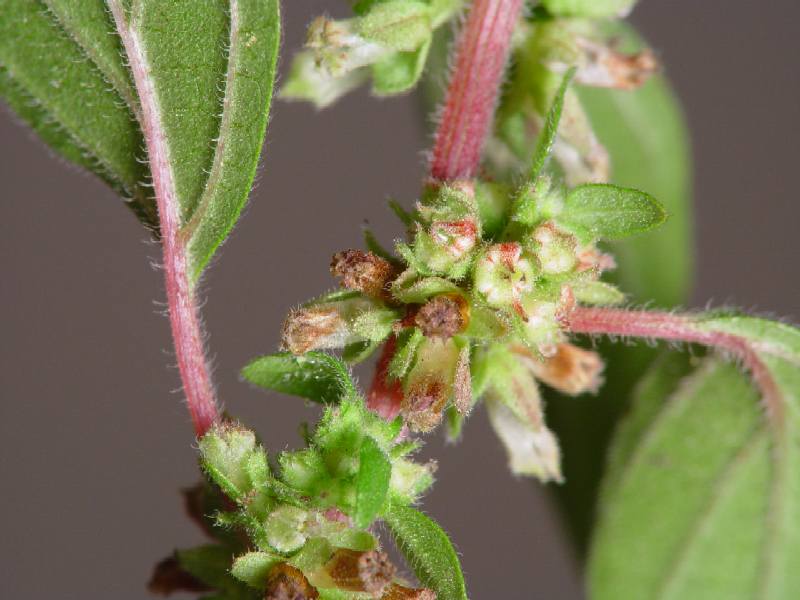
Pellitory-of-the-wall is a low, bushy perennial of the nettle family, but without stinging hairs. Here it grows mainly on old walls built with lime mortar: church and castle walls, quaysides, ruins and old garden walls, and at their foot. In Belgium it is fairly common in towns, old village centres and river valleys such as the Meuse valley, but scarcer elsewhere. You can recognise it by its reddish, much-branched stems, its small oval leaves with smooth edges that cling lightly to your clothes, and its inconspicuous greenish flowers in clusters in the leaf axils. It brings greenery to paved and built-up places, and red admiral caterpillars are sometimes found on it.
Caution: The pollen is a well-known cause of hay fever. If you suffer from it, do not plant it near windows or a patio, and weed or cut it in damp weather or outside the flowering season. The plant does not sting, unlike nettles.
Light
Sun or partial shade
preferably some sun
Moisture
Dry
tolerates drought
Hardiness
down to -18 °C
protect young plants
Size
0.4 m
tall, 0.5 m wide
Flowering
June–October
| Pruning months | March |
|---|---|
| Height | 0.4 m |
| Native to Belgium | Yes |
| Flowering | June–October |
Identify
How to recognise it
- Growth form
- Perennial of 10–40 cm, much branched, with sprawling to ascending, reddish, softly hairy stems that form loose clumps.
- Leaf
- Alternate, oval to elliptical, 1–5 cm, with a smooth edge and a stalk. Finely hairy and slightly sticky, without stinging hairs.
- Flower
- Small greenish flowers in clusters in the leaf axils, from June to October. In warm weather the stamens suddenly flick outwards and release a little puff of pollen.
- Fruit/Seed
- Tiny, shiny black nutlets, enclosed by the dried-up perianth.
- Roots
- A woody rootstock with roots that reach deep into joints and crevices.
- Confusion with
- Upright pellitory (Parietaria officinalis) grows erect, is barely branched and has larger leaves of 5–12 cm; it grows rather in tall herbage along rivers. Stinging nettle has toothed leaves and stinging hairs. Annual mercury has opposite, toothed leaves.
Flowering: June–October · Pruning: March
In your garden
Why grow it?
- One of the few plants that grow on old walls: it turns a bare town wall into a small habitat.
- Red admiral caterpillars are sometimes found on it, as on its relative the stinging nettle.
- Its dense clumps shelter small snails, woodlice, spiders and small insects, which wrens hunt for.
- Flowers for a long time, from June to October, though inconspicuously: it is wind-pollinated and of no interest to bees.
- A piece of history: old walls covered in pellitory show where people have built with lime mortar for centuries.
Pellitory-of-the-wall: where does it grow best?
- In the wild on old walls with lime mortar, quaysides, ruins, rocks and at the foot of walls, often in nitrogen-rich spots.
- Sun to partial shade; it copes well with warm, dry walls.
- Lime-rich, free-draining soil or mortar; at the foot of walls also fertile soil.
- In the garden: in the joints of an old garden wall, a dry-stone wall or a stone staircase, or between stones at the foot of a wall.
Goes well with
- Ivy-leaved toadflax: Lilac flowers and rounded leaves that clamber over the same old walls.
- Wall-rue: A small fern of lime-rich wall joints.
- Maidenhair spleenwort: Fine fronds with a black midrib in shady joints.
- Yellow corydalis: Flowers yellow for months on walls and kerbs.
- Wallflower: Fragrant yellow to orange flowers in spring, for sunny walls.
Maintenance
Pellitory-of-the-wall: when and how to plant it?
- Buy a plant from a native plant nursery, or in late summer collect a little ripe seed from a plant on a wall near you, never in a nature reserve.
- Sow in September–October: scatter the seed with a handful of loam or sand into the joints of an old wall or between the stones at its foot.
- Or sow in a small pot of poor, lime-rich soil and plant the young plant in spring into a hole in a wall or between stones.
- Push some damp moss or loam behind and around the root ball so that it does not dry out.
- For the first weeks, mist it now and then with a plant sprayer; after that it looks after itself.
- Do not plant it on a historic monument or a wall with crumbling joints without asking the owner.
Care
- Water
- Only until it is established. After that not needed, even in dry summers.
- Feeding
- Not needed; at the foot of walls the soil is often rich enough already.
- Wall maintenance
- On a sound old wall it can safely stay. If a wall needs repointing, remove it from the joints you repair.
- Spreading
- Self-seeds along walls and in joints. Pull out unwanted seedlings while young, when their roots are still small.
- Hay fever
- Bothered by pollen? Weed or cut it preferably after a shower or outside the flowering season.
Tip: To green up a bare old wall, scatter seed of pellitory and ivy-leaved toadflax with a handful of loam into the joints in autumn: you get a living wall without planting anything.
Pruning and mowing
Pruning months: March.
When: In March, before new growth starts, or not at all.
How:
- Leave the old stems standing over winter: small insects and spiders overwinter in them.
- In March, cut dead and overlong stems back to just above the new shoots at the base.
- An oversized clump at the foot of a wall can be cut back by half in summer; it soon regrows.
Caution: If you suffer from hay fever, do not cut it while it is flowering: every touch releases a puff of pollen.
Propagation
- Seed
- Sow in September–October in wall joints or in small pots of poor, lime-rich soil. Seedlings appear in spring.
- Division
- In March–April, a clump at the foot of a wall can be split with a spade and replanted elsewhere between stones.
Pellitory-of-the-wall: how does it get through the winter?
Hardy to −18 °C: protect young plants.
- In mild winters it stays partly green; in hard frost the stems die back and it regrows from the rootstock in spring.
- In a sheltered wall it tolerates frost down to about −18 °C.
- Its dense clumps shelter small snails, woodlice and spiders, and so provide food for wrens.
Diseases and pests
- Hay fever: The pollen can cause hay fever in sensitive people. Do not plant it right next to windows or a patio, and work on it outside the flowering season.
- Damage to joints: On a wall with loose or soft mortar the roots can open up the joints further. On a sound wall it is usually harmless.
- Self-seeding: Seedlings in borders or cracks where you do not want them are easy to pull out while small.
- Drying out: Young plants dry out quickly in a sunny wall. Sow instead, or plant in autumn or early spring.
Through the year
- March: Cut back old stems. Divide oversized clumps.
- April: New shoots. Plant young plants into the wall.
- June: Flowering begins. Take care if you have hay fever.
- July: Flowering. Sometimes red admiral caterpillars on the leaves.
- August: Flowering. Cut back oversized clumps.
- September: Seed ripens. Sow into wall joints.
- October: Last flowers. Still time to sow.
- December: The clumps shelter small creatures.
You and this species
Did you know?
- Parietaria comes from the Latin paries, ‘wall’; judaica means ‘from Judaea’.
- In the bud the stamens are bent inwards under tension; in warm weather they suddenly spring outwards and release a little cloud of pollen.
- The rough, slightly sticky leaves were once used to rub glass and bottles clean: hence the Dutch name glaskruid, ‘glass herb’.