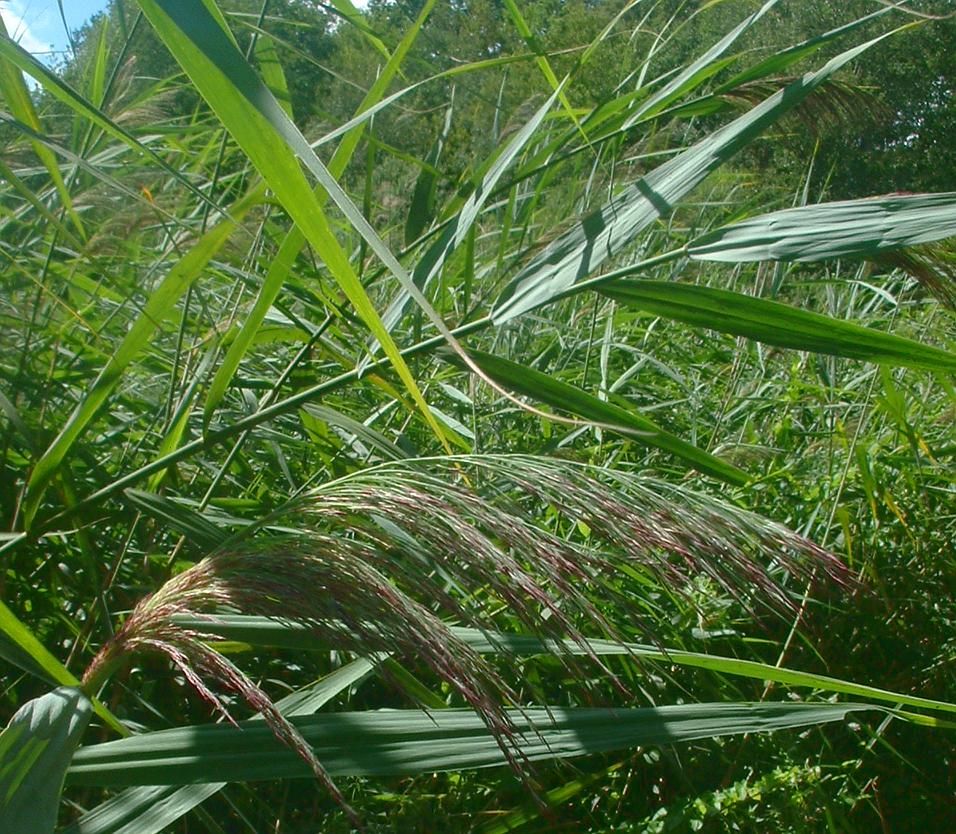
Photo: Wikimedia Commons, CC BY-SA 3.0 · source

Grass-like plant · Grass family (Poaceae)
Common reed
Phragmites australis
In other languages: Riet (Nederlands) · Roseau commun (Français)
Grows wild in Belgium.
Common reed is our largest native grass: its sturdy, hollow stems reach 1.5–3 m and from July to September carry large, purplish-brown plumes that later turn silvery and fluffy. It forms extensive reed beds along ditches, ponds and rivers, in marshes and even in brackish water near the coast, and it is common throughout Belgium. You recognise it by its broad, grey-green leaves that all stream to one side in the wind and by its straw-coloured stems that stay standing all winter. Reed beds are vital for marsh birds such as reed warbler and sedge warbler, and reed also helps to purify water.
Light
Full sun
warm and bright
Moisture
Moist to wet
must not dry out
Hardiness
Fully hardy
down to -30 °C
Size
2.5 m
tall, 2 m wide
Flowering
July–September
| Pruning months | February–March |
|---|---|
| Height | 2.5 m |
| Native to Belgium | Yes |
| Flowering | July–September |
Identify
How to recognise it
- Habit
- Tall perennial grass of 1.5–3 m, in dense, extensive stands that spread by long rhizomes and above-ground runners.
- Leaf
- Grey-green, flat, 1–3 cm wide and up to 50 cm long, with a rough, sharp edge. In place of the ligule there is a fringe of short hairs.
- Flower
- Large, slightly drooping panicle of 20–40 cm, purplish brown at first, from July to September. After flowering it turns silvery and fluffy thanks to long hairs between the florets.
- Stem
- Sturdy, hollow, unbranched stem with clear nodes; straw-coloured in winter and standing for months.
- Roots
- Thick, creeping rhizomes with sharp tips, reaching deep into wet soil; they can pierce a pond liner.
- Confusion with
- Reed canary grass has a membranous ligule instead of a fringe of hairs and a narrower, less fluffy panicle. Reed sweet-grass has bright green leaves with a membranous ligule and often grows in the water.
Flowering: July–September · Pruning: February–March
In your garden
Why grow it?
- Reed beds are breeding and sheltering places for marsh birds such as reed warbler, sedge warbler, water rail and marsh harrier.
- Caterpillars of many moths live on the leaves or even inside the stems of reed.
- The hollow stems are nesting sites for solitary bees and wasps; leave them standing in winter.
- Reed is used in reed-bed filters to purify waste water, and along banks it slows erosion.
- In winter, the straw-coloured stems and silvery plumes form an elegant curtain along the water.
- For centuries the material for thatched roofs, mats and windbreaks.
Common reed: where does it grow best?
- In the wild: reed beds, marshes, the banks of ditches, ponds, rivers and canals, wet verges and brackish coastal polders.
- Full sun to light partial shade; in shade it stays sparse and flowers little.
- Wet to waterlogged soil or shallow water; it tolerates nutrient-rich and slightly brackish water.
- In the garden: only for a large pond with a natural bottom, or in a sturdy container in a smaller pond.
Goes well with
- Yellow iris: Yellow flowers in May–June on the same bank.
- Purple loosestrife: Purple spikes in July–August, a magnet for bees.
- Hemp agrimony: Pink flower heads in August, covered in butterflies.
- Water mint: Low, fragrant bankside plant for the foot of the reed bed.
- Meadowsweet: Creamy, fragrant plumes on wet soil.
Maintenance
Common reed: when and how to plant it?
- Think carefully: reed spreads aggressively and can pierce pond liners. Choose it only for a large, natural pond, or plant it in a sturdy container.
- Never take plants from a reed bed in the wild: buy reed from a nursery for aquatic or native plants.
- Plant from April to June, when the water warms up; set the root ball in wet soil or in water up to 20 cm deep.
- In a lined pond, use a sturdy, impenetrable container without holes, so that the rhizomes cannot reach the liner.
- Allow 3–4 plants per m² for a quick reed fringe; it then fills in by itself.
- Keep the soil wet at all times in the first year.
Care
- Watering
- Never let it dry out; by a pond the water level takes care of this.
- Feeding
- Not needed: reed takes its nutrients from the water and the soil.
- Cutting
- Cut in February–March, after winter and before the breeding season. Always leave part uncut for birds and insects.
- Spreading
- Every year, cut off runners outside the desired zone with a spade. Cutting it short a few times each summer, preferably below the water line, weakens the reed.
- Breeding season
- From March to the end of July, do not cut or mow in reed beds where birds may nest; always check carefully for nests first.
Tip: If you want reed in a small pond, plant it in an impenetrable container without holes: you get the rustling stems and the winter plumes without a leak in your liner.
Pruning and mowing
Pruning months: February–March.
When: In February–March, before the breeding season and before the new shoots appear.
How:
- Cut or mow the old stems just above the ground or the water level.
- Each year leave a different part standing, a third to a half: insects overwinter there and birds will nest there the following year.
- Remove the cuttings so the water does not become richer in nutrients; the stems can be used as mulch or for an insect hotel.
- To weaken reed in a small garden pond: cut it short in June–July, below the water line, after checking that there is no nest.
Caution: Do not cut reed beds during the breeding season, from March to the end of July, if birds may be nesting there.
Propagation
- Division
- In April–May, cut off a piece of rhizome with a few buds or young shoots and plant it straight away in wet soil or shallow water.
- Stem cuttings
- In summer, lay a piece of stem with a few nodes horizontally in wet mud; roots and shoots form at the nodes.
- Seed
- Possible but unreliable: much of the seed does not germinate. Sow in spring on wet soil in the light, barely covering it.
Common reed: how does it get through the winter?
Hardy to −30 °C.
- The leaves wither and fall, but the straw-coloured stems with their plumes stay standing until spring.
- Fully hardy, to about −30 °C; the rhizomes overwinter in the wet soil.
- Insects overwinter in the stems and in cigar-shaped galls; tits search them out, and bearded tits eat the seed.
- A frosted reed bed is one of the finest winter sights by the water.
Diseases and pests
- Spreading: The main problem in gardens: the rhizomes creep for metres. Plant in a container and cut off runners every year.
- Punctured liner: The sharp tips of the rhizomes can pierce a liner. Use a sturdy, impenetrable container.
- Aphids: In summer, sometimes grey, mealy aphids; they overwinter on plum trees. Do not treat them: they are food for birds and ladybirds.
- Cigar galls: Cigar-shaped swellings at the tip of the stem are galls caused by a small fly. Harmless; the empty galls later serve as nesting sites for small bees.
- Sharp leaf edges: The leaf edges are rough and can cut your hands: wear gloves when cutting reed.
Through the year
- February: Cut old stems, leaving part standing. Remove the cuttings.
- March: Last chance to cut before the breeding season.
- April: New shoots emerge. Plant or divide.
- May: Reed and sedge warblers are back: leave the reed bed in peace.
- June: Rapid growth. Cut off runners outside the container.
- July: First plumes. Take stem cuttings.
- August: Full flower with purplish-brown plumes.
- September: The plumes turn silvery. Seed ripens.
- October: The stems turn straw-coloured.
- December: Winter silhouette with plumes; insects overwinter in the stems.
You and this species
Did you know?
- Common reed is one of the most widespread plants in the world: it grows on every continent except Antarctica.
- Phragmites comes from the Greek phragma, a fence: reed forms dense ‘hedges’ along the water.
- Reed is still the material for thatched roofs; a well-laid reed thatch lasts for decades.