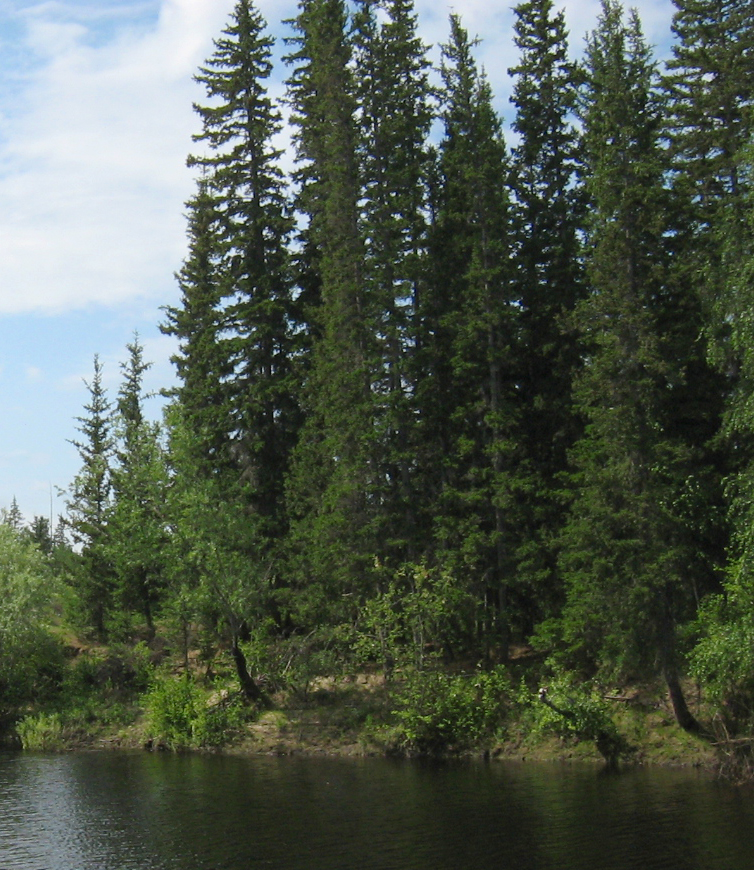
Photo: Svetlana Ivanova, CC BY 3.0 · source

Tree · Pine family (Pinaceae)
Siberian spruce
Picea obovata
In other languages: Siberische spar (Nederlands) · Épicéa de Sibérie (Français)
Grows wild in Europe, but not in Belgium.
The Siberian spruce is a slender, conical conifer from the taiga, the endless coniferous forest of the far north. Its wild range runs from north-eastern Europe, where it merges into Norway spruce in Finland and northern Scandinavia, across the Urals deep into Siberia and Mongolia. It is a close relative of our familiar Christmas tree, the Norway spruce, and is sometimes even treated as a subspecies of it. You can recognise it by its small cones, 5–8 cm long, with rounded, smooth-edged scales, and by its finely hairy young shoots. In Belgium it is only found planted, mainly in arboreta and collections; in a large garden it is a tough, extremely hardy tree with a fine, narrow outline.
Light
Sun or partial shade
preferably some sun
Moisture
Normal to wet
must not dry out
Hardiness
Fully hardy
down to -45 °C
Size
25 m
tall, 7 m wide
Flowering
May–June
| Pruning months | August–September |
|---|---|
| Height | 25 m |
| Native to Belgium | No, planted |
| Flowering | May–June |
Identify
How to recognise it
- Habit
- Straight, slender tree with a narrow, pointed crown; 20–35 m tall in the wild, usually less here. Branches level to slightly drooping. The grey-brown bark later flakes off in thin plates.
- Needles
- Four-sided, stiff and short, 1–2 cm, dull dark green to greyish green. They grow all round the shoot on small woody pegs, which leave the shoot rough once the needles fall.
- Cones
- Hanging, egg-shaped to shortly cylindrical, 5–8 cm long. Green or purple when young, ripe and brown in the autumn of the same year. The scales are broadly rounded with a smooth, entire edge.
- Shoots
- Young shoots are yellowish brown to reddish brown and densely covered in fine hairs; the buds are small and egg-shaped.
- Roots
- A shallow, flat root system: sensitive to drought and, on wet ground, liable to blow over.
- Confusion with
- Norway spruce: longer cones, 10–15 cm, with pointed or wavy-toothed scale tips, and usually hairless or sparsely hairy shoots. Where both grow together there are many intermediates. Serbian spruce: flat needles with two white bands underneath and a very narrow crown.
Flowering: May–June · Pruning: August–September
In your garden
Why grow it?
- One of the hardiest trees in the world: it grows up to the northern tree line in Siberia, where winter temperatures fall below −40 °C.
- A dense evergreen crown that gives birds cover, roosts and nest sites all year; goldcrests and tits search the needles for insects.
- The seeds in the cones feed crossbills, siskins and the great spotted woodpecker, which wedges the cones in a crack to hack them open.
- A narrow, regular cone shape that gives structure to a large garden or park, even in winter.
- Fascinating for tree lovers: next to a Norway spruce you immediately see the differences in cones and shoots between two closely related species.
Siberian spruce: where does it grow best?
- In the wild: vast coniferous forests of the taiga, often on moist ground along rivers and in valleys, with birch, larch, pine and fir.
- Sun to partial shade; young trees tolerate quite a lot of shade.
- Cool, moisture-retentive, preferably slightly acid soil: sand, loam or peaty ground. It copes poorly with hot, dry summers and dry chalky soil.
- In the garden: only for a large garden or park, as a specimen or in a group, at least 6–8 m from houses and other large trees.
Goes well with
- Silver birch: A light, white trunk next to the dark green, just as in the taiga.
- European larch: A conifer that turns golden yellow in autumn and stands bare in winter.
- Rowan: White flowers in May and red berries for birds at the edge of the crown.
- Bilberry: Low ground cover on acid, humus-rich soil.
- Narrow buckler-fern: Green underplanting in the partial shade beneath the branches.
Maintenance
Siberian spruce: when and how to plant it?
- Buy a young tree from a specialist tree nursery or a nursery for unusual conifers. Never take seedlings or young trees from the wild.
- Plant in October–November or in March–April, when the ground is not frozen. Small trees of 60–100 cm establish best.
- Dig a wide but shallow planting hole, loosen the bottom and set the root ball at the same depth as it was in the pot.
- Drive a short stake in at an angle on the windward side and tie the tree loosely; remove the stake after two years.
- Water in thoroughly straight away and spread a layer of needle litter, bark or leaf mould around the base.
- Water during dry spells for the first two summers: the shallow roots dry out quickly.
Care
- Water
- For the first two years, once a week in dry weather, a good soaking each time. After that only in long, hot droughts.
- Feeding
- Not needed. Leave fallen needles where they lie: they form a natural litter layer that keeps the soil slightly acid.
- Mulching
- A layer of wood chips or needle litter keeps the roots cool and moist in summer.
- Lower branches
- Leave them: the tree looks best when branched right down to the ground, and birds like to shelter there.
- Late frost
- In our mild climate it can come into leaf early. Avoid hollows where cold air collects; on young trees, cover the shoots with fleece on frosty nights.
Tip: Plant Siberian spruce in an open, slightly raised spot rather than in a cold hollow: there it suffers far less from late frost on its young shoots.
Pruning and mowing
Pruning months: August–September.
When: Rarely needed. Remove dead or damaged branches in August–September.
How:
- Saw off dead, broken or diseased branches close to the trunk, just outside the swollen branch collar.
- If a young tree has two leaders, keep the strongest and cut out the other.
- Never cut back into bare wood without needles: a spruce will not regrow from there.
- Only remove lower branches if you really must, for example for a path.
Caution: Never top a spruce: it will form several leaders and lose its fine conical shape for good.
Propagation
- Seed
- Pick cones in September–October, let them open in a warm, dry place and store the seed cool and dry. Sow in March–April in a seed tray; a few weeks cold and moist in the fridge (stratification) improves germination. Shade the seedlings from strong sun.
- Grafting
- Special forms are grafted by nurseries onto a Norway spruce rootstock. That is a job for the specialist.
Siberian spruce: how does it get through the winter?
Hardy to −45 °C.
- Evergreen and extremely hardy: a Belgian winter is a mild one for this tree.
- The cones hang on the tree for a long time and provide seed for crossbills, siskins and woodpeckers.
- The dense crown is a sheltered roost for small birds on cold nights.
- After a mild winter it can start growing too early; a late frost then scorches the young shoots, but the tree usually recovers.
Diseases and pests
- Green spruce aphid: A small green aphid that feeds on older needles in winter and spring; they turn yellow and drop, especially after a mild winter. The tree usually recovers on its own, and tits eat the aphids.
- Red spider mite: Tiny mites make the needles dull and greyish in hot, dry summers. Watering and a not-too-hot, airy spot help.
- Spruce bark beetle: This bark beetle mainly attacks weakened spruces after dry summers. A healthy tree in a cool spot is the best protection; remove badly affected trees in good time.
- Drought: Brown needles and dead branches after a hot summer. Mulching and watering help; on dry sandy soil it is not a good choice.
- Windthrow: Because of its shallow roots it can blow over in a storm on wet ground. Avoid spots where water stands.
Through the year
- January: Dormant. Withstands any Belgian winter.
- March: Planting possible as long as the ground is not frozen.
- April: Planting. The buds swell; in a mild spring it sometimes starts growing early.
- May: Flowering: yellow male and green to purple female cones. Fresh light-green shoots.
- June: End of flowering. Water young trees in dry weather.
- July: Water in heat and drought. Watch out for red spider mite.
- August: Saw off dead or broken branches.
- September: Cones ripen. Last month for pruning work.
- October: Pick cones for seed. Good month for planting.
- November: Planting. Crossbills and siskins look for seed in the crown.
- December: Evergreen outline; birds shelter in the dense crown.
You and this species
Did you know?
- The name obovata means ‘reverse egg-shaped’ and refers to the cone scales, which are broadly rounded at the top.
- Where Siberian spruce and Norway spruce meet, from Finland to the Urals, they hybridise freely and form a broad zone of intermediate trees.
- It grows right up to the northern tree line, where summer lasts only a few weeks and the ground freezes deep down.