Photo: Rasbak, CC BY-SA 3.0 · source

Shrub · Heather family (Ericaceae)
Pontic rhododendron
Rhododendron ponticum
In other languages: Pontische rododendron (Nederlands) · Rhododendron pontique (Français)
Grows wild in Europe, but not in Belgium.
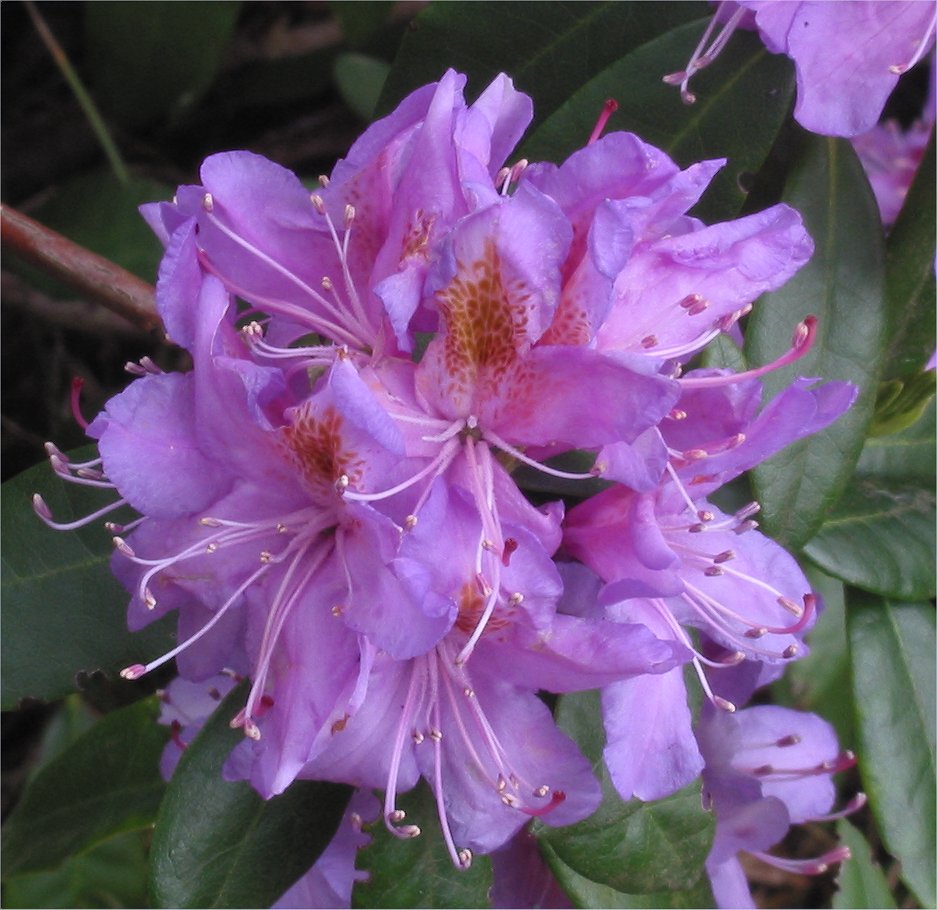
Pontic rhododendron is an evergreen shrub of the heather family. In the wild it grows around the Black Sea, in northern Turkey and the Caucasus, and also in small, scattered populations in southern Spain and Portugal. In Belgium it is only planted, often in old parks, castle grounds and gardens on acid soil, and it was long used as a rootstock for cultivated rhododendrons. You can recognise it by its large, leathery, dark green leaves and its clusters of lilac to purplish flowers with brownish-green spots in May–June. Bumblebees love the flowers, but the whole plant is highly poisonous. In Britain and Ireland it has become a notorious problem in woodland: plant it wisely and never in or right next to a wood.
Caution: All parts of the plant are highly poisonous to people and animals, including the nectar and honey made from it. Horses, sheep, goats and cattle become seriously ill if they eat the leaves, and it is also dangerous for dogs, cats and rabbits. Do not let children suck the flowers or leaves and never throw prunings into a field. In Britain and Ireland it spreads massively through woodland: do not plant it in or near woodland or a nature reserve.
Light
Partial shade or shade
tolerates little sun
Moisture
Normal
no wet feet
Hardiness
Fully hardy
down to -20 °C
Size
3 m
tall, 3 m wide
Flowering
May–June
| Pruning months | April and June |
|---|---|
| Height | 3 m |
| Native to Belgium | No, planted |
| Flowering | May–June |
Identify
How to recognise it
- Growth habit
- Broad, dense evergreen shrub of 2–5 m tall and often even wider; sometimes up to 8 m in old parks. Branches that touch the ground take root there.
- Leaf
- Alternate, leathery, oblong to lance-shaped, 6–18 cm, with a smooth edge; glossy dark green above, paler green and hairless below.
- Flower
- Bell- to funnel-shaped, 4–5 cm across, lilac to purplish pink with brownish-green spots on the upper lobe; 10–15 together in clusters at the branch tips, in May–June.
- Fruit/Seed
- Elongated woody capsule that splits open in autumn and releases thousands of dust-fine seeds, which the wind carries far.
- Roots
- Shallow and fibrous, in a dense mat just below the surface; no taproot.
- Confusion with
- Cultivated rhododendron hybrids often have larger flowers in other colours. On a grafted shrub, shoots from a Pontic rootstock can grow out and take over: you recognise them by their narrower, darker leaves and lilac flowers. Cherry laurel also has glossy leaves, but white flower spikes and black berries.
Flowering: May–June · Pruning: April and June
In your garden
Why grow it?
- Evergreen and hardy: a dense green mass all year round, useful as a screen or windbreak on acid soil.
- Abundant flowers in May–June in large lilac to purple clusters.
- Bumblebees eagerly visit the flowers for nectar and pollen.
- Blackbirds and wrens find shelter in the dense evergreen shrub.
- Historically interesting: one of the first rhododendrons in European parks and gardens.
Pontic rhododendron: where does it grow best?
- In the wild: moist forests, stream valleys and slopes on acid soil, often in the understorey of broadleaved woodland.
- In the garden: partial or light shade; in full sun only if the soil stays moist.
- Acid, humus-rich, moisture-retentive but free-draining soil (pH 4.5–5.5). On chalky soil the leaves turn yellow.
- Sheltered from hot midday sun and drying east winds. Do not plant it in or next to woodland or a nature reserve: seedlings can run wild there.
Goes well with
- Hard fern: A native evergreen fern for the same acid, moist soil.
- Bilberry: A low native heather-family plant for acid soil, with berries for birds.
- Holly: A native evergreen shrub as a companion, with red berries for birds.
- Honeysuckle: Climbs into nearby trees and scents summer evenings for moths.
- Rowan: A light tree above, with orange-red berries for birds in late summer.
Maintenance
Pontic rhododendron: when and how to plant it?
- Buy it in a pot or root-balled from a nursery or garden centre. Never dig up plants or seedlings in parks or woods.
- Plant in March–April or in September–October, when the soil is neither frozen nor waterlogged.
- Plant shallowly: the top of the root ball should just show above the soil, as roots planted too deep suffocate.
- Mix the planting site with leaf mould or conifer-needle compost; on chalky soil, choose another shrub instead.
- Allow 2–3 m of space per plant; for a hedge, plant 1–1.5 m apart.
- Water well straight away and regularly in dry spells during the first year, preferably with rainwater. Mulch with leaf mould or pine needles.
Care
- Water
- In dry weather, use rainwater: tap water often contains lime.
- Feeding
- Usually not needed. Leave fallen leaves in place and add some leaf mould in April if you like.
- Mulching
- A layer of pine needles, bark or leaf mould keeps the shallow roots cool and moist.
- Spent flowers
- Gently snap off the spent flower clusters: it then forms no seed, does not spread and puts its energy into new buds.
- Spreading
- Pull up seedlings nearby straight away and do not let branches grow over the garden boundary or into a woodland edge.
Tip: To enjoy the flowers without the risk of it spreading, snap off all spent flower clusters every June: no seed, and more energy for next year’s flowers.
Pruning and mowing
Pruning months: April and June.
When: Deadhead in June; renovation pruning in April.
How:
- In June, snap off the spent flower clusters just above the new buds or shoots.
- Straight after flowering, shorten over-long branches to just above a whorl of leaves.
- An overgrown, leggy shrub can be cut back hard in April to 30–50 cm above the ground: it regrows from old wood, but will not flower for one or two years.
- If needed, spread hard renovation over two or three years, cutting part of the branches each time.
Caution: Wear gloves and never leave prunings where horses, sheep, goats or rabbits can reach them: even wilted leaves are poisonous.
Propagation
- Layering
- The easiest method: in spring, peg a low branch down into the soil. After one or two years it has roots and you can cut it free.
- Cuttings
- Semi-ripe cuttings of 10–15 cm in August–September, with a small wound at the base, in acid cutting compost under plastic. They root slowly.
- Seed
- The dust-fine seed germinates easily on moist, acid soil, and that is exactly how it spreads. Better not to let the capsules ripen.
Pontic rhododendron: how does it get through the winter?
Hardy to −20 °C.
- Evergreen: in hard frost the leaves curl up and droop to save water. This is normal and they recover in milder weather.
- Hardy to about −20 °C.
- An evergreen shelter for birds; beneath the shrub almost nothing grows because of the deep shade.
- In sun and frost the leaves lose water: in a dry winter, give some rainwater on a frost-free day.
Diseases and pests
- Yellow leaves: A sign of soil that is too chalky or too much tap water. Use rainwater and acid compost, or choose a more acid spot.
- Bud blast: Flower buds turn grey-brown in winter and grow tiny black bristles, caused by a fungus spread by the rhododendron leafhopper. Snap off affected buds and put them in the household waste.
- Vine weevil: Half-moon notches in the leaf edges; the larvae feed on the roots. Pick off the adults by torchlight in the evening or use nematodes against the larvae in autumn.
- Spreading: Seedlings and rooting branches can spread through acid woodland and smother the ground flora. Do not let seed ripen, pull up seedlings and do not plant it near woodland.
Through the year
- January: Curled leaves in hard frost are normal.
- March: Plant. Mulch.
- April: Renovation pruning of overgrown shrubs. Plant.
- May: In flower: bumblebees on the lilac clusters. Watch for vine weevil.
- June: Last flowers. Snap off spent flower clusters.
- July: Water with rainwater in dry spells.
- August: Take semi-ripe cuttings. Watch for leafhoppers.
- September: Plant. Snap off grey, affected buds.
- October: Plant. Pull up seedlings in the surroundings.
- November: Leave fallen leaves as mulch.
You and this species
Did you know?
- The name ponticum refers to Pontus, the ancient name of the region on the south coast of the Black Sea, in present-day Turkey.
- Honey from that region can be poisonous because of rhododendron nectar: the Greek writer Xenophon already described how soldiers fell ill after eating this ‘mad honey’.
- It was introduced to England in 1763 and then planted on a huge scale as an ornamental shrub and as cover for pheasants; today it is one of the most troublesome invaders of British woodland.