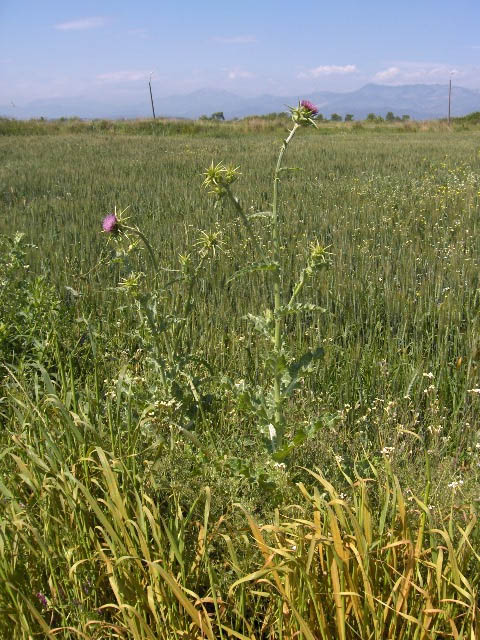
Photo: No machine-readable author provided. JoJan assumed (based on copyright claims)., CC BY-SA 3.0 · source

Herbaceous plant · Daisy family (Asteraceae)
Milk thistle
Silybum marianum
In other languages: Mariadistel (Nederlands) · Chardon-Marie (Français)
Grows wild in Europe, but not in Belgium.
Milk thistle is a robust annual or biennial thistle from the Mediterranean. In Belgium it does not grow wild: you mainly see it in herb gardens and ornamental gardens, and now and then it escapes for a short while onto waste ground. You recognise it at once by its glossy, spiny leaves with striking white marbling along the veins, and by its large purple flower heads surrounded by long, sharp spines. Bumblebees, bees and butterflies visit the flowers, and goldfinches feast on the seeds in late summer. According to an old legend, the white markings come from a drop of the Virgin Mary’s milk.
Caution: Wear gloves: the leaves and bracts have sharp spines. In very rich soil the plant can build up a lot of nitrate, which can be poisonous to grazing animals such as cattle and sheep: do not plant it in a grazed field.
Light
Full sun
warm and bright
Moisture
Dry to normal
no wet feet
Hardiness
down to -15 °C
protect young plants
Size
1.2 m
tall, 0.6 m wide
Flowering
June–August
| Pruning months | August–September |
|---|---|
| Height | 1.2 m |
| Native to Belgium | No, planted |
| Flowering | June–August |
Identify
How to recognise it
- Growth habit
- Annual or biennial: first a flat rosette up to 80 cm across, then a branched flowering stem of 1–1.5 m (sometimes 2 m).
- Leaf
- Large, glossy dark green, deeply lobed and edged with yellow spines; white marbling along the veins. The stem leaves clasp the stem.
- Flower
- Flower heads of 4–8 cm, purple to pink, from June to August. They sit on broad bracts that each end in a long yellowish spine.
- Fruit/seed
- Shiny seeds of 6–7 mm, mottled brown-black, with a white pappus that breaks off easily.
- Roots
- A sturdy taproot: only young plants can be moved.
- Confusion with
- Cotton thistle (Onopordum acanthium) is grey and woolly with winged stems; spear thistle has no white marbling. No native thistle has such glossy, white-veined leaves.
Flowering: June–August · Pruning: August–September
In your garden
Why grow it?
- A real eye-catcher: the white-marbled rosette is decorative all spring, long before the plant flowers.
- In summer the large purple flower heads provide plenty of nectar and pollen for bumblebees, bees and butterflies.
- In late summer goldfinches and other seed-eaters pick the seeds from the faded heads.
- A useful plant in history: young leaves, the flower base and roasted seeds were once eaten, and the seeds were used in folk medicine.
- Perfect for a dry, sunny gravel garden or a herb garden with a Mediterranean feel.
Milk thistle: where does it grow best?
- Originally a plant of dry, stony places, roadsides and waste ground around the Mediterranean.
- Full sun is a must: in shade it stays floppy and barely flowers.
- Well-drained, dry to normal soil: sand, loam or stony ground; lime is well tolerated.
- It cannot stand wet feet in winter: the rosette rots.
- Allow 60–80 cm per plant, as the rosette spreads wide.
Goes well with
- Viper’s-bugloss: Blue flower spikes for the same dry, sunny spot, and a magnet for bees.
- Great mullein: Tall yellow candles and grey leaves next to the marbled thistle leaves.
- Wild teasel: Another bold structural plant, whose seeds birds eat in winter.
- Lavender: A fragrant grey edging for a Mediterranean gravel garden.
- Wild marjoram: Low pink flowers at its feet, also popular with butterflies.
Maintenance
Milk thistle: when and how to plant it?
- Sow where it is to flower, as the taproot resents being moved. Sow in April–May for flowers the same year, or in August–September for a rosette that overwinters and flowers the following year.
- Place the large seeds in twos or threes, 1–2 cm deep and 60 cm apart; thin later to one plant.
- The seed germinates without a cold period, usually within a few weeks.
- If you buy a young plant from a nursery, plant it out as young as possible with the root ball intact.
- Water until the plants are established; after that extra water is rarely needed.
- Wear gloves when planting and weeding, and never dig up plants from the wild.
Care
- Water
- Only for young plants or in a pot. Established plants cope well with drought.
- Feeding
- Not needed. In rich soil the plant becomes floppy and builds up nitrate.
- Support
- In a windy spot a sturdy stake keeps the flowering stem upright.
- Letting it seed
- Leave a few heads to set seed if you want new plants next year; cut off the rest before the seed ripens.
- Clearing up
- After setting seed the plant dies. Pull it out wearing gloves; the root can rot down in the soil.
Tip: Sow in late summer: a rosette that overwinters grows much larger the following year and flowers more freely than a plant sown in spring.
Pruning and mowing
Pruning months: August–September.
When: After flowering, in August–September; real pruning is not needed.
How:
- Cut off faded heads as soon as the fluff appears if you do not want seedlings.
- Leave a few heads for the goldfinches and to collect your own seed.
- Once the plant has died, cut it off at the base; the taproot can rot down in the ground.
Caution: Wear sturdy gloves and long sleeves: the spines go straight through thin fabric.
Propagation
- Seed
- Collect seed in August–September, when the fluff comes loose. Store it dry and cool; sow in place in spring or late summer.
- Self-seeding
- In an open, sunny gravel garden it self-seeds. Move seedlings only while they have just a few leaves.
Milk thistle: how does it get through the winter?
Hardy to −15 °C: protect young plants.
- Autumn sowings overwinter as a flat, white-marbled rosette that is decorative even in winter.
- Hardy to about −15 °C in dry soil; a wet winter is a greater risk than frost.
- Plants that have flowered die after setting seed. The dry stems can stay for insects and birds.
Diseases and pests
- Winter rot: On heavy, wet soil the rosette rots. Sow in a well-drained spot or mix grit into the soil.
- Aphids: On stems and buds in early summer. Ladybirds and parasitic wasps usually clear them; otherwise hose them off.
- Slugs: They eat young seedlings. Sow a little more thickly or protect the seedlings for the first few weeks.
- Too many seedlings: On bare soil it can self-seed heavily. Cut off faded heads in time and pull up young seedlings.
Through the year
- March: Overwintered rosettes start growing again. Weed around them.
- April: Sow in place for summer flowers.
- May: Thin to one plant per spot. Watch for slugs and aphids.
- June: Flowering begins. Bumblebees and bees on the flowers.
- July: Full flower. Add a stake if needed.
- August: Collect seed. Cut off faded heads if you do not want seedlings.
- September: Sow for a rosette that overwinters. Clear plants that have finished.
- November: The rosettes lie flat; make sure fallen leaves do not smother them.
You and this species
Did you know?
- The species name marianum and the common names refer to the legend that a drop of the Virgin Mary’s milk fell on the leaves and left the white markings.
- The seeds are grown on a large scale for the pharmaceutical industry, which extracts a substance called silymarin from them.
- Goldfinches love thistle seed: their scientific name Carduelis comes from carduus, the Latin word for thistle.