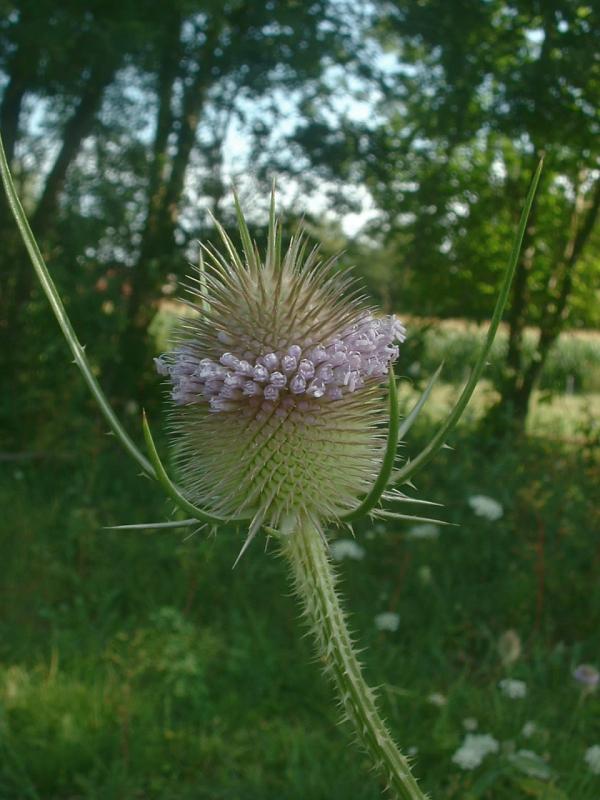
Photo: photo J.F. Gaffard Jeffdelonge at fr.wikipedia, CC BY-SA 3.0 · source

Annual · Caprifoliaceae
Wild teasel
Dipsacus fullonum
In other languages: Grote kaardebol (Nederlands) · Cardère sauvage (Français)
Wild teasel is a native biennial of roadsides, dykes and rough ground, in Belgium too. In its first year it forms a flat rosette of large, somewhat puckered leaves; in its second year a stiff, prickly stem shoots up to 2 m. In July and August it carries egg-shaped, spiny heads in which small lilac flowers open in rings. Bees, bumblebees and butterflies love it, and in winter goldfinches pick the seed from the dry heads. After setting seed the plant dies, but it self-seeds readily.
Caution: It self-seeds freely and can quickly take over a small garden. Cut off some of the heads before the seed ripens and weed out surplus seedlings while young. Mind the prickles, too.
Light
Sun or partial shade
preferably some sun
Moisture
Normal
no wet feet
Legal basis
Sand, loam or clay
any pH
Hardiness
Fully hardy
down to -25 °C
Size
1.8 m
tall, 0.5 m wide
Flowering
July–August
| Pruning months | March and September |
|---|---|
| Height | 1.8 m |
| Native to Belgium | Yes |
| Good for bees, butterflies and birds | Yes, for bees, butterflies and birds |
| Poisonous to people and pets | Not known to be poisonous |
| Flowering | July–August |
Identify
Wild teasel: how do you recognise it?
- Habit
- Biennial: a flat leaf rosette in the first year, then a stiff, branching stem 1.5–2 m tall in the second.
- Leaves
- Long and lance-shaped, with prickles along the midrib underneath; the stem leaves are opposite and joined at the base to form a cup.
- Stem
- Ridged and covered with short, sharp prickles.
- Flower
- Egg-shaped heads 3–8 cm long with long, curved, spiny bracts; the small lilac flowers open in rings.
- Fruit
- Brown, dry heads full of seed, which stand well into winter.
- Roots
- A deep taproot: move it while young, as later it rarely succeeds.
Flowering: July–August · Sowing: March–April and September–October · Pruning: March and September
In your garden
Why grow it?
- A native plant that feeds many insects: bees, bumblebees and butterflies.
- In winter, goldfinches eat the seed from the dry heads.
- An architectural plant 2 m tall that gives structure to a natural garden.
- The dry seed heads look good all winter, especially with frost on them, and are ideal for dried arrangements.
- Easy and tough: it grows in almost any soil without watering or feeding.
Wild teasel: where does it grow best?
- Sun or partial shade; in sun it grows sturdiest.
- Almost any soil: sand, loam or clay, acid to chalky.
- Moist but not wet; it also tolerates fairly heavy, damp soil.
- At the back of a border, in a wildlife garden, a meadow planting or along a hedge.
- Allow 40–50 cm per plant.
- Light
- Sun and partial shade
- Soil type
- Sand, loam or clay
- Acidity
- Not fussy
- Moisture
- Normal
- Size
- 1.8 m tall, 0.5 m wide
- Hardiness
- Hardy (to -25 °C)
Goes well with
- Mullein: Another tall biennial that self-seeds and attracts bees.
- Hemp agrimony: Pink flower clusters in the same summer, also a butterfly plant.
- Wild marjoram: A low, fragrant bee plant for the foot of the teasel.
- Ornamental grasses: Their plumes and the teasel heads make a fine winter silhouette together.
Maintenance
Wild teasel: when and how to plant it?
- Sow in situ in March–April or September–October, or in small pots to plant out while young.
- Loosen the soil, sow thinly and cover with a thin layer of soil.
- Keep the soil moist until the seedlings come up.
- Thin or transplant young rosettes to 40–50 cm apart while the taproot is still small.
- Water after transplanting; after that, watering is rarely needed.
- Sow two years in a row so that a generation flowers every year.
Care
- Water
- Only while it establishes. After that it copes even in dry summers.
- Feeding
- Not needed. In rich soil it only grows bigger and floppier.
- Seedlings
- In spring, weed out unwanted seedlings while they are small.
- Spent heads
- Leave most of them for the birds and as winter decoration.
- Gloves
- Wear sturdy gloves for every job: stems, leaves and heads all prickle.
Tip: Plant it where you can see it from the window: in winter you can then watch the goldfinches picking seed from the heads.
Wild teasel: when to prune it?
Pruning months: March and September.
When: Real pruning is not needed. In March, cut down the dead stems once the birds have eaten the seed; in September you can remove some of the heads to limit self-seeding.
How:
- In March, cut the dead stems of second-year plants off at ground level, or pull the whole plant out, root and all.
- For fewer seedlings, cut off some of the heads in September before the seed ripens, and leave a few for the goldfinches.
- For dried arrangements, cut heads with a long stem as soon as they turn brown.
- Leave this year’s green rosettes: they will flower next year.
Caution: The plant dies after flowering: that is normal for a biennial.
Propagation
- Seed
- Sow in situ in March–April or September–October. The seed germinates readily; thin to 40–50 cm.
- Moving seedlings
- In spring or autumn, dig up young rosettes with a good root ball and replant them straight away in their new spot.
Wild teasel: how does it get through the winter?
Hardy to −25 °C.
- Fully hardy to about −25 °C: the leaf rosettes overwinter without protection.
- Leave the dry seed heads standing all winter: goldfinches feed on the seed.
- With frost on them, the heads and stems are a fine winter feature.
Diseases and pests
- Too many seedlings: It self-seeds freely. Weed them out young, or cut off some of the heads before the seed ripens.
- Prickles: Stems, leaves and heads prickle. Wear gloves and do not plant it beside a narrow path or where children play.
- Powdery mildew: White powder on the leaves in late summer. Of little harm to a plant that dies anyway; good spacing helps.
- Plant disappears: It dies after flowering. Leave a few seedlings every year so it stays in your garden.
- Blowing over: In a very windy spot or rich soil, the tall stems can blow over. Choose a sheltered position and do not feed.
Through the year
- January: The dry heads decorate the garden. Goldfinches eat the seed.
- February: Leave the heads for the birds.
- March: Remove dead stems. Sow in situ.
- April: Sow. Thin or transplant seedlings.
- May: Second-year plants start to send up their flower stems.
- June: Weed out surplus seedlings.
- July: Flowering: bees and bumblebees. Rainwater collects in the leaf cups.
- August: Flowering. Cut heads for drying.
- September: Cut off some heads to limit self-seeding. Sow.
- October: Sow. Move young rosettes.
- December: Rest. The rosettes stay green.
Use
Good for wildlife
- Bees
- Nectar and pollen for honeybees and wild bees.
- Butterflies
- Nectar for butterflies.
- Birds
- Berries, seeds or insects as food, or a place to nest.
You and this species
Did you know?
- A related species with hooked bracts, fuller’s teasel, was once used to raise the nap on woollen cloth; hence the name fullonum, from the Latin fullo, ‘fuller’.
- Rainwater collects in the cups formed by the leaf bases, and insects sometimes drown in it.
- The flowers first open in a ring around the middle of the head; this ring then splits into two bands that move up and down.