Photo: Kristian Peters -- Fabelfroh 16:07, 27 November 2006 (UTC), CC BY-SA 3.0 · source

Herbaceous plant · Daisy family (Asteraceae)
Sea aster
Tripolium pannonicum
In other languages: Zulte (Nederlands) · Aster maritime (Français)
Grows wild in Belgium.
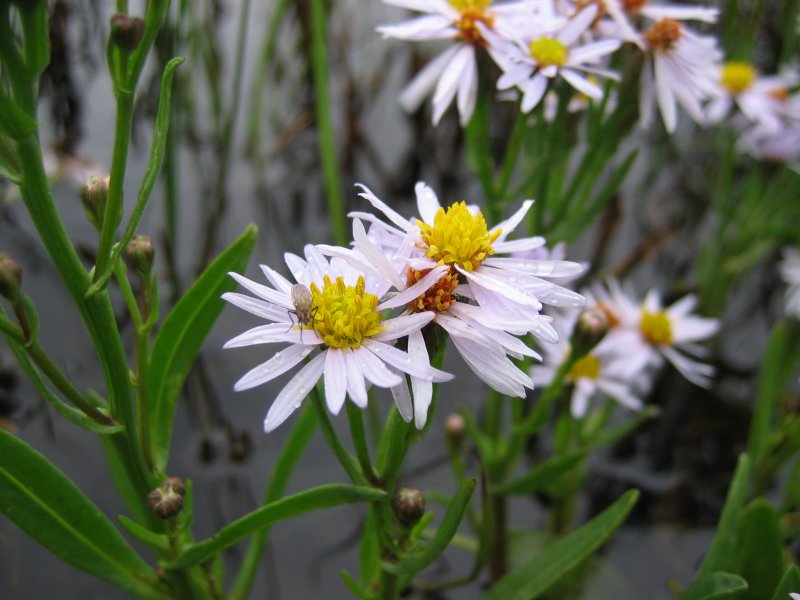
Sea aster is a perennial, often short-lived aster of 15–100 cm with thick, somewhat fleshy leaves and loose clusters of lilac flower heads with a yellow centre. It is a true salt plant of saltmarshes, mudflat edges and brackish ditches, and tolerates regular flooding by seawater. In Belgium it grows mainly on the saltmarshes of the Zwin and the Yser estuary and along the brackish tidal Scheldt; elsewhere it is rare. You can recognise it by its narrow, hairless, fleshy leaves and the aster flowers that rise above the saltmarsh vegetation from July into October. As a late nectar source it matters a great deal to bees, bumblebees and butterflies, and in Zeeland its young leaves are eaten as ‘lamsoren’.
Light
Full sun
warm and bright
Moisture
Normal to wet
must not dry out
Hardiness
Fully hardy
down to -20 °C
Size
0.5 m
tall, 0.3 m wide
Flowering
July–October
| Pruning months | March |
|---|---|
| Height | 0.5 m |
| Native to Belgium | Yes |
| Flowering | July–October |
Identify
How to recognise it
- Habit
- Perennial, often short-lived herb of 15–100 cm, with upright, hairless, often reddish stems that branch freely towards the top.
- Leaf
- Narrowly lance-shaped, 5–12 cm, untoothed, hairless, thick and somewhat fleshy. The lower leaves are stalked, the upper ones sit directly on the stem.
- Flower
- Heads 1–2 cm across in loose, broad clusters, with lilac to bluish-purple ray florets around a yellow centre, from July to October. There is also a form without ray florets, with yellow heads only.
- Fruit/Seed
- Small achenes with a long white to brownish pappus, spread by the wind and by tidal water.
- Roots
- A short rhizome with fleshy roots, adapted to wet, oxygen-poor and salty soil.
- Confused with
- Common sea-lavender (Limonium vulgare) also flowers lilac on the same saltmarshes, but has a rosette of leathery leaves and tiny flowers in flat sprays, not aster flowers. Garden Michaelmas daisies have thinner, non-fleshy leaves and do not grow on salty soil.
Flowering: July–October · Pruning: March
In your garden
Why grow it?
- One of the last flowers of the year: nectar and pollen from July into October for bees, bumblebees, hoverflies and butterflies.
- Along the North Sea coast the solitary bee Colletes halophilus depends almost entirely on sea aster for its pollen.
- Typical of saltmarshes: it tolerates salt water and regular flooding, which few flowers can.
- The young leaves are eaten in Zeeland as a sea vegetable and sold there as ‘lamsoren’.
- In the garden, a graceful late-flowering aster for a wet, sunny spot or a pond edge, even on salty soil by the coast.
Sea aster: where does it grow best?
- In the wild: saltmarshes on the coast and in the tidal zone of the Scheldt, mudflat edges, brackish ditches and salty grassland.
- Full sun, in an open spot without tall, dense competition.
- Wet to moist, heavy soil: clay or silt, ideally slightly salty. It also grows in ordinary moist garden soil, but is overgrown more quickly there.
- In the garden: at a pond edge, in a bog bed or in a large pot of moist, clayey soil. On the coast it suits a salty corner of the garden.
Goes well with
- Thrift: Pink cushions for a sunny, salty garden by the coast; flowers earlier in the year.
- Common sea-lavender: Lilac clouds of flowers on the same salty, wet soil in late summer.
- Marsh mallow: A tall, pale pink flower of brackish, wet places.
- Purple loosestrife: Purple spikes at the pond edge, in flower at the same time.
Maintenance
Sea aster: when and how to plant it?
- Buy plants or seed of native origin from a wild-plant nursery; it is not offered everywhere, so search specifically.
- Sow in October or March–April in a tray of moist seed compost, barely cover the seed and keep it wet until germination.
- Plant in April–May or September, 30–40 cm apart, in wet to moist soil and full sun.
- Water well after planting and keep the soil wet for the first few weeks; at a pond edge this takes care of itself.
- Never dig up plants on saltmarshes or in the polders: these places are fragile and mostly nature reserves. Do not pick leaves there to eat either.
Care
- Water
- The soil must never dry out. Water generously in dry summers, or stand the pot in a saucer of water.
- Feeding
- Not needed: on rich soil it grows tall and floppy and loses out to other plants.
- Salt
- Adding salt is not necessary; it also grows on ordinary wet clay. Salty soil does keep competitors away.
- Competition
- Keep tall, spreading marsh plants such as common reed and reed sweet-grass at a distance: sea aster wants light at its base.
- Self-seeding
- Let some of the seed heads ripen: on wet, open ground it self-seeds and so replaces older plants.
- Harvesting
- If you want to eat the leaves, pick a few young leaves per plant in your own garden in May–June and leave the rest.
Tip: Give sea aster a spot that never dries out, such as a pond edge or a pot standing in a saucer of water: that is where it flowers best and lasts longest.
Pruning and mowing
Pruning months: March.
When: Late February–March, before the new shoots appear.
How:
- Leave the faded stems with their fluffy seed heads standing all winter.
- Cut them back in late February–March to just above the new leaf rosette.
- If you want fewer seedlings, cut off the faded heads in October before they release their fluff.
Propagation
- Seed
- Collect the ripe seed heads in October–November and sow straight away or in spring in wet seed compost.
- Division
- Large clumps can be divided in April. As plants often live only a few years, seed is the most reliable method.
Sea aster: how does it get through the winter?
Hardy to −20 °C.
- Above ground it largely dies back; the fluffy seed heads stay standing for a long time.
- It overwinters as a small leaf rosette and a short rhizome and is fully hardy.
- Flooding by salt water during storm surges does it no harm.
- Leave the dead stems standing: small insects overwinter in them.
Diseases and pests
- Short-lived: Plants often disappear after a few years. Let them seed or sow more, so there are always young plants coming on.
- Getting overgrown: On rich, wet soil common reed, grasses and other marsh plants crowd it out. Cut or pull out the competitors around it.
- Slugs: Young rosettes and seedlings are sometimes eaten in spring. Only plant out larger plants and pick off slugs in the evening.
- Aphids: Sometimes appear on the shoot tips; ladybirds and other natural enemies usually clear them up.
Through the year
- March: Cut back old stems. Sow in a tray of wet compost.
- April: Plant and divide. Watch out for slugs on young plants.
- May: Pick a few young leaves if you like.
- June: The stems lengthen; keep the soil wet.
- July: First lilac flowers.
- August: Full flower, with plenty of bees, bumblebees and butterflies.
- September: Flowering and first seed heads. Planting is still possible.
- October: Last flowers; collect ripe seed.
- November: Leave the fluffy seed heads standing.
- December: Rest. Leave dead stems for insects.
You and this species
Did you know?
- Pannonicum refers to Pannonia, the Roman province around present-day Hungary, where it grows inland around salt lakes.
- It used to be called Aster tripolium. The ‘lamsoren’ sold on Dutch markets are sea aster leaves, not leaves of the plant the Dutch call lamsoor (sea-lavender).
- On some saltmarshes a form without purple ray florets, with yellow heads only, is the most common.