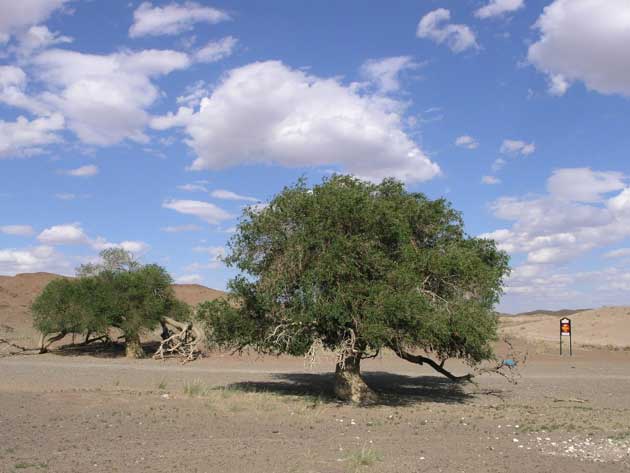
Photo: Tiarescott, CC BY-SA 3.0 · source

Tree · Elm family (Ulmaceae)
Siberian elm
Ulmus pumila
In other languages: Siberische iep (Nederlands) · Orme de Sibérie (Français)
Comes from outside Europe, but is often planted here in gardens and parks.
Siberian elm is a fast-growing broadleaved tree from central and eastern Asia, from Siberia and Mongolia to northern China and Korea. In the wild it grows along rivers, in dry steppes and on sandy or stony ground, and it copes with both severe cold and hot, dry summers. You can recognise it by its small, almost symmetrical, glossy green leaves, by the round, winged seeds that hang in masses on the branches in spring and by its grey, furrowed bark. In Belgium it is only found planted, as a street, park or garden tree and as a parent of hybrids that are less susceptible to Dutch elm disease. It self-seeds easily, so plant it with care and keep an eye on the seedlings.
Light
Full sun
warm and bright
Moisture
Dry to normal
no wet feet
Hardiness
Fully hardy
down to -40 °C
Size
15 m
tall, 10 m wide
Flowering
March–April
| Pruning months | December–February |
|---|---|
| Height | 15 m |
| Native to Belgium | No, planted |
| Flowering | March–April |
Identify
How to recognise it
- Habit
- Tree of 10–15 m, sometimes up to 25 m, with an open, rounded crown and thin, often slightly drooping twigs; sometimes a large shrub. Bark grey to grey-brown, rough and irregularly furrowed. Buds small, round and dark brown.
- Leaves
- Alternate and small: 2–7 cm, elliptical, with a short tip and a single or double toothed edge. Smooth, glossy dark green; the base is almost symmetrical, unlike most elms. Yellow in autumn.
- Flowers
- Small reddish flowers in clusters on the bare twigs, in March–April, before the leaves. Bisexual and wind-pollinated.
- Fruit/Seed
- Round, flat, winged nutlets of 1–1.5 cm with the seed in the centre, ripening in masses in April–May. They blow a long way.
- Confusion with
- Chinese elm: also small leaves, but flowers in late summer and has flaking, mottled bark. Field elm: larger leaves with a clearly lopsided base, and the seed sits towards the top of the wing. Wych elm: large, rough leaf with a very lopsided base.
Flowering: March–April · Pruning: December–February
In your garden
Why grow it?
- Flowers as early as March, before the leaves: an early source of pollen for bees.
- The seeds ripen as early as April–May and are eaten by finches such as greenfinch and bullfinch.
- Elms are the food plant of the white-letter hairstreak, a rare butterfly; disease-resistant elms can help it survive.
- Less susceptible to Dutch elm disease than our native elms, and therefore used to breed resistant elms.
- Tolerates drought, wind, cold and paving: a tough tree for difficult, open sites.
- Grows fast and tolerates hard pruning, even as a tall hedge or windbreak.
Siberian elm: where does it grow best?
- In the wild: riverbanks, steppes, sandy and stony ground and woodland edges in central and eastern Asia, with cold winters and hot, dry summers.
- Full sun; in shade it grows lanky and thin.
- Almost any free-draining soil: sand, loam or clay, including chalky and poor soil. Tolerates drought well, long periods of waterlogging less so.
- In the garden: only in a spacious spot, at least 8 m from the house, and not next to a nature reserve where its seedlings could spread.
- Suitable as a windbreak or tall hedge on open, windy sites.
Goes well with
- Dog rose: A native shrub for the foot of a windbreak, with flowers for bees and hips for birds.
- Blackthorn: White blossom in March–April, just like the elm, and a thorny shelter for birds.
- Sea buckthorn: Silver-grey leaves and orange berries on the same dry, sunny soil.
- Wild marjoram: A fragrant butterfly plant for the sunny, dry edge.
Maintenance
Siberian elm: when and how to plant it?
- Buy a tree from a tree nursery and never take seedlings from the wild or from a roadside verge.
- Plant while dormant, from November to March, when the ground is not frozen.
- Dig a generous hole, set the tree at the same depth as before and firm the soil well.
- Put a stake on the windward side and tie the trunk with a broad strap: the fast-growing young crown catches a lot of wind.
- Water thoroughly straight away and during long dry spells in the first year.
- Keep an eye on the surroundings: pull up seedlings in borders, gutters and between paving every year, so it does not spread.
Care
- Water
- Only during dry spells in the first year; after that it is very drought-tolerant.
- Feeding
- Not needed: extra fertiliser only makes the fast growth and brittle wood worse.
- Seedlings
- It self-seeds freely. Weed out seedlings in spring and summer as young as possible, before they form a deep root.
- Safety
- The wood is brittle and branches with a narrow angle tear out easily. Prune young trees to a good shape and have old trees checked.
- Dutch elm disease
- It is less susceptible, but not immune. Wilting, yellowing branches in summer may be a sign: cut them out generously in winter and remove the wood.
Tip: Weed out seedlings as soon as they appear, every spring and summer: keep this up for a few years and you will have a sturdy, drought-tolerant tree without a forest of seedlings around it.
Pruning and mowing
Pruning months: December–February.
When: In winter, from December to February. The tree is then dormant and the elm bark beetles that spread Dutch elm disease are not flying.
How:
- Young tree: choose one central leader and remove branches with a narrow, sharp angle in good time, as they tear out later.
- Remove dead, broken and crossing branches just outside the branch collar.
- As a hedge or windbreak: cut back every year to the height you want; it regrows well.
- Do not leave piles of elm wood with bark on: elm bark beetles can breed in them.
Caution: Do not prune in spring or summer: fresh pruning wounds attract elm bark beetles, which can carry Dutch elm disease.
Propagation
- Seed
- Collect the ripe seeds in May and sow them straight away, on the surface of moist soil; they germinate within a few weeks. Stored seed quickly loses its viability.
- Softwood cuttings
- In June take 10–15 cm cuttings from young shoots and put them in moist cutting compost under plastic.
Siberian elm: how does it get through the winter?
Hardy to −40 °C.
- Deciduous: after its yellow autumn colour it stands bare, with small, round, dark buds.
- Extremely hardy: in its homeland it survives −40 °C and colder.
- Wet snow and ice can snap branches because of the brittle wood.
- In winter you can clearly see branches with narrow angles; a good time for formative pruning.
Diseases and pests
- Dutch elm disease: A fungus, spread by elm bark beetles, makes branches suddenly wilt and turn yellow or brown in summer. Cut out generously in winter and remove the wood.
- Elm leaf beetle: Small yellowish brown beetles and their larvae eat the leaves into lace. It looks bad, but a healthy tree makes new leaves. Tits and other birds eat the larvae.
- Branch failure: Brittle wood and narrow branch angles: branches tear in storms, wet snow or ice. Formative pruning of young trees prevents a lot of this.
- Seedlings: Many seedlings in borders, gutters and between paving. Pull them up young, and do not plant it next to nature reserves.
Through the year
- January: Dormant. Prune in mild weather. Planting.
- February: Last pruning. Planting.
- March: Flowering on the bare branches: small reddish clusters.
- April: End of flowering. Leaves unfold and the round seeds turn pale green.
- May: Seed ripens and blows away. Collect and sow seed. Weed out seedlings.
- June: Watch for elm leaf beetle. Weed out seedlings. Take softwood cuttings.
- July: Watch for wilting branches caused by Dutch elm disease. Water young trees in dry weather.
- October: Yellow autumn colour.
- November: Leaf fall. Planting.
- December: Dormant. Pruning and planting.
You and this species
Did you know?
- After the dust storms of the 1930s, Siberian elm was planted in huge numbers in windbreaks on the Great Plains of the United States; it has since become a troublesome invader there.
- In Spain and Italy it hybridises with the native field elm, so that the original elms there are locally becoming mixed.
- The species name pumila means ‘dwarf’, which sounds odd for a tree that can reach 25 m.