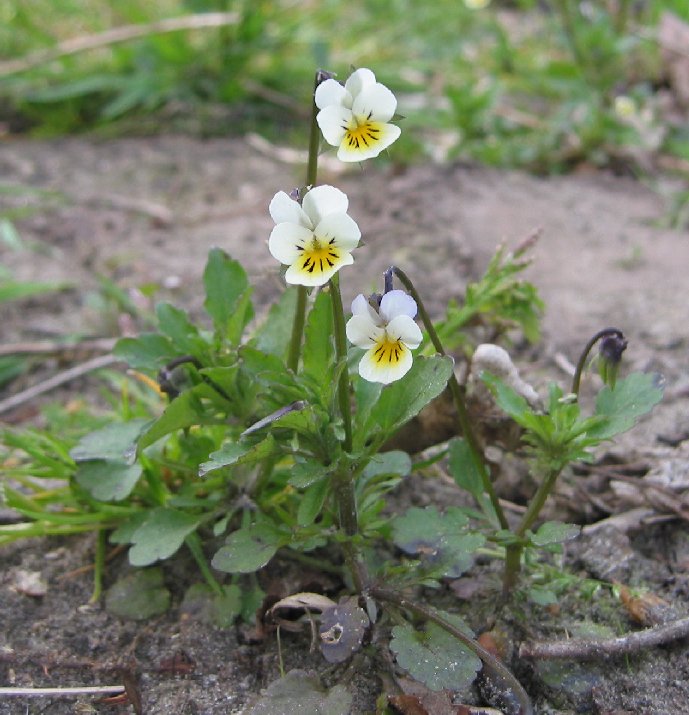
Photo: Rasbak at Dutch Wikipedia, CC BY-SA 3.0 · source

Herbaceous plant · Violet family (Violaceae)
Field pansy
Viola arvensis
In other languages: Akkerviooltje (Nederlands) · Pensée des champs (Français)
Grows wild in Belgium.
Field pansy is a small annual pansy of 5–30 cm with cream to pale yellow flowers, sometimes with a purple flush on the upper petals. It grows in arable fields, vegetable plots and borders, on fallow land, verges and open patches in grassland, especially on sandy and loamy soils, and is very common in Belgium. You can recognise it by the small flowers whose petals are no longer than the sepals, and by the large, deeply cut stipules with a leaf-like central lobe. It flowers from April into October and sets seed all the time. In a field it is a weed that does little harm; in the garden a sweet, unobtrusive little flower and a food plant for the caterpillars of the Queen of Spain fritillary.
Light
Full sun
warm and bright
Moisture
Normal
no wet feet
Hardiness
Fully hardy
down to -20 °C
Size
0.15 m
tall, 0.15 m wide
Flowering
April–October
| Height | 0.15 m |
|---|---|
| Native to Belgium | Yes |
| Flowering | April–October |
Identify
How to recognise it
- Habit
- Annual herb of 5–30 cm, upright or spreading, often branching from the base.
- Leaf
- Stalked, the lower ones round to oval, the upper ones oblong, with a scalloped edge. The stipules are large and deeply divided like a feather, with a scalloped, leaf-like central lobe.
- Flower
- Small, 8–20 mm, cream to pale yellow with a dark yellow spot and dark lines on the lower petal; the upper petals are sometimes tinged purple. The petals are as long as or shorter than the sepals. Flowers from April to October.
- Fruit/Seed
- A round capsule that splits into three valves and shoots out the small pale brown seeds.
- Roots
- A thin taproot: easy to pull up.
- Confused with
- Wild pansy has larger flowers, usually with plenty of purple, whose petals are clearly longer than the sepals. The two sometimes hybridise, so you see intermediate forms. Garden pansies are much larger.
Flowering: April–October
In your garden
Why grow it?
- Food plant for the caterpillars of the Queen of Spain fritillary, which on arable land and fallow mainly uses field pansy.
- Flowers for months, from April to October, and gives small bees and hoverflies pollen and a little nectar, although it often pollinates itself too.
- The capsules split into three valves and shoot out the seeds: fun to show children.
- Low and harmless: it grows among vegetables and perennials without crowding them out.
- A typical cornfield flower that fits into a cornfield-flower strip with common poppy and cornflower.
Field pansy: where does it grow best?
- In the wild: arable fields, vegetable plots, fallow land, verges, open patches in grassland, gardens and railway land.
- Full sun to light half shade.
- Loose, sandy to loamy soil, fairly poor to moderately fertile and not too wet.
- In the garden: in a cornfield-flower strip, among the vegetables, along the edge of a border or between the paving of a sunny path.
Goes well with
- Common poppy: Red above the low pansies in a cornfield-flower strip.
- Cornflower: Blue on the same open, sunny ground.
- Henbit dead-nettle: Pink two-lipped flowers on the same open vegetable-plot soil.
- Wild pansy: A larger, more purple relative for the same sunny, sandy soil.
- Common stork’s-bill: Pink flowers on sandy soil, another small, modest cornfield flower.
Maintenance
Field pansy: when and how to plant it?
- It usually turns up by itself in the vegetable plot or border; sowing is rarely needed.
- If you do want it, buy seed of native origin from a wild-plant nursery, on its own or in a cornfield-flower mix.
- Sow in September–October or March–April on open, loose soil and rake the seed in very lightly.
- Keep the soil moist until germination and leave 10–15 cm between plants.
- Never dig up plants from the wild; a few ripe capsules from your own garden are enough.
Care
- Water
- Not needed.
- Feeding
- Not needed; on rich soil it gets overgrown by other plants.
- Keeping the soil open
- As a cornfield flower it needs bare ground: lightly cultivate a flower strip every autumn.
- Weeding
- Too many? Hoe off or pull up the plants before they set seed; their roots are shallow.
- Self-seeding
- Let a few plants ripen; the capsules scatter the seed by themselves.
Tip: Look at the petals and sepals: if the petals are no longer than the calyx, you have a field pansy; if they stick out well beyond it, it is a wild pansy.
Pruning and mowing
When: Not needed; hoe off or pull up the plants when you need the bed.
How:
- This small annual pansy needs no pruning.
- If you want fewer seedlings, remove the plants before the capsules burst open.
- Put pulled plants without seed on the compost heap or use them as mulch between the vegetables.
Propagation
- Seed
- Ripens continuously from June to October. Sow in autumn or spring on bare soil, or let it self-seed.
Field pansy: how does it get through the winter?
Hardy to −20 °C.
- Plants that germinate in autumn overwinter as a small rosette and flower from April.
- In mild autumns it sometimes keeps flowering into December.
- Fully hardy; the seed also overwinters in the soil.
Diseases and pests
- Too many seedlings: On bare soil it can become numerous. Hoe early and mulch the soil between the vegetables.
- Getting overgrown: In dense vegetation or on rich soil it disappears. Keep a strip of open ground or lightly cultivate the soil.
- Aphids and powdery mildew: Occur now and then; usually harmless in an annual.
- Slugs: Sometimes eat young plants; usually enough are left.
Through the year
- March: Overwintered rosettes start growing. You can still sow.
- April: First cream-coloured flowers.
- May: Flowering; simply leave caterpillars on the leaves.
- June: Flowering and first ripe capsules.
- July: Flowering; weed where it is in the way.
- August: Flowering and seed setting.
- September: Sow on bare soil for next year.
- October: Last flowers; new seedlings appear.
- November: Young rosettes go into winter.
You and this species
Did you know?
- Arvensis means ‘of the fields’.
- Field pansy and wild pansy hybridise easily, which is why you often see intermediate forms with more or less purple in fields.
- The French name pensée and the English pansy come from the French word for ‘thought’.