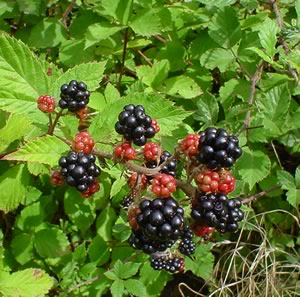
Photo: Wikimedia Commons, Public domain · source

Pruning guide · Shrub
Blackberry: when and how to prune
Rubus
Prune blackberries after the harvest, in September–October, or at the end of winter, in February–March: cut the canes that have fruited off at ground level and tie in 4–6 strong young canes.
Every blackberry cane lives for two years: in the first year it grows, in the second it bears fruit, and then it dies. So pruning a blackberry is simple: the old canes come out, the young ones are tied in. In the garden, ideally plant a thornless variety along wires, which gives large, sweet berries without scratches. A wild bramble belongs in a wild edge or a hedgerow, where it is worth its weight in gold for insects and birds; in a border it runs rampant, as its tips root wherever they touch the ground.
| Pruning months | February–March and September–October |
|---|---|
| Nesting season (15 March–15 August) | Take care in March |
| Flowering | June–August |
| Good for bees, butterflies and birds | Yes, for bees, butterflies and birds |
| Native to Belgium | Yes |
Blackberry: when to prune it?
The best time is straight after the harvest, in September–October: you can then see clearly which canes have fruited, and the young canes get all the room.
If you don’t get round to it in autumn, do it at the end of winter, in February–March. Cut off any frozen or dead tips at the same time.
In March, ideally finish before mid-March: wrens, robins, whitethroats and blackbirds like to nest in a dense bramble thicket.
What else to prune in those months? February · March · September · October
Blackberry: how to prune it?
- Wear sturdy gloves and long sleeves, especially with wild brambles and thorny varieties.
- Cut the canes that have fruited off at ground level: a cane only fruits once, in its second year. You can recognise them by the old fruit stalks and the dull brown bark.
- Choose 4–6 strong young canes and tie them to the wires, in a fan or in loops; the rest can go. Space the wires 40–50 cm apart, up to about 1.8 m high.
- In summer, train the young canes to one side and the fruiting ones to the other: after the harvest you can see straight away which ones have to go.
- Cut off cane tips before they touch the ground, and dig out rooting tips straight away. If you want a new plant, let just one tip root and sever it in autumn.
- A wild bramble in a wildlife garden or hedgerow does not need pruning every year: every few years, cut part of the thicket down to the ground, and keep it in check where it takes over a path or a border.
How much to cut, and how often?
- Every year all the canes that have fruited, and of the young canes you keep 4–6, the strongest.
- If a cane is longer than your wires, shorten it to that length at the end of winter, just above a bud.
- A wild bramble that has taken over a whole corner of the garden can only be removed by digging out the rootstock and cutting new shoots again and again until the plant is exhausted.
What does it mean for wildlife?
- A bramble thicket is one of the safest nesting sites in the garden: wrens, robins, whitethroats and blackbirds breed among the thorns. If you prune in March, look carefully first, as the nesting season runs from mid-March (15 March–15 August) and disturbing an active nest is against the law.
- The flowers from June to August are one of the most important nectar sources of the summer: honeybees, bumblebees, solitary bees and butterflies such as the gatekeeper and the comma flock to them.
- The blackberries you leave on the plant are eaten by blackbirds, thrushes and blackcaps, and by foxes and badgers too.
- Leave a corner of wild brambles undisturbed, and tie a few cut, dead stems upright: small solitary bees gnaw their nest tunnels in the soft pith. Put the rest on a dead hedge, a shelter for hedgehogs.
Common mistakes
- Cutting out the young canes instead of the ones that have fruited, so there are no blackberries next year.
- Keeping all the young canes, so it becomes an impenetrable tangle with small berries.
- Letting cane tips touch the ground, so they root and the bramble spreads through the whole garden.
- Working among the thorns without sturdy gloves.
- Pruning in March without checking for nests first.
Caution: Don’t cut out the young canes: they carry next year’s crop. Wear sturdy gloves when dealing with wild brambles.
Nearby: related pruning guides
Similar to: Difference from raspberry · Difference from dog rose · Difference from Japanese wineberry
Plant profile: Blackberry · Pruning calendar and basic rules