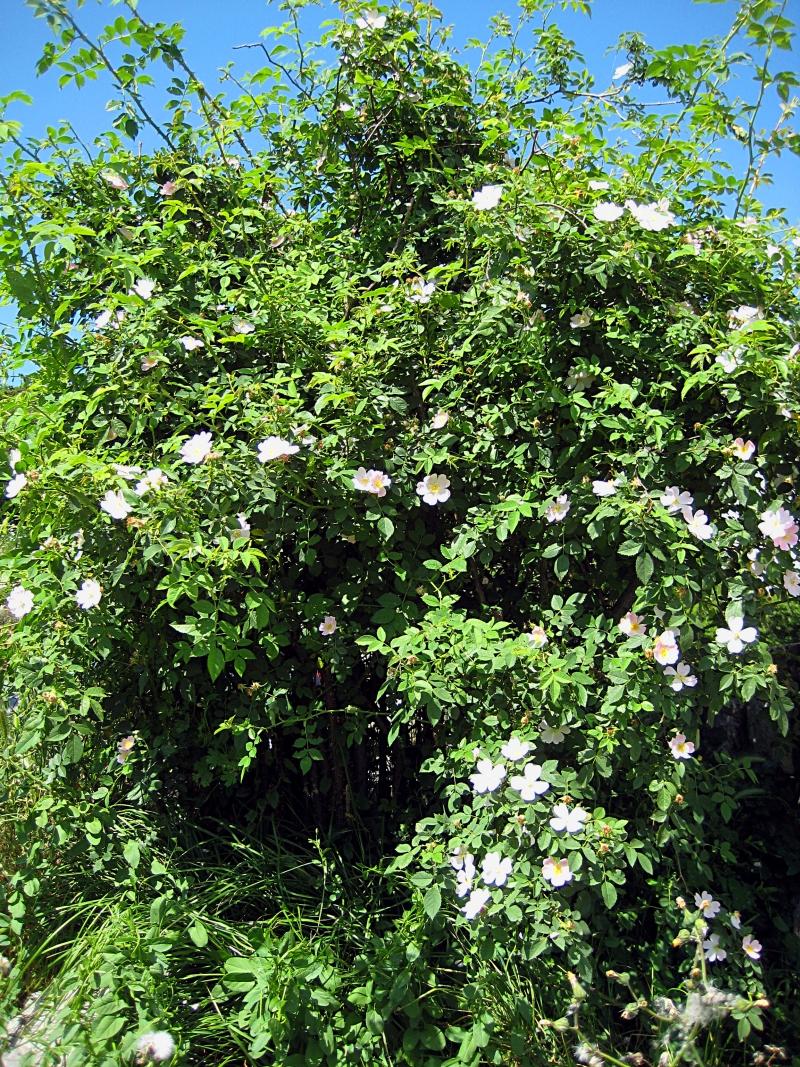
Photo: Roberta F., CC BY-SA 3.0 · source

Pruning guide · Shrub
Dog rose: when and how to prune
Rosa canina
Prune a dog rose at the end of winter, in February–March, and only lightly: thin out a few of the oldest, grey branches at the base, and don’t shorten every branch, or there will be no hips.
The dog rose is the most widespread wild rose in Belgium and the Netherlands: a shrub of 2–4 m with long, arching branches full of hooked prickles. It flowers in June on side shoots from last year’s wood, with simple pink to white flowers, followed by red hips in autumn. So you prune a wild rose very differently from a garden rose: no hard cutting back, but replacing some old wood now and then and letting the shrub keep its loose shape.
| Pruning months | February–March |
|---|---|
| Nesting season (15 March–15 August) | Take care in March |
| Flowering | June |
| Good for bees, butterflies and birds | Yes, for bees, butterflies and birds |
| Native to Belgium | Yes |
Dog rose: when to prune it?
Prune at the end of winter, in February–March, while the shrub is still bare and you can see the branches clearly. By then the birds have usually eaten the hips.
Ideally finish before mid-March, when the nesting season begins. Whitethroats and lesser whitethroats like to nest in a dense rose bush.
Don’t prune in autumn: you would cut off the hips, food for birds well into winter.
Dog rose: how to prune it?
- Wear sturdy gloves and use long-handled secateurs or loppers, so you don’t have to reach in between the prickles.
- Every few years, saw or cut one or two of the oldest, greyed branches off at the base. They hardly flower any more; young branches from the base take their place.
- Cut branches that hang over a path or the lawn back to a side branch growing in the right direction. Don’t cut them all to the same length, or you lose the natural shape.
- Remove dead branches, and branches that cross and rub against each other.
- An old, overgrown shrub can be cut right back to 30–50 cm above the ground in February. It regrows, but flowers little the following year: better spread it over two winters, half the branches each time.
- If the dog rose is part of a mixed hedge that you trim, cut it as little as possible along with it: every twig you cut off is one flower and one hip fewer.
How much to cut, and how often?
- Little: one or two old branches every few years, and each year only what is in the way.
- A dog rose that can grow freely flowers and fruits the most. Rather give it a spacious spot than shorten it every year.
What does it mean for wildlife?
- Prune in February and early March, before the nesting season (15 March–15 August). If you are working later, check first that there is no nest between the prickles: disturbing an active nest is against the law.
- The June flowers offer plenty of pollen for bees, bumblebees, hoverflies and beetles. Simply leave the faded flowers: that is how you get hips.
- Blackbirds, thrushes, fieldfares and finches eat the hips in autumn and winter. Red, hairy balls on the stems are robin’s pincushion galls, made by a tiny gall wasp: harmless, so leave them.
- Stack the prunings in a dead hedge or between other shrubs: the prickly stems make a safe shelter for small birds and hedgehogs.
Common mistakes
- Cutting a dog rose hard back like a garden rose, so there are no flowers and no hips.
- Pruning in autumn and taking away the hips meant for the birds.
- Never removing old wood, so the shrub becomes a grey, bare tangle that hardly flowers.
- Working among the prickles without gloves or with secateurs that are too short.
Caution: Don’t prune during the nesting season, and leave the hips for the birds in autumn.
Nearby: related pruning guides
Similar to: Difference from sweet-briar · Difference from Japanese rose · Difference from field-rose · Difference from bramble · Difference from burnet rose · Difference from raspberry