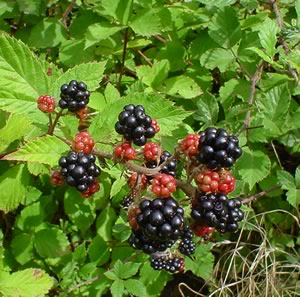
Photo: Wikimedia Commons, Public domain · source

Shrub · Rose family (Rosaceae)
Bramble
Rubus · also: Blackberry
Bramble is a native, prickly shrub of 1–3 m with long, arching stems that take root wherever their tips touch the ground. In summer it flowers white or pink, and in August–September the blackberries ripen. Wild brambles are worth their weight in gold for insects and birds, but run rampant in an ordinary garden. There, plant a thornless variety trained along wires instead: it gives large, sweet blackberries without scratches. Each cane lives for two years: in the first it grows, in the second it fruits.
Caution: Wild brambles run rampant: their tips root everywhere. For the garden, choose a thornless variety, train it along wires and cut off the tips before they touch the ground.
Light
Sun to shade
not fussy
Moisture
Dry to wet
not fussy
Legal basis
Any garden soil
any pH
Hardiness
Throughout Belgium
no protection needed
Size
1–3 m
tall
Flowering
June–August
| Pruning months | February–March and September–October |
|---|---|
| Height | 1–3 m |
| Native to Belgium | Yes |
| Good for bees, butterflies and birds | Yes, for bees, butterflies and birds |
| Poisonous to people and pets | Not known to be poisonous |
| Flowering | June–August |
Identify
Bramble: how do you recognise it?
- Habit
- Shrub of 1–3 m with long, arching stems; the tips take root where they touch the ground.
- Leaf
- Alternate, palmately compound with 3–5 toothed leaflets; often semi-evergreen.
- Bark
- Angular stems with strong, hooked prickles.
- Flower
- White or pink flowers from June to August.
- Fruit
- Blackberries (August–September).
- Difference from raspberry
- Raspberry has straight canes, white-felted leaves and red fruit.
Flowering: June–August · Harvest and fruit: April–September · Pruning: February–March and September–October
Identify by feature: Black berries · Thorns or prickles
Looks like it, but isn’t
- Raspberry Rubus idaeus: straight canes, white-felted leaves and red fruits. Difference from raspberry
In your garden
Why grow it?
- Blackberries in August–September, fresh, in jam or in pies.
- One of the most important shrubs for insects and birds; the thicket provides shelter.
- Grows in sun and shade, in almost any soil.
- A thornless variety along a fence or wall gives lots of fruit on little ground.
Bramble: where does it grow best?
- Sun to shade; in the sun they bear the most and sweetest fruit.
- Almost any soil, dry or moist.
- A cultivated variety needs 2–4 m of fence, wall or wire, depending on its vigour.
- Wild brambles belong in a wild edge, hedgerow or corner of a large garden, where they can spread.
- Light
- Sun to shade
- Legal basis
- Any garden soil
- Moisture
- Dry to wet
- Size
- 3 m tall, 3 m wide
- Hardiness
- Throughout Belgium, no protection needed
Goes well with
- Raspberry: Together a soft-fruit row: raspberries in early summer, blackberries in late summer.
- Dog rose: In a wild edge: together a prickly thicket where birds nest safely.
- Blackthorn: Early blossom for bees and an impenetrable edge full of birds.
Good and bad companions
Goes well with
- Tolerates shade and suits planting under large trees such as: ginkgo, box elder, ash, honey locust, field maple, silver maple
Maintenance
Bramble: when and how to plant it?
- Plant from November to March; container plants can go in later, except during frost or drought.
- First stretch wires between posts or along a fence, every 40–50 cm up to about 1.8 m.
- Space the plants 2–4 m apart, depending on how vigorous the variety is.
- After planting, cut the stems back to 20–25 cm: strong new canes will then come from the base.
Care
- Watering
- In dry spells during the first year, and later in dry spells as the fruit swells.
- Mulching
- A layer of compost or leaves in spring keeps the soil moist.
- Training
- In summer, tie in the young canes regularly; train them to one side and the fruiting canes to the other.
- Harvest
- Pick when the blackberries are glossy black and come away easily; they don’t ripen after picking.
- Spreading
- Cut off the cane tips before they touch the ground and dig out rooted tips and seedlings straight away.
Tip: Train the young canes to one side and the fruiting canes to the other: after harvest you can see at once which ones to cut out.
Bramble: when to prune it?
Pruning months: February–March and September–October.
When: After harvest (September–October) or at the end of winter.
How:
- A cane fruits only once, in its second year: cut the fruited canes off at ground level.
- Tie 4–6 strong young canes to the wires; the rest can go.
- At the end of winter, cut off frozen or dead tips.
Caution: Don’t cut out the young canes: they carry next year’s crop. Wear sturdy gloves when dealing with wild brambles.
Propagation
- Tip layering
- In summer, push the tip of a young cane a few centimetres into the ground; by autumn it has roots and you can cut it free and replant it.
Bramble: how does it get through the winter?
Hardy throughout Belgium: no protection needed.
- Hardy; the leaves often partly stay on the plant.
- Cut off frozen or dead tips at the end of winter.
Diseases and pests
- Spreading: Wild brambles soon take over a whole corner of the garden. Dig out the rootstock and keep cutting new shoots until the plant is exhausted.
- Grey mould: Grey fluff on the fruit in wet weather. Keep the plant open and remove rotten fruit.
- Spotted wing drosophila: Soft fruit with tiny maggots in late summer. Pick often and thoroughly, and clear up rotten fruit.
- Partly red blackberries: Fruit with parts that stay red and hard: the work of a tiny mite. Cut out the fruited canes after harvest.
Through the year
- February: Pruning: remove dead tips, tie in canes.
- March: Last month for pruning and planting; add compost.
- June: Flowering begins; tie in young canes.
- July: Flowers for bees and butterflies; train the canes.
- August: Harvest begins.
- September: Main harvest; then cut out the fruited canes.
- October: Last pruning; cut free and replant tip layers.
- November: Planting.
Use
What can you use it for?
- Food and drink
- Blackberries, fresh, in jam or in pies.
- For wildlife
- One of the most important shrubs for insects and birds; the thicket provides shelter.
Caution: Wild brambles run rampant; for the garden, choose a thornless variety and train it along wires.
Edible and useful
- Leaves (April–June)
- In spring, wearing gloves, pick the young, pale green leaves at the shoot tips. Dried, or fermented first, they make a herbal tea that tastes surprisingly like black tea.
- Fruit (July–September)
- Blackberries are ripe when they are glossy black and come away easily; the large berries at the tip of each cluster ripen first. Fresh, in jam, jelly, pies, crumble, syrup or liqueur. After late September they often turn watery and mouldy.
- Storing
- Blackberries go mouldy quickly: wash them just before use and use them within a day or two. They freeze very well, spread out on a plate. Dry the leaves in the shade, or ferment them first (see recipe).
- Fermenting
- Blackberry leaves used to be bruised and fermented like real tea to make a dark ‘home-grown tea’. Blackberries also make a fruit wine.
Caution: Pick wild blackberries above knee height, away from busy roads, dog-walking spots and sprayed fields, and wash them before use (fox tapeworm). Throw away mouldy berries. Only use healthy leaves for tea; discard leaves that smell musty or go mouldy while fermenting.
Eating and using is at your own risk: see the terms of use.
Recipes
- Blackberry jelly (Jelly · ± 4 jars · 45 min + 3 hours draining)
- Fermented blackberry leaf tea (Fermentation · 1 jar (± 50 g dried) · 30 min + 2–3 days fermenting + drying)
- Blackberry and apple crumble (Dish · 4–6 servings · 25 min + 40 min baking)
- Blackberry liqueur (Liqueur · ± 600 ml · 20 min + 4–6 weeks steeping)
Good for wildlife
- Bees
- Nectar and pollen for honeybees and wild bees.
- Butterflies
- Nectar for butterflies.
- Birds
- Berries, seeds or insects as food, or a place to nest.
- Caterpillars
- Host plant: caterpillars of butterflies or moths eat the leaves.
- Hedgehogs
- Shelter and a layer of leaf litter full of insects.
You and this species
Did you know?
- Hundreds of hard-to-tell-apart bramble species occur in Belgium and the Netherlands.
- Unlike a raspberry, a blackberry comes away with its core: that is why it isn’t hollow.
- The leaves often stay green well into winter, when they feed roe deer.
- There are so many bramble species because of apomixis: many brambles form seed without fertilisation, so each small variant reproduces as a ‘species’ of its own.
- The study of brambles has its own name: batology, from the Greek batos, bramble.