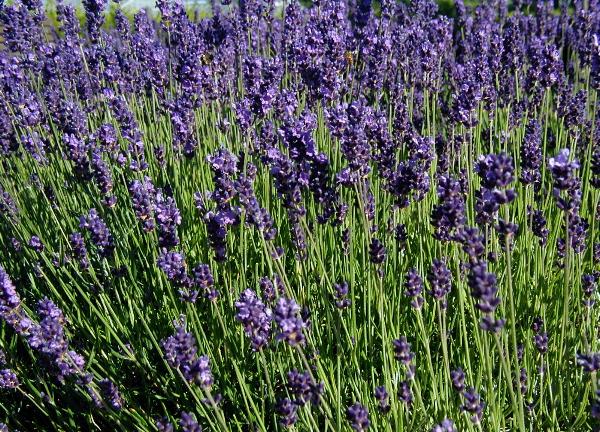
Photo: Sten Porse, CC BY-SA 3.0 · source

Pruning guide · Dwarf shrub
Lavender: when and how to prune
Lavandula angustifolia
Prune lavender after flowering, in August–September, and lightly again in April: always into the green leaves, never into the bare old wood.
Lavender won’t regrow from old, bare wood: a plant you prune every year stays full and compact, one you leave alone falls open and turns woody.
| Pruning months | April and August–September |
|---|---|
| Flowering | June–August |
| Good for bees, butterflies and birds | Yes, for bees and butterflies |
| Native to Belgium | No, planted |
Lavender: when to prune it?
The most important prune comes after flowering, from August to early September: the plant still has time to grow new leaves before winter.
In April, when new growth starts, lightly trim it into shape, only into the green leaves: that keeps it nicely rounded.
Don’t prune late in autumn or in winter: let the plant go into winter with its leaves. Lavender dies from wet roots more often than from frost.
What else to prune in those months? April · August · September
Lavender: how to prune it?
- After flowering, cut off the faded flower stalks and take a little of the foliage with them, leaving a compact mound.
- Always leave a few centimetres of green leaves above the woody part: that is where the new shoots break.
- Cut a single plant with secateurs and a row or low hedge with shears; keep a domed shape, so rain runs off quickly.
- Start young: lightly trim a plant in its very first year after planting, even if you lose a few flowers. A plant that is pruned every year stays full right to the base.
- If you want to dry the flowers, cut the stalks as soon as the first florets open: that is already part of the prune.
- You can’t rejuvenate an old, bare, woody plant by cutting it back hard: replace it with a young plant, perhaps grown from your own cuttings.
How much to cut, and how often?
- Twice a year: after flowering, the flower stalks and a little of the foliage; in April, just a few centimetres to trim it into shape.
- Never cut into the bare, old wood: lavender won’t regrow from it, and the plant can die.
- After 8–10 years a plant often turns woody and bare even with good pruning: replace it then.
What does it mean for wildlife?
- From June to August, English lavender is a top plant for honeybees, bumblebees and solitary bees, and butterflies such as whites and peacocks drink from it too.
- If some plants are still in full flower in August, wait with those until flowering is over, or prune in turns: that way bees and butterflies have something to eat right to the end.
- Birds seldom nest in lavender: it is too low and too open. The April and August prunes do fall in the nesting season (15 March–15 August), though, so watch out for a nest in a hedge or shrub right next to it.
- Lavender isn’t native, but it is one of the best nectar plants for a sunny, dry spot. The fragrant prunings can go on the compost heap.
Common mistakes
- Cutting into the bare wood, after which the plant doesn’t regrow.
- Never pruning, so the plant falls open and turns bare and woody at the base.
- Still pruning hard late in autumn, so the plant goes into the wet winter bare.
- Feeding or watering a lot: lavender then turns soft, smells less and falls open sooner.
Caution: Never cut back into bare, old wood: lavender won’t regrow from it.
Nearby: related pruning guides
Similar to: Difference from common sage · Difference from rosemary · Difference from lavender-cotton